


Key Highlights
- Equity futures showed minimal movement Friday morning as traders anticipated March consumer price index figures
- Nasdaq positioned for eighth consecutive session of advances, marking longest rally since summer 2024
- Middle East geopolitical concerns persist despite planned diplomatic discussions
- Crude oil markets advanced, with Brent futures approaching $97.81 per barrel on 2% gains
- Forecasts suggest March consumer prices jumped 0.9% from February levels
Wall Street futures displayed minimal volatility Friday morning as market participants adopted a wait-and-see approach before two critical catalysts: March’s inflation data release and scheduled diplomatic discussions concerning Iran-Israel tensions over the weekend.
Dow Jones Industrial Average futures remained unchanged. Futures tied to the S&P 500 advanced marginally by 0.1%. Nasdaq 100 contracts climbed 0.1%, positioning the technology-heavy benchmark for its eighth consecutive positive session — representing its most extended winning sequence since August of last year.
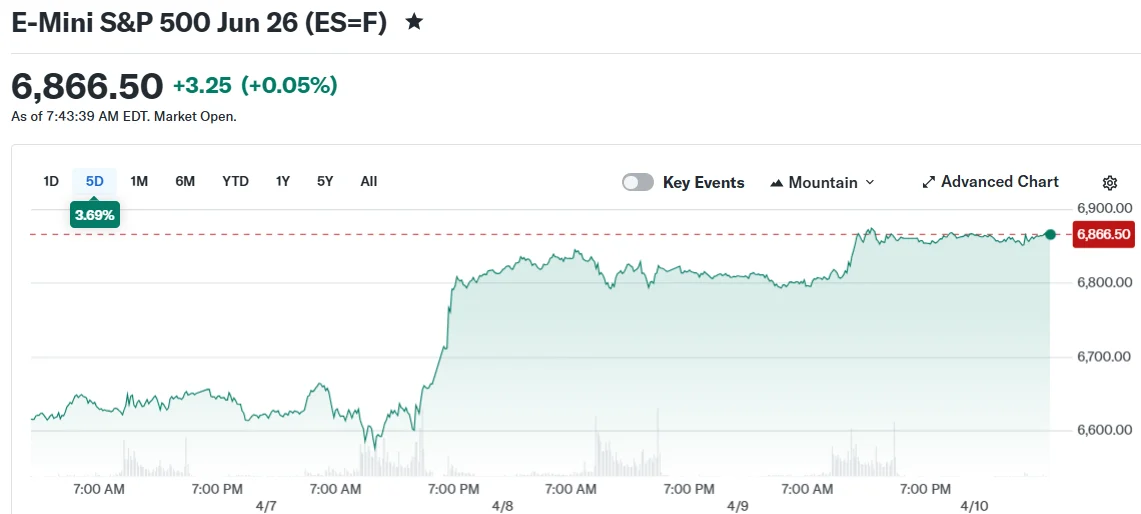
Thursday’s trading concluded with all three primary benchmarks posting gains, notably pushing the Dow into positive territory for the year 2026.
Market observers are focused on the upcoming consumer price index for March, representing the initial inflation snapshot encompassing the timeframe following the escalation of Iran-related hostilities. Economic analysts project the headline figure will demonstrate a 0.9% monthly acceleration, translating to a 3.3% annual increase.
Henry Allen, macro strategist at Deutsche Bank, emphasized the significance of this data release. “It’s the first to cover the period since the Iran war began,” he noted.
Middle East Developments Impact Market Psychology
Geopolitical uncertainties across the Middle East continue casting a shadow over investor sentiment. While Israeli Prime Minister Benjamin Netanyahu has consented to commence discussions with Lebanon, Israel’s formal stance clarified: “There is no ceasefire in Lebanon.”
Tehran authorities have alleged Israeli violations of the current ceasefire arrangement and subsequently restricted tanker passage through the Strait of Hormuz. President Donald Trump addressed the situation via Truth Social, criticizing Iran for “doing a very poor job” maintaining oil transit through the strategic waterway.

Top-level White House representatives contacted Netanyahu midweek, requesting Israel reduce military operations targeting Lebanon. Diplomatic negotiations are slated for the coming weekend.
Oil prices strengthened amid ongoing uncertainty. Brent crude contracts advanced 2% reaching $97.81 per barrel. West Texas Intermediate contracts gained 1.9% settling at $99.75 per barrel. Additionally, Saudi Arabia issued warnings that recent Iranian military actions have diminished its petroleum production capabilities.
Precious Metals, Fixed Income, and Currency Movements
Gold contracts declined 0.9% to $4,777 per ounce Friday morning, despite positioning for positive weekly performance.
The US dollar index strengthened 0.1% relative to a collection of major global currencies. Benchmark 10-year Treasury yields increased 2 basis points to 4.30%.
Goldman Sachs analysts highlighted that any potential supply normalization from Persian Gulf producers would require multiple weeks to materialize.
The March consumer price data represents traders’ initial comprehensive assessment of how petroleum market disruptions have influenced broader consumer pricing since the beginning of Iran-related military tensions.
Get 3 Free Stock Ebooks
Discover top-performing stocks in AI, Crypto, and Technology with expert analysis.
- Top 10 AI Stocks - Leading AI companies
- Top 10 Crypto Stocks - Blockchain leaders
- Top 10 Tech Stocks - Tech giants


