


TLDR
- Stock futures experienced significant declines Tuesday following coordinated US and Israeli military strikes on Iranian and Lebanese targets.
- The S&P 500 futures contract dropped 1.5%, while Dow futures declined 1.4% and Nasdaq 100 futures plunged nearly 2%.
- Crude oil prices jumped more than 6%, with Brent crude reaching $82.64 per barrel amid concerns over Strait of Hormuz shipping routes.
- Trump declined to exclude ground troop deployment, stating the conflict could persist “far longer” than the initially projected four-to-five-week timeframe.
- Bond yields climbed on oil-fueled inflation worries, while Bitcoin declined 2.2% and gold rebounded after an initial pullback.
American equity futures experienced substantial declines Tuesday morning following renewed military operations targeting Iran and Lebanon that unsettled investor sentiment and propelled energy prices higher.
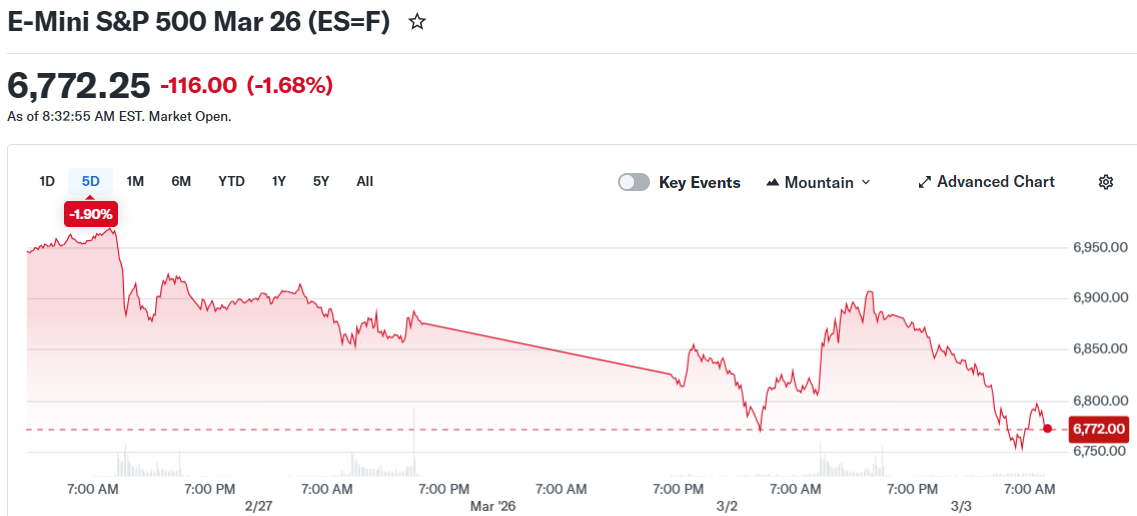
Dow Jones Industrial Average futures declined by 692 points, representing approximately 1.4%. The S&P 500 futures contract retreated 1.5%, while Nasdaq 100-linked contracts fell roughly 2%.
The market weakness followed overnight military operations conducted by Israeli and American aircraft against Iranian and Lebanese positions. Tehran retaliated with strikes targeting the American Embassy in Saudi Arabia and additional facilities throughout Gulf nations, with reports of attacks spanning at least nine countries.
The downturn marked a dramatic shift from Monday’s trading session. Equities had rebounded from significant intraday losses to finish predominantly higher, with the S&P 500 recording its most impressive intraday recovery since November.
Tuesday’s premarket weakness proved more widespread and persistent.

Oil Spikes as Strait of Hormuz Concerns Mount
Crude prices surged more than 6% as shipping vessels began circumventing the Strait of Hormuz, an essential chokepoint for worldwide petroleum distribution. Brent crude advanced to $82.64 per barrel, gaining 6.3%, while West Texas Intermediate increased 6.5% to $75.87.
The petroleum price surge intensified inflation anxieties and pushed Treasury yields upward. The benchmark 10-year yield advanced 5 basis points to 4.09%, following a 9-point increase in the previous session.
Gold futures gained 0.4% to $5,331 per ounce despite initial weakness, as market participants shifted toward safe-haven assets. The dollar strengthened 0.6% versus a basket of major currencies.
Bitcoin fell 2.2% to $67,616, mirroring the widespread risk-averse sentiment.
President Trump intensified market anxiety Monday evening with a Truth Social post declaring the US possessed “a virtually unlimited supply” of armaments. He declined to eliminate the possibility of ground force deployment, stating “whatever it takes,” while suggesting the military engagement might continue “far longer” than the original four-to-five-week projection.
Corporate Earnings Still in Focus
Despite geopolitical turbulence, quarterly reporting season proceeded. Target shares advanced in premarket trading after delivering holiday and annual revenue figures that aligned with analyst projections. Financial results from Ross Stores, AutoZone, and Best Buy were scheduled for Tuesday release.
Deutsche Bank analyst Jim Reid said the path for markets would hinge on where oil goes. “Any sustained spike would undoubtedly trigger a more meaningful risk-off move,” he said, “but without that, markets are likely to revert fairly quickly to focusing on macro data and AI-related themes.”
As of Tuesday morning, Dow futures were down 744 points at 48,201, S&P 500 futures sat at 6,780, and Nasdaq 100 futures were at 24,521.
Get 3 Free Stock Ebooks
Discover top-performing stocks in AI, Crypto, and Technology with expert analysis.
- Top 10 AI Stocks - Leading AI companies
- Top 10 Crypto Stocks - Blockchain leaders
- Top 10 Tech Stocks - Tech giants


