



Key Takeaways
- Major US indexes declined on Friday, with the Nasdaq falling 1% and extending its correction
- Crude oil prices jumped more than 2%, pushing Brent crude beyond $103 per barrel amid ongoing Middle East tensions
- President Trump postponed his Iran strike deadline by 10 days to April 6, failing to boost market sentiment
- The S&P 500 headed toward its fifth consecutive weekly loss, marking the longest slide since spring 2022
- The VIX volatility index climbed to approximately 30, indicating expectations of continued market turbulence
Wall Street experienced another rough session on Friday as crude oil prices rallied and market participants remained skeptical about a quick resolution to escalating Iran tensions.
The Nasdaq Composite declined 1%, deepening its correction territory position. The Dow Jones Industrial Average shed roughly 500 points, representing a 1.1% loss. The S&P 500 decreased nearly 1%.
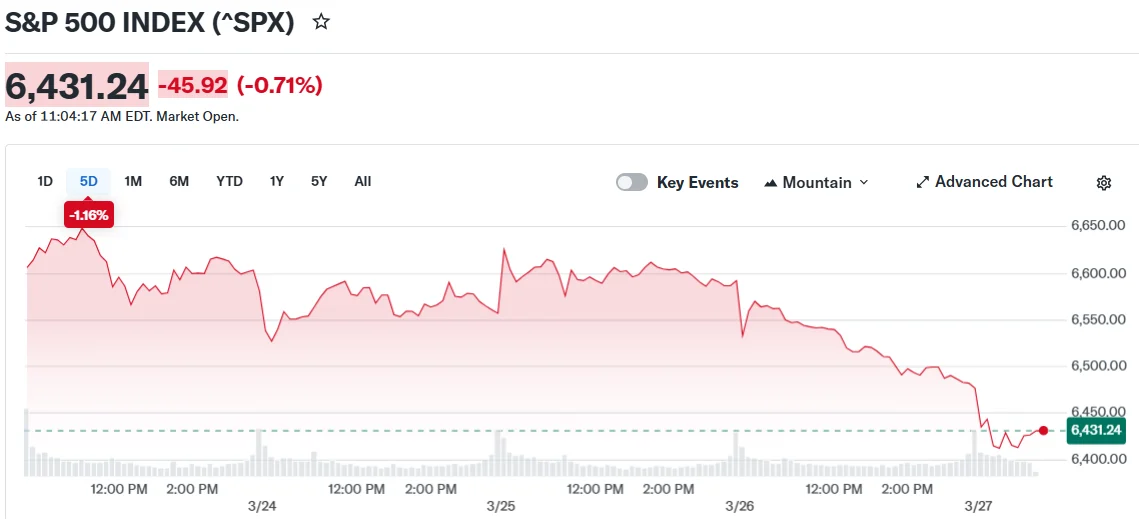
The S&P 500 was tracking toward its fifth consecutive weekly decline. This would mark the index’s most prolonged losing period since the spring of 2022.
Energy markets played a central role in Friday’s selloff. Oil prices surged, with Brent crude pushing above the $103 per barrel threshold. West Texas Intermediate rose above $97. Both oil benchmarks posted gains exceeding 2% during the session.
The energy price spike occurred even as President Trump announced an extension to his Iran ultimatum. Trump had initially stated the United States would target Iran’s energy facilities if negotiations failed by Friday. Late Thursday evening, he moved that deadline to April 6 following a request from Iranian officials.

Investors interpreted the deadline extension negatively. Concerns persisted that the temporary reprieve would merely allow elevated oil prices additional time to damage global economic growth.
“It’s another one of those days where futures drift lower throughout the morning as traders follow the new daily routine of getting up, brushing their teeth, and clicking ‘Sell,'” said Paul Hickey, co-founder of Bespoke Investment Group.
Shipping through the Strait of Hormuz has been disrupted by the ongoing conflict, intensifying pressure on energy supplies. Iranian officials have thus far rebuffed American diplomatic overtures.
Volatility Index Climbs
The CBOE Volatility Index increased 2.6 points to reach approximately 30, a threshold indicating market participants anticipate challenging conditions ahead.
Hickey observed that the Nasdaq is approaching its 10th weekly decline in the past 11 weeks. He emphasized that such persistent downward momentum has only occurred during a handful of periods throughout the index’s entire existence.
Consumer sentiment figures published Friday also revealed increasing pessimism among American consumers.
Treasury yields showed mixed movement during the session. Ten-year yields reached an eight-month peak earlier in the week, with certain analysts suggesting bond market stress might encourage Trump to seek a faster conflict resolution.
Senate Approves Shutdown Legislation
The Senate approved legislation in the early Friday hours to finance the TSA and additional Department of Homeland Security functions, although ICE funding was omitted. The approval brings closer to resolution a partial government shutdown that has caused airport disruptions and sparked economic concerns.
Gold encountered additional downward pressure from central bank reserve liquidation, based on Friday morning market intelligence.
As of Friday midday, the Dow had declined more than 500 points, the S&P 500 was lower by approximately 1%, and the Nasdaq had dropped 1.3%.
Get 3 Free Stock Ebooks
Discover top-performing stocks in AI, Crypto, and Technology with expert analysis.
- Top 10 AI Stocks - Leading AI companies
- Top 10 Crypto Stocks - Blockchain leaders
- Top 10 Tech Stocks - Tech giants


