


Key Takeaways
- Wedbush’s Daniel Ives maintained his Buy rating with a $600 price objective on Tesla, suggesting approximately 57% potential upside
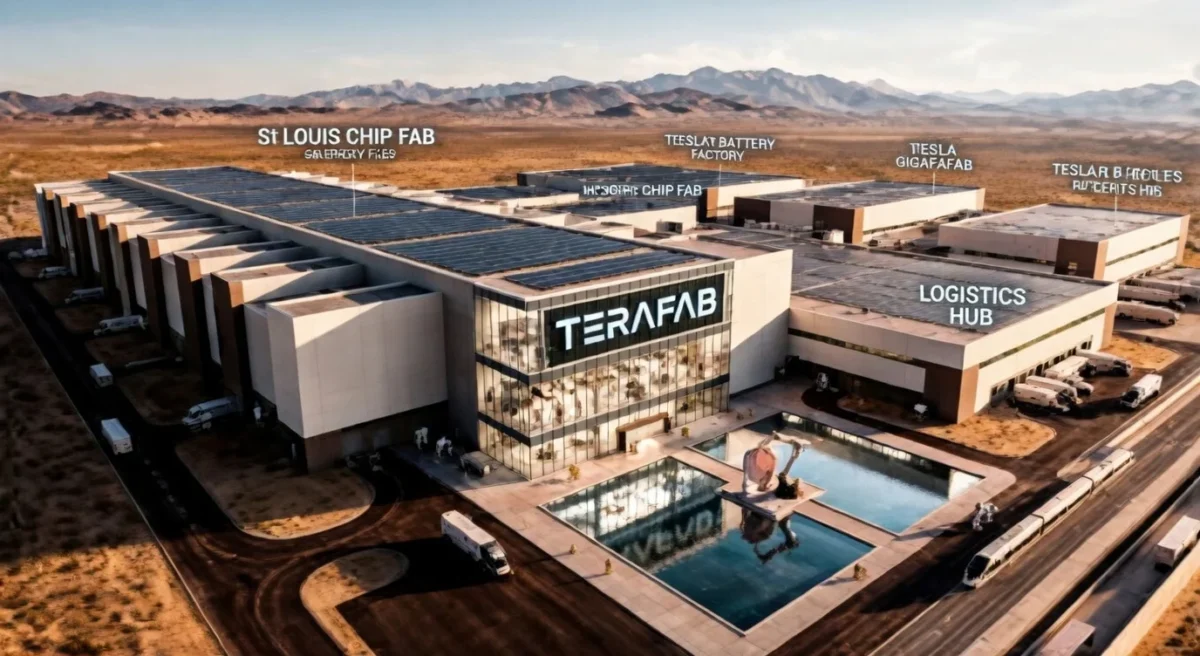
- Elon Musk revealed Terafab: dual chip manufacturing facilities in Austin, Texas, developed through collaboration between Tesla, SpaceX, and xAI
- The first facility will supply chips for Tesla’s electric vehicles and Optimus humanoid robots; the second will focus on AI data centers for space applications
- Ives characterizes Terafab as the “opening move” in an anticipated Tesla-SpaceX combination he projects for “likely 2027”
- Barclays’ Dan Levy maintained a more reserved stance, preserving an Equalweight rating with a $360 price objective
Wedbush analyst Daniel Ives has reaffirmed his optimistic stance on Tesla, maintaining a Buy rating alongside his Wall Street-leading $600 price target after CEO Elon Musk revealed plans for an ambitious chip manufacturing initiative dubbed Terafab.
Musk presented the Terafab vision Saturday evening at Austin’s historic Seaholm Power Plant, with Texas Governor Greg Abbott present for the announcement. The initiative represents a collaborative effort among Tesla, SpaceX, and xAI — which SpaceX acquired through an all-stock transaction this past February.
The blueprint outlines two separate chip production facilities in Austin. The first will manufacture semiconductors for Tesla’s electric vehicle lineup and its Optimus humanoid robot platform. The second is engineered specifically for AI data center operations, including space-based infrastructure.
Operating at maximum capacity, Tesla projects the complex could achieve output equivalent to roughly 70% of TSMC’s current worldwide production volume. Musk has set an ambitious goal of reaching 1 terawatt of annual manufacturing capacity — approximately twice the current United States production output.

Development focuses on two distinct chip architectures. The AI5 represents a ground-based inference processor designed for Tesla’s Full Self-Driving technology, the Cybercab robotaxi platform, and Optimus robots. Tesla asserts it provides a 50-fold performance enhancement compared to the existing AI4 chip. The D3 is a radiation-resistant processor engineered for SpaceX’s orbital satellite network.
Musk indicated that 80% of Terafab’s production would support space-oriented applications, with the remaining 20% allocated to ground-based uses.
Preliminary objectives establish 100,000 wafer starts monthly, eventually expanding to one million at peak capacity. The operation would manufacture between 100 and 200 billion specialized AI and memory chips annually using 2-nanometer process technology.
Tesla’s Rationale for Vertical Integration in Chip Production
Musk explained that existing suppliers — Samsung, TSMC, and Micron — cannot scale production rapidly enough. “There’s a maximum rate at which they’re comfortable expanding. That rate is much less than we’d like,” he stated.
Ives reinforced this perspective, noting these suppliers “are unable to meet future demand.” He positioned Terafab as a vertical integration strategy that unifies chip design, manufacturing, memory production, and packaging within a single operation — an unprecedented achievement at this magnitude in the semiconductor industry.
Tesla’s CFO acknowledged the projected $20–25 billion investment has not been incorporated into the company’s 2026 capital expenditure forecast, which already surpasses $20 billion. Construction timelines remain unspecified.
Limited production runs of the AI5 chip are anticipated in late 2026, with high-volume manufacturing scheduled for 2027 — though Tesla had previously pushed the AI5 timeline to mid-2027 prior to the Terafab disclosure.
Skepticism Remains Among Some Analysts
Barclays analyst Dan Levy retained his Equalweight rating and $360 price target, cautioning the project may demand spending “many multiples” beyond even his $50 billion optimistic scenario.
Levy highlighted that Barclays projects Tesla’s 2026 free cash flow at negative $3 billion excluding any Terafab expenditures.
Ives also positions Terafab as the initial step toward a Tesla-SpaceX combination “likely in 2027.” He originally introduced this concept in February, forecasting it could materialize “over the next 12 to 18 months.”
Wall Street’s collective perspective on Tesla remains divided. The stock carries a Hold consensus rating on TipRanks, derived from 13 Buy recommendations, 11 Hold ratings, and 7 Sell ratings. The average analyst price target stands at $399.25 — representing merely 4.2% potential appreciation from present levels. TSLA has declined 14.8% year-to-date.
Separately, SpaceX is reportedly preparing to submit its IPO prospectus as soon as this week, aiming for a public market debut as early as June with a $1.25 trillion valuation target.
Get 3 Free Stock Ebooks
Discover top-performing stocks in AI, Crypto, and Technology with expert analysis.
- Top 10 AI Stocks - Leading AI companies
- Top 10 Crypto Stocks - Blockchain leaders
- Top 10 Tech Stocks - Tech giants


