



TLDR
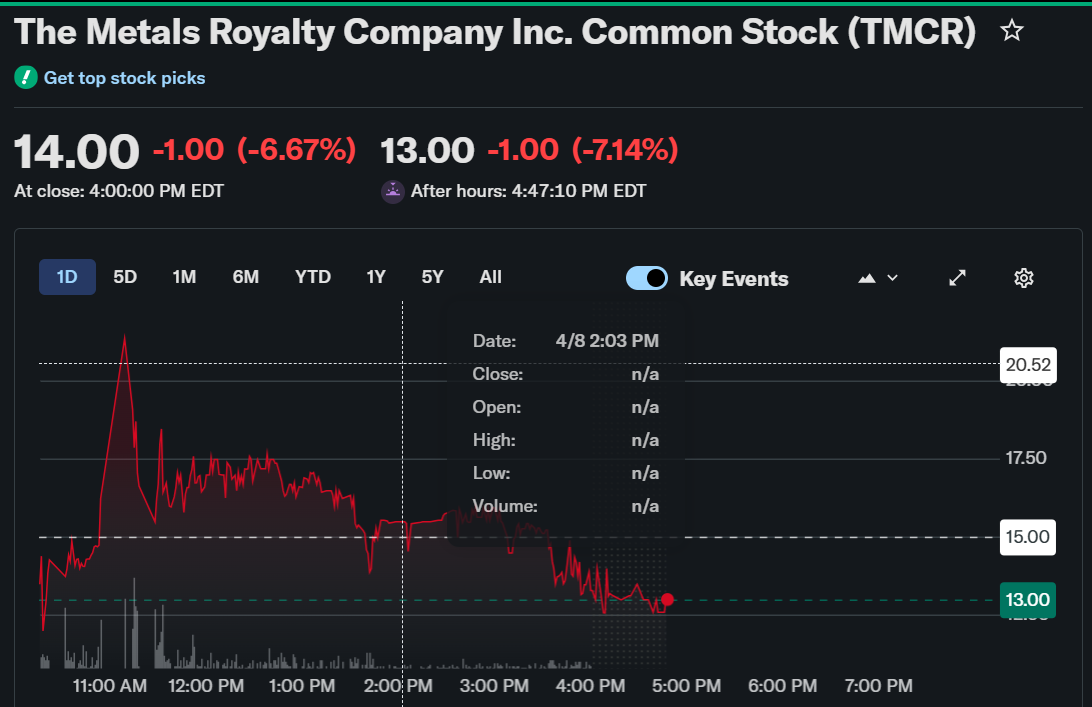
- TMCR falls 6.67% to $14.00, drops further to $13.00 after hours
- Direct listing sees weak demand as selling pressure dominates debut
- Royalty model targets long-term gains in critical minerals sector
- NORI project anchors portfolio with key battery metal exposure
- Bearish momentum builds despite strong policy support outlook
The Metals Royalty Company Inc. (TMCR) recorded a weak Nasdaq debut as shares declined sharply on the first trading day. The stock closed at $14.00, down 6.67%, and extended losses after hours to $13.00, falling another 7.14%. The early decline reflected bearish sentiment despite the company’s strategic focus on critical minerals.
Nasdaq Debut Marks Soft Entry Into Public Markets
TMCR began trading on the Nasdaq on April 8, 2026, following regulatory approval of its registration statement. The company entered the market through a direct listing structure without issuing new shares. This approach allowed existing shareholders to provide liquidity without raising additional capital.
The stock faced immediate selling pressure during its first session on the exchange. The price moved lower throughout the day and failed to recover into the close. After-hours activity extended the decline, signaling continued weakness in early sentiment.
The listing introduced TMCR to U.S. markets as a focused royalty company in the critical minerals sector. The company aims to position itself within a growing demand cycle tied to energy transition and industrial supply chains. Yet, the initial performance showed hesitation toward the new listing.
Royalty Model Targets Critical Minerals Value Chain
TMCR operates a royalty-based model designed to capture long-term cash flows from mineral production assets. The structure reduces direct exposure to operational and environmental risks tied to mining activities. Instead, the company focuses on financing and acquiring royalty interests across development stages.

The strategy centers on critical minerals such as nickel, copper, cobalt, and manganese. These materials support energy systems, electrification, and defense-related infrastructure. TMCR plans to allocate capital across exploration, production, and expansion projects within the United States.
The company aligns its strategy with policy support for domestic mineral supply chains. Government initiatives continue to promote local extraction and processing capabilities. TMCR aims to benefit from this shift while maintaining a capital-efficient model.
NORI Royalty Anchors Portfolio Strategy
TMCR’s current portfolio relies on a single royalty tied to the NORI polymetallic nodule project. The company holds a 2.0% gross overriding royalty on the deposit located in the Clarion-Clipperton Zone. This asset represents a significant undeveloped source of key industrial metals.
The NORI project contains large estimated resources of nickel, copper, cobalt, and manganese. These metals remain essential for batteries, infrastructure, and advanced manufacturing systems. TMCR expects the royalty to provide long-term exposure to commodity price movements.
The company views recent U.S. policy developments as supportive of its broader strategy. Efforts to strengthen domestic mineral security may increase the value of related assets. TMCR plans to expand its portfolio beyond the NORI royalty over time.
Get 3 Free Stock Ebooks
Discover top-performing stocks in AI, Crypto, and Technology with expert analysis.
- Top 10 AI Stocks - Leading AI companies
- Top 10 Crypto Stocks - Blockchain leaders
- Top 10 Tech Stocks - Tech giants


