


Key Highlights
- Tokenized assets on the XRP Ledger have surged from below $80 million to $453 million over approximately 12 months
- As of early March 2026, XRP exchange-traded funds have accumulated more than $1.1 billion in investor capital
- Cardano’s DeFi ecosystem holds just $138 million in total value locked, significantly trailing its $3 billion goal for 2030
- XRP is currently valued at approximately $1.42 with an $87 billion market capitalization; Cardano sits at $0.27 with a $10 billion valuation
- Price projections suggest XRP could climb to $3–$8 before year-end; Cardano estimates remain conservative at $0.30–$1
In 2026, XRP and Cardano stand among the most widely discussed digital assets in the cryptocurrency market. While both projects maintain dedicated supporter bases, their actual market performance and adoption metrics reveal distinctly different trajectories.
XRP was built specifically for institutional finance. Its primary audience includes banking institutions, foreign exchange platforms, and investment firms. The underlying XRP Ledger enables tokenization of traditional assets, allowing financial instruments such as corporate bonds to be represented and tracked on blockchain infrastructure.
Twelve months ago, tokenized asset value on the XRP Ledger measured less than $80 million. That figure now stands at $453 million—a dramatic expansion occurring primarily throughout the latter half of 2025 and the opening months of 2026.
XRP investment products have pulled in over $1.1 billion in total capital according to data from March 6, 2026. These exchange-traded fund vehicles enable mainstream investors to access XRP exposure through traditional brokerage accounts without managing cryptocurrency wallets.
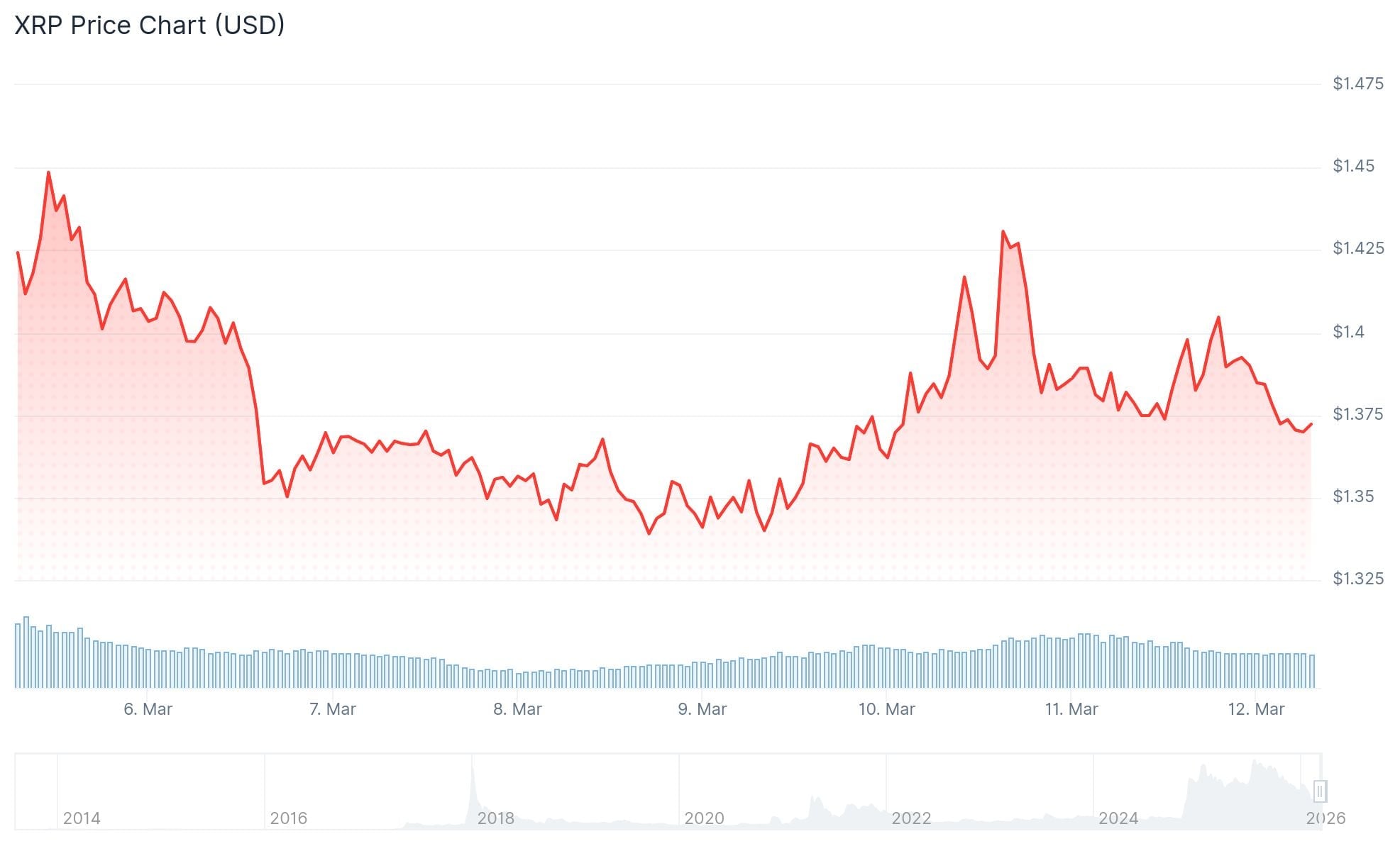
Current market pricing places XRP at roughly $1.42 per token, representing an $87 billion aggregate market value. Over the past year, the token has fluctuated between $1.14 and $3.65.

Cardano operates under a fundamentally different philosophy. The platform emphasizes academically rigorous development and code that undergoes scholarly peer review. Its ambition centers on creating a versatile blockchain infrastructure supporting smart contract execution and decentralized application deployment.
The project’s strategic roadmap through 2030 envisions $3 billion in decentralized finance assets, one million wallet addresses active monthly, and 324 million transactions processed annually. Current metrics suggest these milestones remain far from realization.
Cardano’s Present Reality
Cardano presently manages $138 million in total DeFi value. Network transaction fees generate approximately $1,900 daily. Active wallet addresses number fewer than 17,000 on a typical day.
These measurements indicate relatively limited network utilization despite years of ongoing feature development. A late-2025 initiative designed to boost stablecoin liquidity on the platform failed to generate meaningful increases in either user adoption or capital deployment.
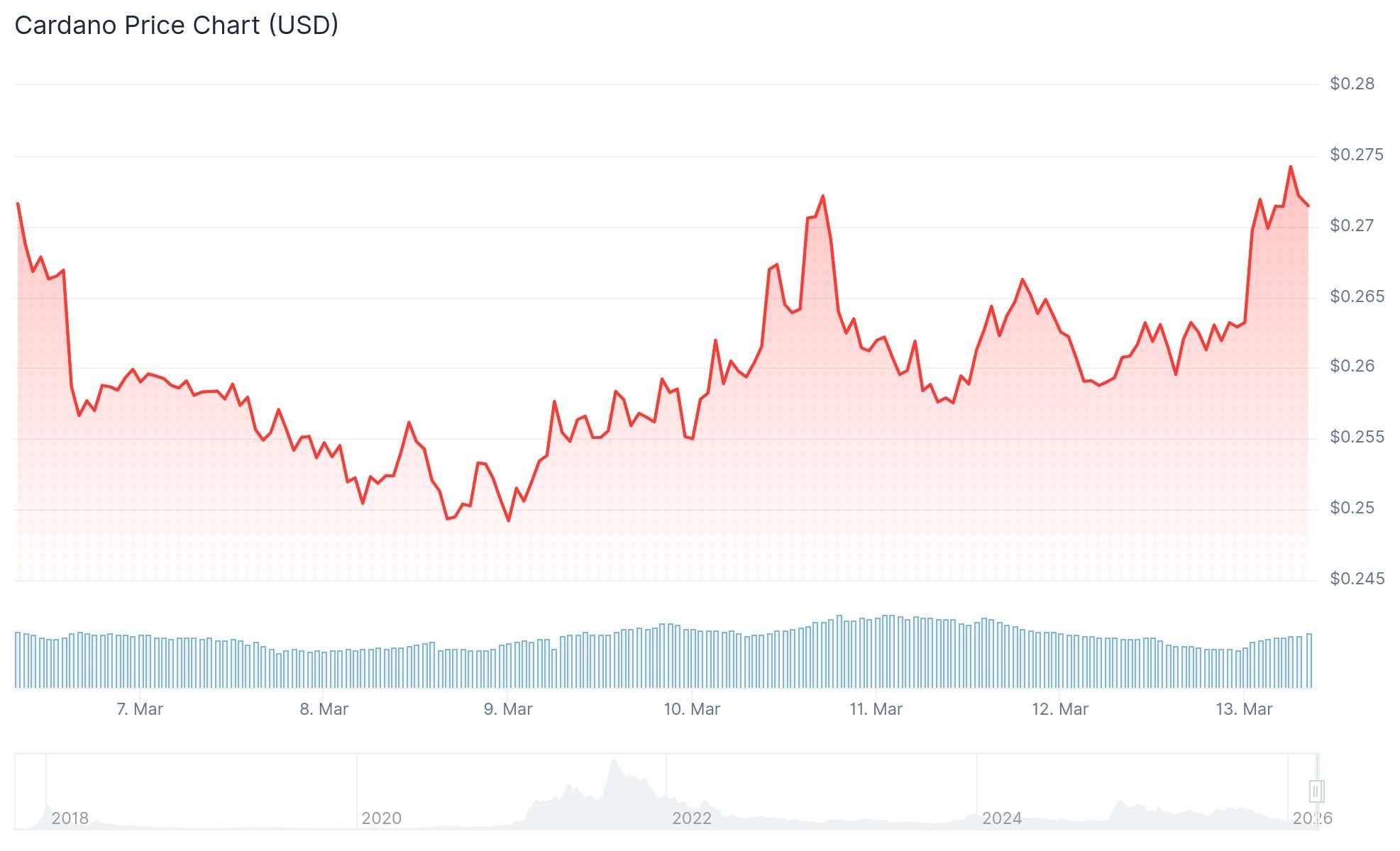
Cardano currently trades at $0.27 per token with a $10 billion market capitalization. Its annual trading range spans from $0.23 to $1.01.
Expert Price Forecasts
For XRP, professional analysts project end-of-2026 prices ranging from $3 to $8. Standard Chartered has issued a public $8 forecast contingent on sustained ETF demand. Certain social media commentators suggest substantially higher targets, though these represent outlier opinions.
Cardano predictions demonstrate greater restraint. Most professional estimates cluster between $0.30 and $1. Select analysts acknowledge potential for $2–$4 appreciation if planned network upgrades succeed as intended, while others warn of downside scenarios should critical support thresholds fail.
Near-term catalysts for XRP include prospective additional ETF product launches and expanded deployment of Ripple’s RLUSD stablecoin throughout Japan via collaboration with SBI Holdings.
Cardano’s upcoming drivers encompass the Midnight Network mainnet activation, which emphasizes privacy-enhancing capabilities, and possible approval of spot ADA ETF products from Grayscale.
As March 2026 progresses, XRP demonstrates substantially stronger institutional integration and blockchain activity metrics relative to Cardano.
Investment Considerations
Both XRP and Cardano represent high-risk speculative digital assets, and historical performance provides no assurance of future outcomes. XRP currently exhibits superior real-world implementation, heightened institutional participation, and accelerated on-chain expansion. Cardano maintains an ambitious long-range strategic framework, but present-day metrics have yet to validate that roadmap. Anyone considering a $1,500 allocation to either cryptocurrency must comprehend the inherent volatility and conduct thorough independent analysis before committing capital.
Get 3 Free Stock Ebooks
Discover top-performing stocks in AI, Crypto, and Technology with expert analysis.
- Top 10 AI Stocks - Leading AI companies
- Top 10 Crypto Stocks - Blockchain leaders
- Top 10 Tech Stocks - Tech giants


