


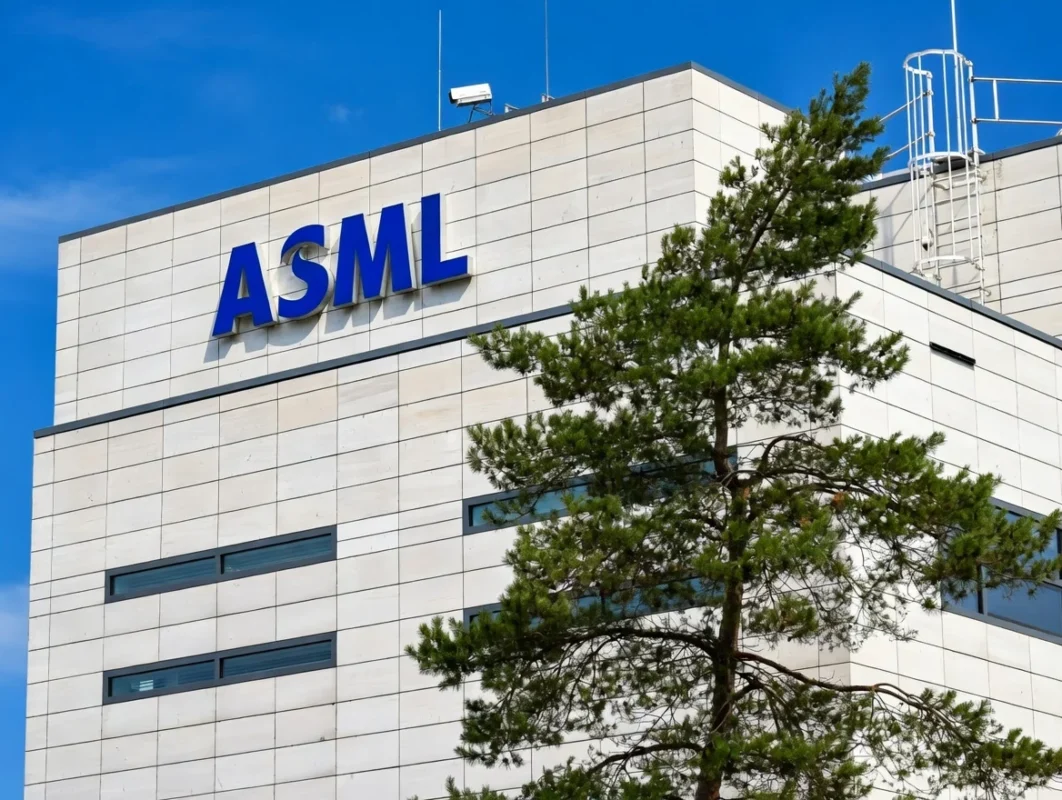
Key Highlights
- ASML delivered Q1 2026 revenue of €8.8B with 53% gross profit margins and €2.8B in net earnings
- Annual revenue forecast upgraded to €36B–€40B range, suggesting approximately 16% growth versus prior year
- Leadership commits to avoiding supply constraints through strategic capacity expansion
- Chinese market represents roughly 20% of projected revenues; potential export rule changes remain unclear
- Company boosts dividend by 17% and launches €12B stock repurchase initiative spanning 2026–2028
ASML delivered an exceptional opening quarter for 2026, surpassing Wall Street projections and elevating its annual targets driven by explosive artificial intelligence semiconductor demand. The Netherlands-based lithography equipment powerhouse generated €8.8 billion in revenue, achieved 53% gross profitability, and secured €2.8 billion in net earnings — translating to a 31.8% bottom-line margin.
Management elevated its annual sales projection to a corridor between €36 billion and €40 billion, anticipating gross margins spanning 51% to 53%. The midpoint calculation indicates roughly 16% revenue expansion compared to the previous year.
Chief Executive Christophe Fouquet spoke candidly to shareholders at Wednesday’s annual gathering in Veldhoven. His message was unambiguous: ASML refuses to recreate the supply constraints that plagued the semiconductor sector earlier this decade.
“We will prevent that scenario through every means available,” Fouquet emphasized. He credited recent infrastructure and efficiency investments for enabling the organization to match accelerating customer requirements.
Fouquet identified delayed deliveries as the primary threat to ASML’s market dominance, potentially driving clients toward alternative suppliers. While acknowledging emerging players Substrate, xLight, and Lace, he clarified these remain “concepts rather than current competitors.”

Regarding market dynamics, memory chip producers informed ASML their 2026 capacity is completely allocated, with shortages anticipated to persist throughout 2027. Logic chipmakers continue expanding production capabilities across various technology nodes while accelerating 2nm manufacturing for artificial intelligence workloads.
Artificial Intelligence Build-Out Accelerates Equipment Bookings
ASML maintains essentially complete market control over extreme ultraviolet (EUV) lithography technology — specialized machinery essential for creating cutting-edge semiconductor circuits. Major clients include TSMC, Samsung, and Intel, who deploy these systems to fabricate processors for Nvidia, Broadcom, AMD, and Micron.
During Q1, ASML shipped only 2 High-NA EUV units, representing its most sophisticated platform. Annual projections call for manufacturing 60 Low-NA EUV systems, which currently generate the majority of revenues. EUV platforms contributed 46.6% of quarterly sales, with legacy non-EUV equipment at 23.9% and maintenance services comprising 28.4%.
The organization presented a technology development timeline extending through 2033, encompassing existing High-NA EUV platforms and next-generation machines under development. Service income from the installed equipment base alone exceeded research and development expenditures by more than double in the recent period.
Chinese Revenue Exposure and Regulatory Uncertainty
Chief Financial Officer Roger Dassen fielded inquiries regarding potential additional U.S. limitations on ASML’s Chinese business. China represents approximately 20% of anticipated 2026 revenues.
Dassen indicated the ultimate impact of proposed regulatory measures remains uncertain. He observed that capacity reductions in any geographic region don’t eliminate underlying demand — alternative producers would necessarily absorb displaced volume.
Regarding shareholder distributions, ASML unveiled a 17% dividend enhancement coupled with a fresh €12 billion stock repurchase authorization extending from 2026 through 2028. The company completed €1.1 billion in Q1 buybacks alone, supplementing €7.6 billion in share retirements executed between 2022 and 2025.
Trading near $1,410 per share at publication, the equity commands a forward price-to-earnings multiple of 39.3, exceeding its decade-long median of 36. ASML would require approximately 42% appreciation to reach the $2,000 per share threshold.
Get 3 Free Stock Ebooks
Discover top-performing stocks in AI, Crypto, and Technology with expert analysis.
- Top 10 AI Stocks - Leading AI companies
- Top 10 Crypto Stocks - Blockchain leaders
- Top 10 Tech Stocks - Tech giants


