


Key Takeaways
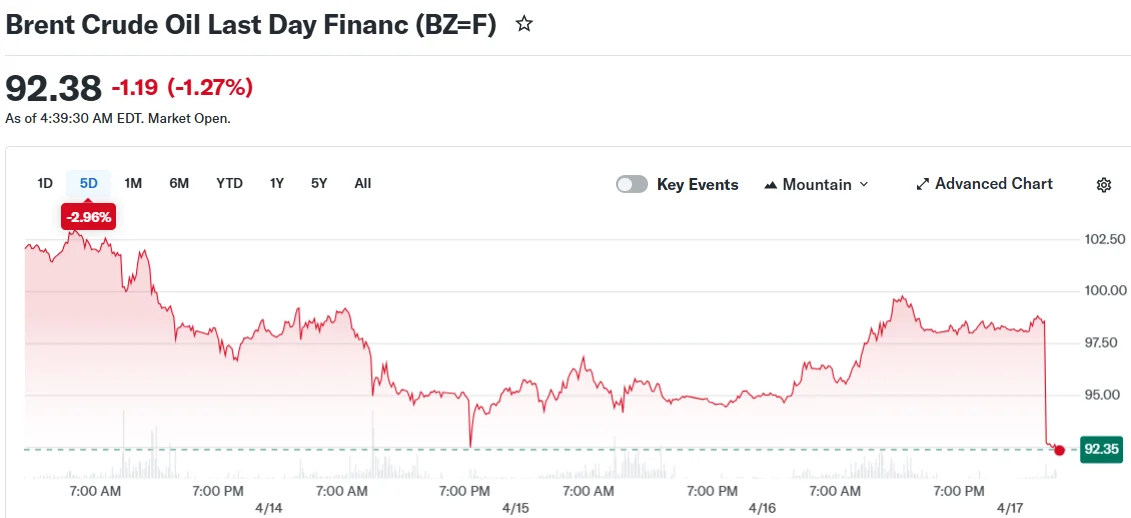
- Crude benchmarks declined more than 3% this week with Brent approaching $98 and WTI near $93
- President Trump revealed a 10-day Israel-Lebanon truce and stated Iran accepted critical negotiation points
- Tehran has not publicly verified any agreements, particularly regarding Strait of Hormuz access
- IEA projects oil and gas supply restoration may require as long as two years
- International Energy Agency and OPEC both project declining global crude demand ahead
Oil prices tumbled Friday as the White House sent diplomatic signals suggesting a potential resolution to the nearly 50-day US-Iran standoff.
Brent crude declined 1.1% to approximately $98.32 per barrel, while West Texas Intermediate retreated 1.3% to $89.95. Week-over-week, both benchmarks recorded losses exceeding 3%.
The standoff commenced in February following coordinated US and Israeli military operations against Iran. In response, Tehran effectively shut down most maritime traffic through the Strait of Hormuz, choking off approximately 20% of worldwide petroleum shipments. Washington subsequently imposed its own naval blockade in the region.
President Donald Trump adopted an upbeat stance Thursday, asserting that Iran had accepted conditions it previously rejected, notably the reopening of the Strait of Hormuz. Tehran has yet to publicly acknowledge these claims.
Trump simultaneously unveiled a 10-day cessation of hostilities between Israel and Lebanon. He extended invitations to Israeli Prime Minister Benjamin Netanyahu and Lebanese President Joseph Aoun for White House discussions.

Iran had previously identified Lebanese participation in any ceasefire as essential for expanding negotiations. The agreement remained intact through Friday morning.
“The prevailing narrative has shifted from escalation to stabilization,” explained Priyanka Sachdeva, senior market analyst at Phillip Nova. “Fear propelled the surge, diplomacy is fueling the pullback.”
Full Agreement May Require Half a Year
Several Gulf Arab and European officials suggested a comprehensive US-Iran settlement could require approximately six months. They encouraged both nations to prolong the existing ceasefire throughout that timeframe.
OCBC analysts observed that the US naval blockade reached its fourth day, maintaining Hormuz shipping at virtually stagnant levels. Petroleum transit through the waterway remains drastically below pre-conflict volumes.
Trump indicated he anticipated no need to prolong the ceasefire for reaching an agreement, forecasting a settlement “fairly soon.” He mentioned potentially visiting Pakistan, the host of initial negotiations, should an accord materialize.
Following weeks of extraordinary volatility, price fluctuations have moderated. Brent fluctuated within approximately $10 per barrel this week, contrasting sharply with a historic $38 swing recorded in mid-March.
Production Disruptions Face Lengthy Recovery Timeline
IEA Executive Director Fatih Birol cautioned that restoring a substantial portion of interrupted oil and gas output could extend up to two years. Any restoration would occur incrementally, he emphasized.
Both the IEA and OPEC highlighted diminishing global petroleum demand projections for upcoming months, contributing additional bearish pressure on valuations.
“Despite some encouraging geopolitical developments, they haven’t materialized into tangible improvements in supply flows,” observed Rebecca Babin, senior energy trader at CIBC Private Wealth Group.
Jurisdiction over the Strait of Hormuz remains disputed. Iran has indicated intentions to impose transit fees on vessels even following conflict resolution.
The existing US-Iran ceasefire is scheduled to conclude on April 21.
Get 3 Free Stock Ebooks
Discover top-performing stocks in AI, Crypto, and Technology with expert analysis.
- Top 10 AI Stocks - Leading AI companies
- Top 10 Crypto Stocks - Blockchain leaders
- Top 10 Tech Stocks - Tech giants


