


TLDR
- Tesla stock closed at $433.71 on October 27, down 3.4% in 24 hours
- Former Stellantis CEO Carl-Peter Forster warns Tesla may not survive the next decade
- Stock remains 11% below its 52-week high of $488 but up 100% from 2024 lows
- Trading volume has declined while prices climbed, signaling weakening buying conviction
- Tesla trades at a P/E ratio exceeding 260 times earnings, well above industry averages
Tesla stock (NASDAQ: TSLA) closed at $433.71 on October 27, marking a 3.4% decline in 24 hours. Former Stellantis CEO Carl-Peter Forster warned the electric vehicle maker may not survive the next decade. The stock remains 11% below its 52-week high of $488 but still trades over 100% above 2024 lows.
Technical Indicators Signal Potential Weakness
Tesla stock shows elevated momentum as the Relative Strength Index approaches overbought levels on daily charts. The company trades well above its 50-day and 200-day moving averages. However, technical analysts have identified concerning volume divergence during the recent price climb.
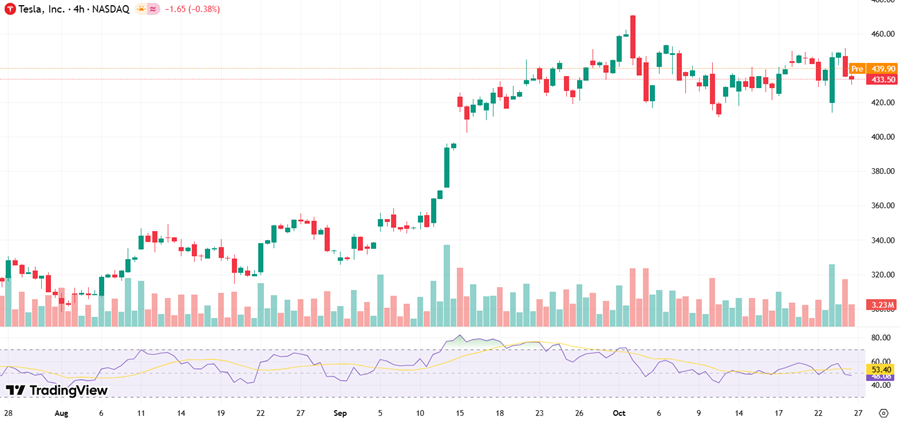
Trading volume has declined while Tesla stock prices moved higher over recent weeks. This pattern often indicates weakening buying conviction before a reversal or consolidation period. Key support levels exist between $400 and $420, which previously served as consolidation zones.
A breakdown below $400 would signal weakening technical structure for Tesla stock. Such a move could push prices toward the $360 to $380 range. Resistance remains firm at the $488 level reached in early October.
Short interest has increased modestly as more traders position for a correction. Tesla stock trades at a price-to-earnings ratio exceeding 260 times earnings. This valuation stands well above industry averages but reflects premiums placed on growth expectations.
Former Executive Casts Doubt on Long-Term Prospects
Carl-Peter Forster delivered critical remarks about Tesla’s competitive position in the evolving electric vehicle market. The former Stellantis executive believes increasing pressure from established automakers threatens the company’s advantage. Chinese manufacturers like BYD and legacy players ramping up production present growing challenges.

Recent earnings reports reveal pressure on both demand and profitability for Tesla stock investors. The company delivered approximately 497,000 vehicles in Q3 but saw revenue growth slow considerably. Tesla’s Q1 2025 earnings showed a 71% drop in earnings per share year-over-year.
Automotive revenue declined 20% compared to the previous year during the same period. Profit margins have narrowed substantially as the company faces pricing pressures. These financial results raise concerns about demand elasticity in competitive markets.
CEO Elon Musk continues focusing on speculative technologies including robotaxi fleets and full self-driving systems. These projects remain in early development stages and generate minimal revenue currently. Questions arise about whether attention shifts away from core automotive operations at critical times.
Musk defended his multi-billion-dollar compensation package by explaining it maintains voting control. He told investors the plan ensures he retains enough influence to guide strategic direction. The CEO emphasized the structure provides accountability while protecting long-term planning.
Tesla Stock Could Test $500 Range
Base-case projections suggest Tesla stock remains range-bound between $400 and $450 near term. This consolidation would allow investors to assess macroeconomic conditions and company challenges. Stability at current levels could support renewed upward momentum in 2026.
Bull-case scenarios require surprise upside in Q4 vehicle deliveries or autonomous driving breakthroughs. Meaningful expansion of full self-driving monetization could push Tesla stock toward $480 to $500. Energy storage and AI-driven mobility segments may provide additional growth catalysts.
Tesla stock currently trades more than double its 2024 lows despite recent declines. The company maintains strong positioning in several emerging technology sectors. However, tightening margins and slowing earnings growth challenge valuation sustainability at current multiples.
Get 3 Free Stock Ebooks
Discover top-performing stocks in AI, Crypto, and Technology with expert analysis.
- Top 10 AI Stocks - Leading AI companies
- Top 10 Crypto Stocks - Blockchain leaders
- Top 10 Tech Stocks - Tech giants


