


Key Highlights
- SoFi Bank now enables XRP deposits, allowing millions to store XRP with BTC, ETH, and SOL through a regulated banking platform
- The OCC-regulated platform offers 12 digital assets for deposit functionality and 27 for active trading
- XRP Ledger’s real-world asset tokenization has exploded 875%, approaching $2.5 billion in total value
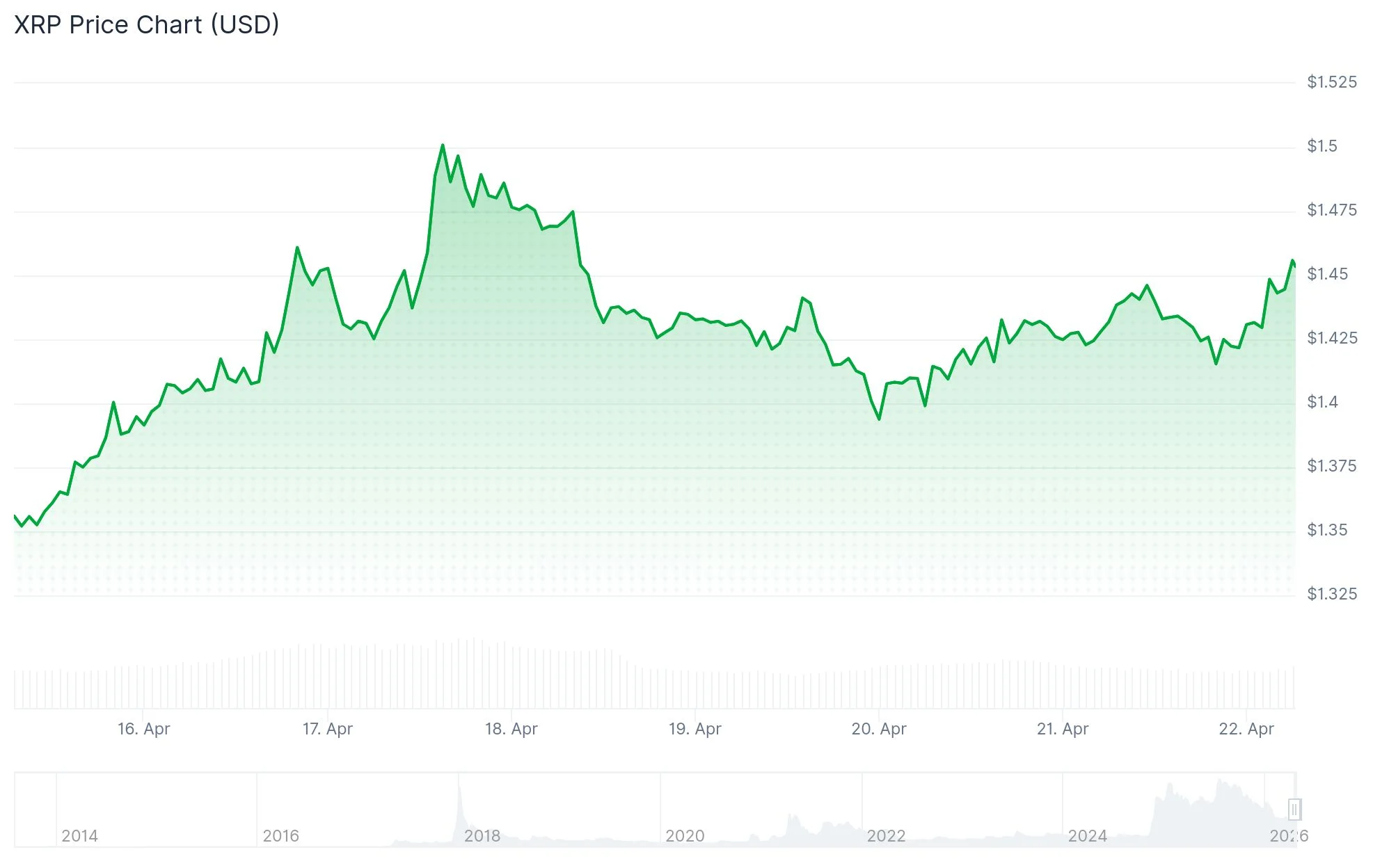
- XRP maintains consolidation above $1.40, facing resistance near $1.50–$1.55 with key support around $1.30–$1.35
- Institutional giants like BlackRock, Franklin Templeton, and Mastercard are exploring XRP Ledger opportunities
Ripple’s XRP is capturing meaningful traction from established financial institutions and traditional banking platforms, fueled by genuine utility expansion rather than pure market hype. The most recent breakthrough involves SoFi Technologies, a federally chartered banking institution operating under Office of the Comptroller of the Currency (OCC) oversight.
On April 21, SoFi revealed that XRP deposit capabilities are now active on its platform, joining Bitcoin, Ethereum, and Solana. Customers can execute trades involving XRP through the application, which currently accommodates 27 digital currencies for trading operations and 12 for direct deposit features.
This positions SoFi among a select group of nationally chartered American banks offering comprehensive XRP services—buying, selling, holding, and depositing—all integrated into a regulated application that users rely on for standard banking operations like bill payments and account management.
Ripple acknowledged the development on X, stating: “More access to XRP with SoFi means more people can participate, and that’s exactly how utility grows.”
SoFi’s cryptocurrency expansion has followed a measured timeline. The company introduced SoFi Crypto last November, enabling customers to execute Bitcoin, Ethereum, and Solana transactions from FDIC-protected accounts. By February, it achieved a milestone as the first nationally chartered U.S. banking institution to accommodate Solana deposits. The XRP integration represents a continuation of this methodical strategy.
Institutional Engagement and Real-World Use Cases Drive XRP Ledger Growth
Beyond SoFi’s integration, the XRP Ledger is experiencing accelerating institutional interest. During the Digital Assets Forum 2026, Odelia Torteman, a FinTech specialist with the World Bank, characterized the XRP Ledger as uniquely engineered for multi-asset, transparent transaction processing.

Real-world asset tokenization on the network has skyrocketed 875%, with aggregate tokenized value nearing the $2.5 billion threshold. Reports indicate that a prominent Japanese travel company is transitioning prepaid payment infrastructure onto the ledger, targeting a domestic market valued at ¥30 trillion.
Financial powerhouses including BlackRock, Franklin Templeton, and Mastercard have demonstrated interest in XRP Ledger capabilities. Ripple’s executive leadership has highlighted a $13 trillion payments opportunity accessible through its Treasury infrastructure.
XRP Price: Critical Support and Resistance Zones
XRP is currently holding consolidation territory above the $1.40 level, hovering near its 50-day exponential moving average, which has consistently capped upward momentum. Trading volume remains subdued, typically indicating that market participants await a definitive directional trigger.
Immediate support establishes at $1.35, with an additional foundation at $1.30. Overhead resistance concentrates around $1.50 and $1.55. A decisive breakout above the 100-day EMA positioned at $1.53 could pave the way toward 21Shares’ year-end forecast of $2.69.
Macro strategist Dr. Jim Willie has outlined a potential $3–$25 valuation corridor should financially distressed banks leverage XRP for settlement operations. Extended-horizon projections from certain market observers suggest $27 by 2030, contingent upon widespread banking sector integration.
As of April 21, XRP deposit functionality is operational on SoFi’s infrastructure, accessible to all 13.7 million account holders.
Get 3 Free Stock Ebooks
Discover top-performing stocks in AI, Crypto, and Technology with expert analysis.
- Top 10 AI Stocks - Leading AI companies
- Top 10 Crypto Stocks - Blockchain leaders
- Top 10 Tech Stocks - Tech giants


