



Key Takeaways
- On May 14, the U.S. Senate Banking Committee examines the CLARITY Act, legislation that would establish regulatory boundaries for digital assets
- Banks and crypto companies are battling over stablecoin reward provisions, creating a major point of contention in the proposed framework
- Bitcoin maintains support above the $80,000 level while encountering significant resistance between $81,000 and $83,000
- Bitcoin ETF inflows show signs of recovery but remain insufficient to offset substantial outflows recorded from late 2025 through early 2026
- Coinbase reported consecutive quarterly losses, with annual revenue declining from $2.03 billion to $1.43 billion
Cryptocurrency markets face a convergence of significant developments this week that could determine near-term direction. Regulatory proceedings, critical price thresholds, institutional investment trends, and major exchange performance are simultaneously commanding attention.
The U.S. Senate Banking Committee has scheduled a hearing for May 14 to examine the CLARITY Act. This legislative proposal seeks to establish definitive classifications for digital assets as either securities or commodities. The bill would also delineate distinct oversight responsibilities between the SEC and CFTC.
Among the bill’s most contentious provisions are rules governing stablecoin rewards. According to Reuters, the current language would permit rewards connected to transaction activity while prohibiting yields on static stablecoin balances. Cryptocurrency platforms are advocating for broader latitude to incentivize payment adoption. Traditional financial institutions prefer restrictions on any mechanism resembling interest-bearing deposits.
The implications extend throughout the ecosystem because stablecoins serve essential functions in trading platforms, payment systems, and decentralized finance protocols. Establishing regulatory clarity could reduce compliance uncertainty for product development. Conversely, restrictive regulations might compel exchanges and issuers to restructure user incentive programs.
Bitcoin Maintains $80,000 Support While Testing Upper Resistance
Bitcoin climbed past the $80,000 threshold last week, supported in part by strength in Asian equity markets. Market analysts suggest a more convincing technical structure would require breaking through the $81,000 to $83,000 resistance zone, Barron’s noted.

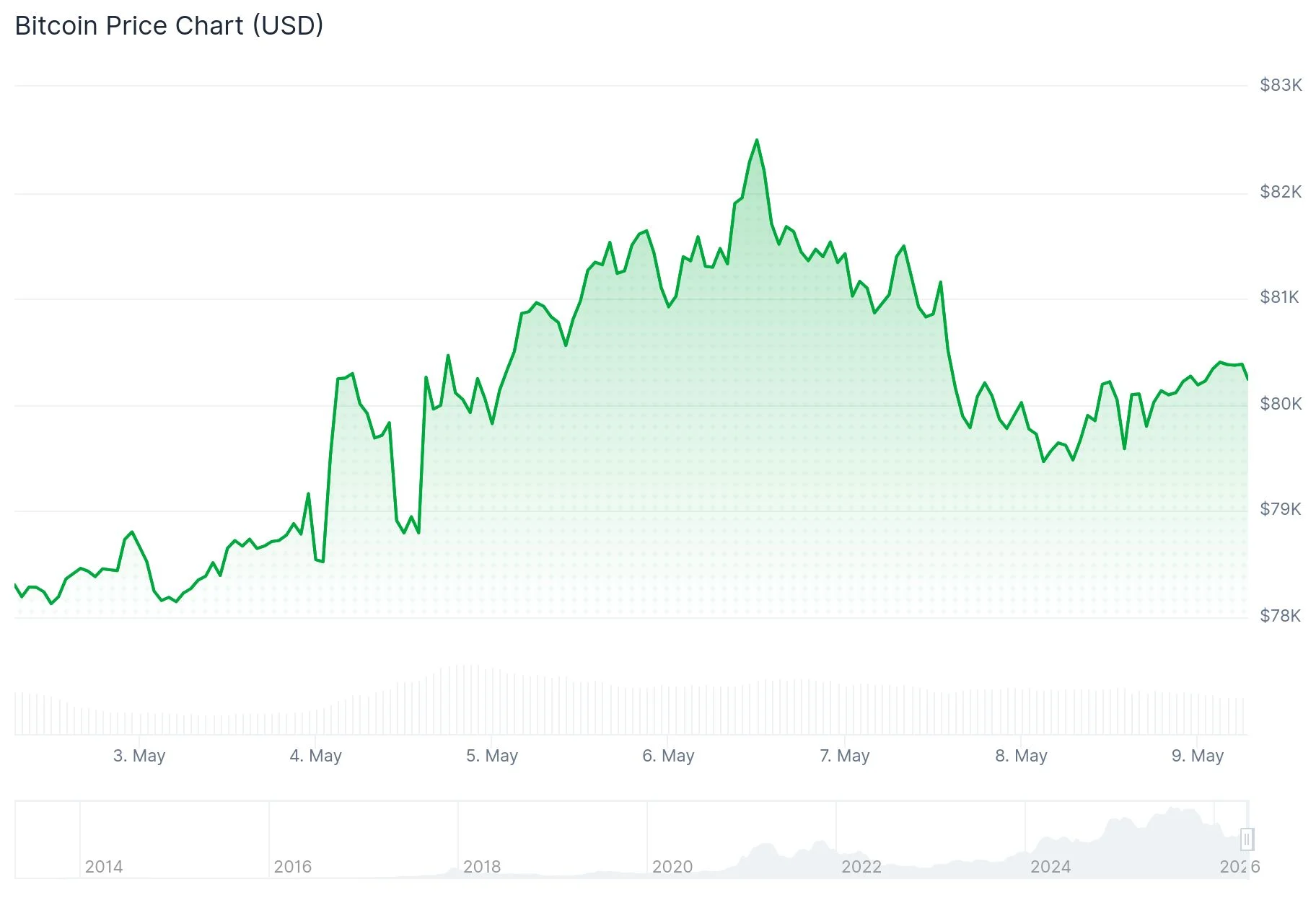
Maintaining current price levels alongside consistent ETF demand could catalyze renewed retail participation. However, failure to overcome overhead resistance might prompt increased caution among traders following the recent price recovery.
Exchange-traded fund activity represents an important component of this narrative. Bitcoin ETF demand has shown improvement in recent weeks. Nevertheless, CoinDesk highlighted that the recovery hasn’t fully compensated for significant capital withdrawals occurring between November 2025 and February 2026.
This week’s daily flow statistics will provide insight into whether institutional participants continue accumulating positions. Sustained positive inflows would validate the recovery trajectory. Conversely, neutral or negative flows would challenge the durability of current market strength.
Coinbase Records Consecutive Quarterly Deficit
Coinbase disclosed another quarterly deficit amid declining trading volumes. Revenue contracted to $1.43 billion from $2.03 billion year-over-year. Transaction-based revenue plummeted 40% to $756 million, Reuters confirmed.
As a prominent publicly-traded cryptocurrency exchange, Coinbase serves as a valuable barometer for retail trading engagement. Diminished platform activity frequently mirrors reduced participation throughout the broader cryptocurrency marketplace.
Alternative cryptocurrencies also warrant attention. During periods of Bitcoin price stabilization, capital frequently rotates into assets like Solana, Ethereum, and XRP seeking enhanced returns. This week, narratives surrounding stablecoins, regulatory developments, and tokenization will likely influence demand for sector-specific tokens.
Alternative cryptocurrencies demonstrate heightened sensitivity to market sentiment fluctuations. Should Bitcoin falter near resistance levels or ETF flows weaken, smaller-capitalization tokens could experience accelerated declines relative to major assets.
The May 14 CLARITY Act hearing represents the week’s most significant scheduled event. The proceedings could materially impact cryptocurrency exchanges, stablecoin issuers, and digital asset valuations broadly.
Get 3 Free Stock Ebooks
Discover top-performing stocks in AI, Crypto, and Technology with expert analysis.
- Top 10 AI Stocks - Leading AI companies
- Top 10 Crypto Stocks - Blockchain leaders
- Top 10 Tech Stocks - Tech giants


