



Key Takeaways
- On Thursday, VanEck introduced VBNB, the inaugural U.S. spot BNB ETF trading on NASDAQ, charging a 0.39% annual fee.
- Staking rewards are not currently included in the ETF structure, though VanEck reserves the right to incorporate third-party staking later.
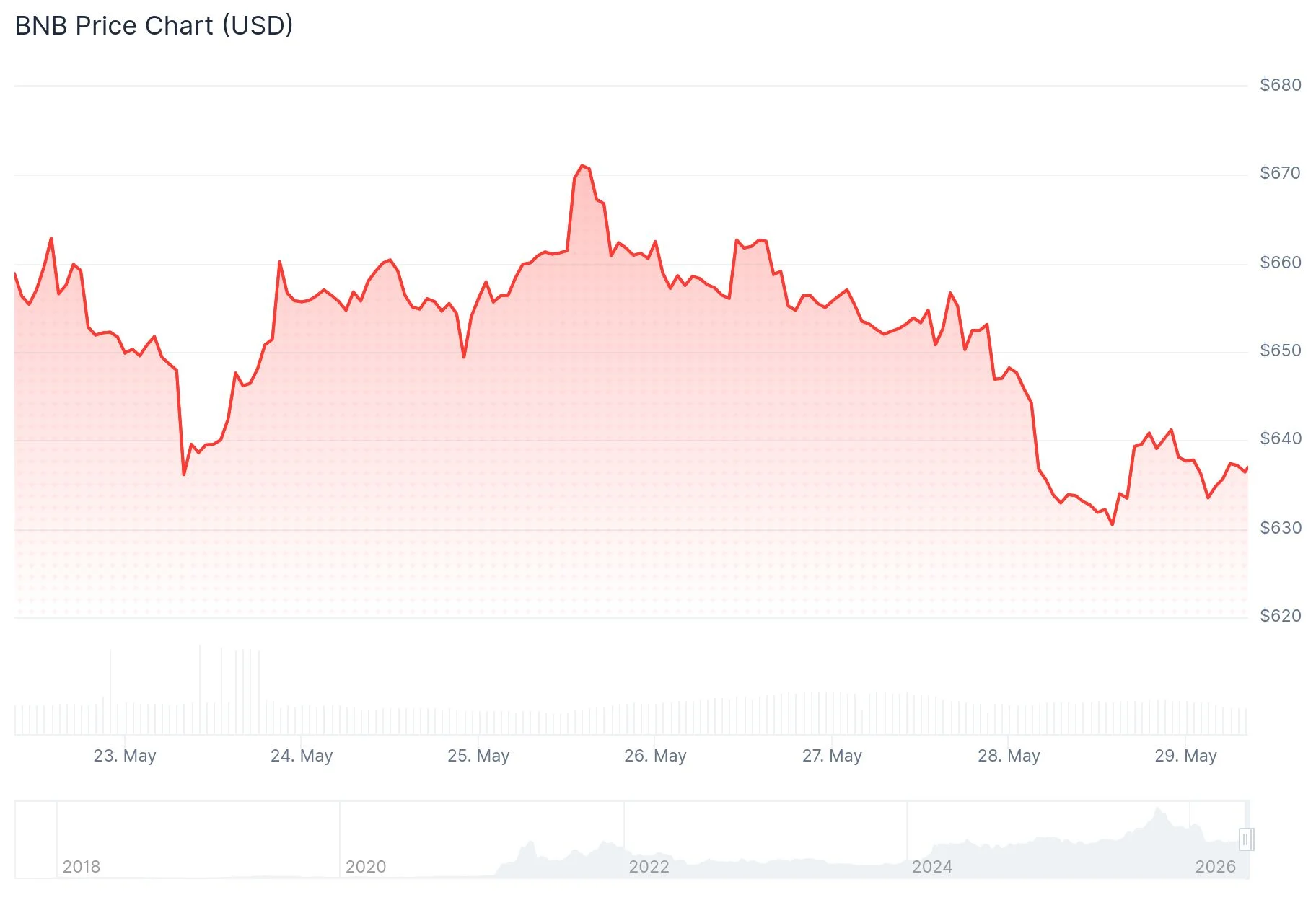
- BNB currently hovers between $631 and $635, declining more than 2% intraday and falling over 26% since the start of the year.
- Futures open interest for BNB has decreased to approximately $961 million, signaling diminished trader enthusiasm amid risk aversion.
- With BNB’s addition, there are now 11 altcoins with U.S. spot ETFs, including Ethereum, Solana, XRP, and several others.
VanEck made history on Thursday by introducing the VanEck BNB ETF, marking the debut of the first U.S.-listed spot exchange-traded fund providing regulated access to Binance’s blockchain-native token. Trading commenced on NASDAQ under the symbol VBNB, with an expense ratio set at 0.39% annually.
The product is organized as a ’40 Act fund, meaning it complies with regulations outlined in the Investment Company Act of 1940. According to VanEck, the trust aims to mirror the spot market price of BNB as closely as possible.
Notably absent from the fund’s features is staking functionality. VanEck will not currently stake its BNB holdings, though the firm has left the door open to incorporate staking via third-party service providers down the line. Until such a decision is implemented, VBNB shareholders will not earn staking yields.
Patrick Bush, Senior Investment Analyst at VanEck, highlighted that the BNB blockchain handles approximately 14 million transactions daily and supports more than 2.5 million active users each day. He characterized BNB as among the “most resilient” leading cryptocurrencies throughout the latest market cycle.
Kyle DaCruz, who leads Digital Assets Product initiatives at VanEck, emphasized that BNB had remained one of the few major digital assets lacking a U.S. spot ETF. “We’re thrilled to be changing that with the launch of VBNB,” DaCruz stated.

Ahead of the launch, Sjuul, a crypto analyst from AltCryptoGems, expressed reservations on X. He cautioned that BNB “seems in trouble after that double top and the bearish retest of that key resistance level,” suggesting that without buyer intervention, a move back to support zones appears probable.
Token Value Declines Amid ETF Rollout
Contrary to expectations, the ETF announcement failed to buoy BNB’s market performance. On launch day, the token traded within a range of approximately $631 to $635, representing an intraday decline exceeding 2%. Year-to-date losses now surpass 26%.
External factors have contributed to the sell-off. BNB’s weakness aligns with heightened geopolitical tensions between the United States and Iran, which triggered a flight from risk assets across multiple markets. The cryptocurrency sector experienced parallel downward pressure.
Chart Analysis Points to Continued Weakness
From a technical standpoint, BNB remains positioned beneath its 50-period exponential moving average at $645, the mid-Bollinger Band near $657, and the 100-period EMA around $663. Each of these levels currently functions as overhead resistance.
The MACD histogram has dipped into negative territory while the RSI lingers just below the 50 threshold, both indicators reinforcing the bearish momentum. Meanwhile, open interest in BNB futures contracts has contracted to roughly $961 million from nearly $1 billion just one day earlier, suggesting market participants are liquidating positions rather than initiating fresh trades.
The nearest support level emerges around the lower Bollinger Band at approximately $634. A sustained break below this threshold could trigger additional downside movement.
Separately, Grayscale has submitted an updated S-1 filing for its own BNB investment vehicle, hinting at a potential launch in the near term. BNB now joins a growing roster of 11 altcoins with approved U.S. spot ETFs, alongside Ethereum, Solana, XRP, Avalanche, Litecoin, Polkadot, Hyperliquid, Hedera, Chainlink, and Dogecoin.
Get 3 Free Stock Ebooks
Discover top-performing stocks in AI, Crypto, and Technology with expert analysis.
- Top 10 AI Stocks - Leading AI companies
- Top 10 Crypto Stocks - Blockchain leaders
- Top 10 Tech Stocks - Tech giants


