



Quick Overview
- BTC reached $79,399, a 12-week peak, before reversing—the third rejection at the $80,000 threshold in eight trading sessions
- The surge followed reports of Iran’s proposal to reopen the Strait of Hormuz, though profit-taking quickly emerged
- April has seen bitcoin climb 16%, with Strategy accumulating $3.9 billion in BTC during the month
- U.S. equity futures declined Sunday evening as crude oil surged past $100 per barrel due to Iranian geopolitical risks
- Central bank policy announcements from the Fed and ECB, plus major technology earnings, dominate this week’s calendar
Bitcoin surged to a three-month peak of $79,399 during overnight trading before encountering resistance that drove prices lower throughout Monday’s Asian session. The cryptocurrency stabilized near $77,705, representing a 0.4% decline over the previous 24-hour period.
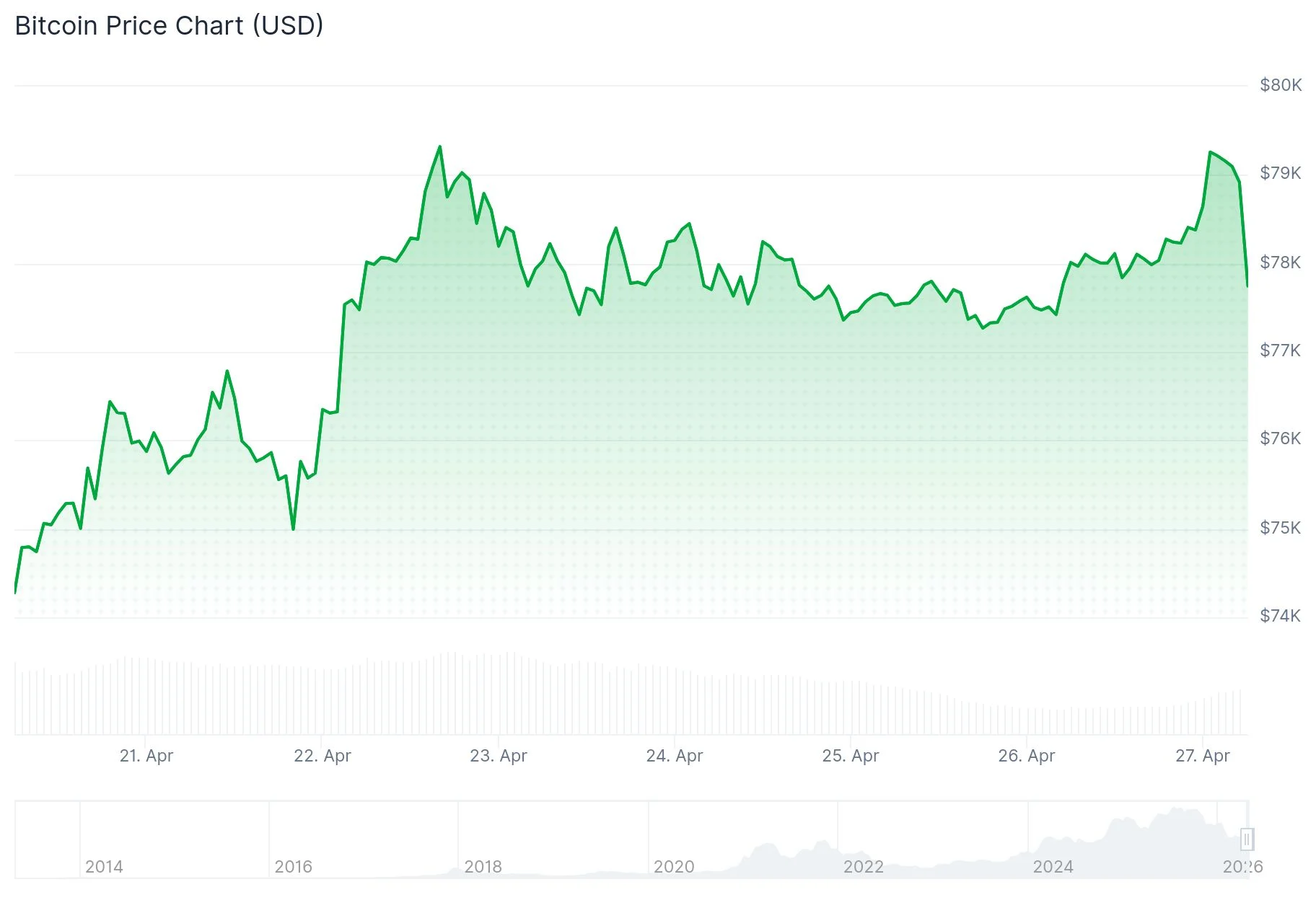
This marked the third instance in the past eight sessions where bitcoin encountered selling pressure near the $79,000 threshold. The consistent pattern of rejections is establishing well-defined resistance levels.
The initial upward momentum stemmed from an Axios report indicating Iran had presented a proposal to reopen the Strait of Hormuz, connecting nuclear negotiations to the removal of America’s naval blockade. Global risk assets rallied on the developments.
Asian stock markets demonstrated robust performance. The MSCI Asia Pacific Index climbed 1.7%, emerging market indices reached all-time highs, and Taiwan Semiconductor Manufacturing jumped 6%. Bitcoin initially participated in the rally before momentum evaporated.
Rachael Lucas, an analyst at BTC Markets, noted that the $80,000 price level represents a breakeven point for numerous recent purchasers. This concentration of underwater positions typically generates selling pressure as traders seek to exit at minimal losses.

Understanding the $80,000 Resistance Zone
Perpetual futures funding rates continue trading in negative territory at -0.13% on a seven-day average, based on Coinglass data. This configuration indicates short positions are compensating longs, potentially setting up conditions for a short squeeze if bitcoin maintains current levels.
Bitcoin is tracking toward its first monthly increase exceeding 10% since May 2025. Strategy executed $3.9 billion in bitcoin acquisitions this month, representing its most substantial monthly purchase volume in twelve months, per Bloomberg reporting.
Alternative cryptocurrencies also experienced declines. Ether decreased 2.4% to $2,329, Solana retreated 1.9% to $86, and BNB slipped 1.2% to $630.
U.S. stock index futures weakened during Sunday evening trading. Dow Jones Industrial Average futures declined approximately 0.2%, while both S&P 500 and Nasdaq 100 contracts dropped roughly 0.2%.
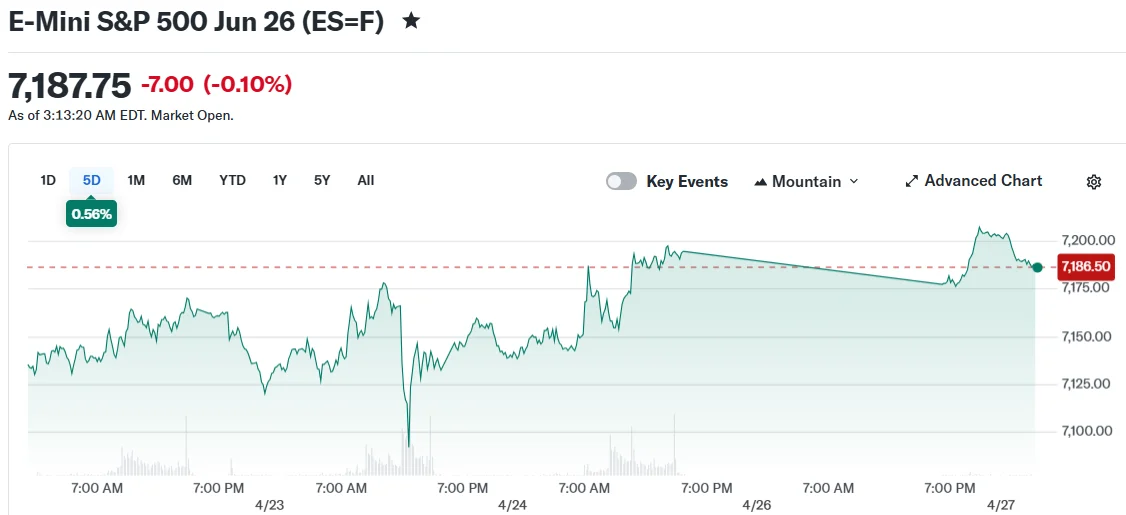
Despite the negative futures action, both the S&P 500 and Nasdaq Composite concluded the previous week at unprecedented levels. April saw the S&P 500 advance more than 9% while the Nasdaq surged over 15%.
Key Events on This Week’s Market Calendar
Oil prices extended gains amid escalating Iranian tensions. Brent crude increased approximately 2% to trade above $100 per barrel, while West Texas Intermediate advanced beyond $96.
Both the Federal Reserve and European Central Bank have scheduled monetary policy announcements this week. The upcoming Fed meeting is anticipated to be among the final sessions led by Chairman Jerome Powell before Kevin Warsh assumes leadership.
Multiple Magnificent Seven technology companies will report quarterly earnings this week. Market participants will scrutinize these results to assess how mega-cap stocks are performing amid current market dynamics.
For bitcoin, market participants are awaiting either the Fed’s policy decision or strong corporate earnings to provide the catalyst necessary to escape the established trading range.
Current market data shows bitcoin trading at $77,705 with negative funding rates persisting and the $80,000 level remaining unconquered after three attempts.
Get 3 Free Stock Ebooks
Discover top-performing stocks in AI, Crypto, and Technology with expert analysis.
- Top 10 AI Stocks - Leading AI companies
- Top 10 Crypto Stocks - Blockchain leaders
- Top 10 Tech Stocks - Tech giants


