


There is a graveyard of crypto projects that did everything right except one thing. They wrote clean code. They audited their smart contracts. They designed elegant tokenomics. They shipped on schedule. They did all of this and still ended up with empty liquidity pools, silent marketplaces and developer documentation that nobody ever read.
The missing piece was never technical. It was attention. The projects that fill that graveyard were not outperformed by better technology. They were outperformed by louder marketing. In the DeFi, NFT and Web3 sectors, the projects that grow are the ones that people encounter repeatedly across trusted publications. The ones that remain invisible — regardless of their technical merit — eventually run out of runway.
Kooc Media, a PR distribution agency that has worked with crypto, fintech, technology and iGaming companies since 2017, helps DeFi protocols, NFT platforms and Web3 infrastructure projects make sure they do not end up in that graveyard. The agency delivers guaranteed media placements on its own network of established news websites and distributes content through major financial and business newswire services. Coverage is confirmed upfront, published within hours and lands on the sites where crypto audiences actually spend time.
“The projects we work with are not looking for hype,” said Michelle De Gouveia, spokesperson for Kooc Media. “They are looking for the baseline visibility they need to compete fairly. Right now, too many excellent DeFi, NFT and Web3 projects are losing to competitors that are simply better at getting press.”
The Discovery Problem Nobody Has Solved
Crypto has a discovery problem that gets worse every month. The number of active DeFi protocols, NFT platforms and Web3 infrastructure projects continues to grow. The number of publications covering them has not kept pace. The number of hours that potential users, investors and developers have available to research new projects has not changed at all.
The result is a bottleneck. Thousands of projects compete for a fixed amount of audience attention. The projects that capture that attention tend to be the ones that appear in the places audiences already look — established crypto news sites, respected finance publications and the first page of Google search results. Everything else blends into background noise.
For DeFi projects, the discovery challenge is acute. A user looking for a new lending platform or decentralised exchange will search Google, read a few articles on sites they trust and choose from the options they find there. They will not manually visit fifty different DEX websites to compare fee structures. They will go with the ones that showed up in their research. If a protocol is not present in that research process, it does not get considered.

NFT platforms face a similar dynamic with a different audience. A digital artist looking for a new marketplace to mint their work will search for options, read reviews and recommendations on media sites and choose based on what they find. A collector looking for the next platform will do the same. Visibility on the publications these audiences read is effectively a prerequisite for growth.
Web3 infrastructure projects have perhaps the hardest discovery challenge. Their customers are developers and enterprise buyers who evaluate solutions through a combination of documentation review, peer recommendation and media coverage. A Web3 project that appears on technology and business publications is far more likely to make it onto an evaluation shortlist than one that exists only in its own documentation.
Kooc Media’s crypto PR services insert DeFi, NFT and Web3 projects into these discovery pathways through guaranteed placements on the publications that each audience actually uses.
Published, Not Pitched
The phrase “guaranteed placement” needs context because the PR industry has diluted the word “guaranteed” beyond recognition. Some agencies guarantee they will send pitches. Some guarantee a minimum number of journalist contacts. Some guarantee coverage on sites nobody has heard of. None of this is what Kooc Media means.
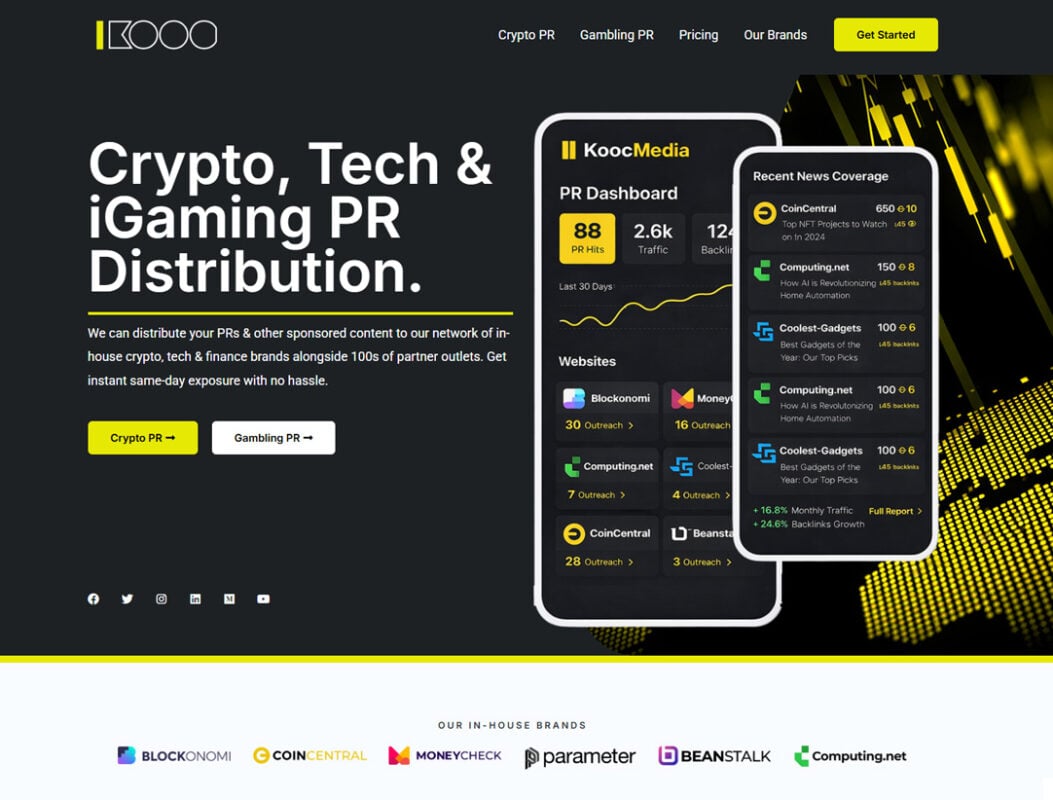
Kooc Media owns and operates Blockonomi, CoinCentral, MoneyCheck, Parameter, Beanstalk and Computing. These are real publications with real audiences, years of publishing history, established domain authority and organic traffic across the crypto, finance and technology sectors. When the agency says guaranteed placement, it means an article published on one or more of these named sites, live and linkable, typically within the same day.
The client knows which publications will carry their article before committing. The article is produced by Kooc Media’s editorial team — writers who cover DeFi, NFTs and Web3 daily — and published directly. No external journalist decides whether the story is worth covering. No editor at a publication the agency does not control weighs the piece against competing stories and rejects it. The ownership model eliminates the variable that makes traditional PR unreliable.
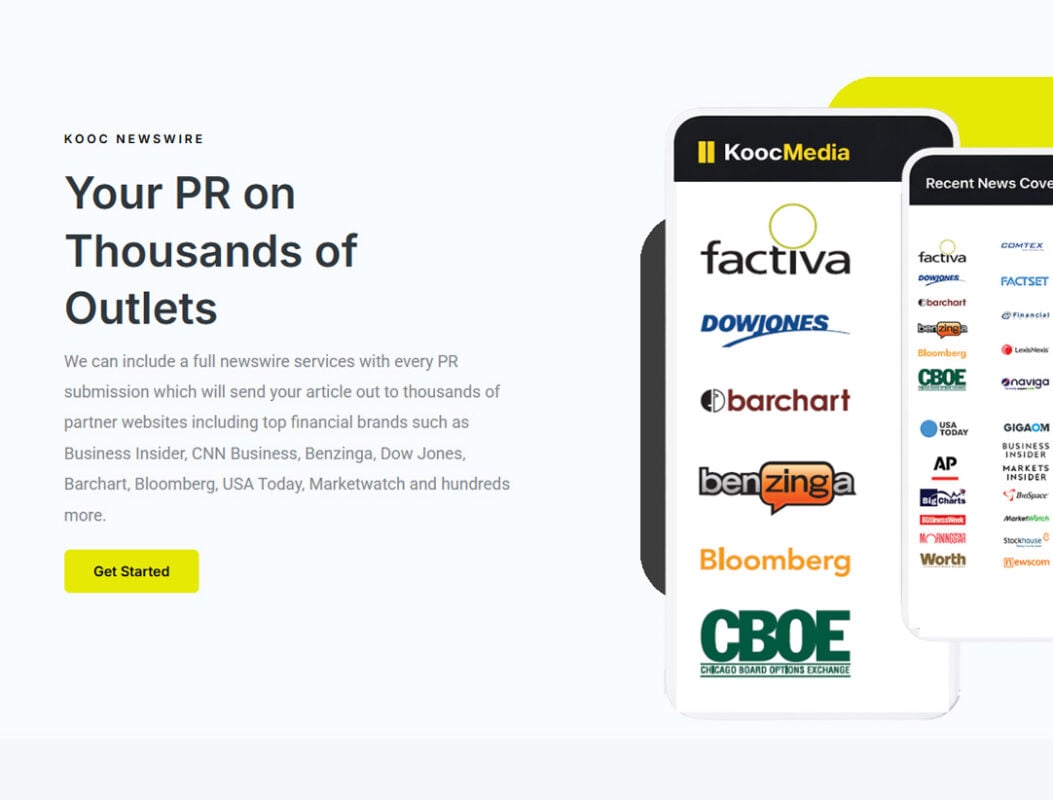
For projects that need coverage beyond the crypto press, Kooc Media distributes through major newswire services. Depending on the package, articles appear on outlets including Business Insider, Bloomberg, Benzinga, MarketWatch, USA Today and Dow Jones feeds. A DeFi protocol raising institutional capital, an NFT platform seeking a partnership with a consumer brand or a Web3 project pursuing enterprise contracts can use this distribution to appear in the media environment that those decision-makers inhabit.
Reporting is straightforward. Live links to every published article. No interpretation needed.
Three Sectors, Three Approaches
Running the same campaign for a DeFi lending protocol, an NFT music platform and a Web3 identity project would be like running the same ad for a bank, a record label and a cloud computing company. They share a technology layer but almost nothing else. Their audiences are different. Their value propositions are different. The publications that matter to them are different. The language that resonates with their users is different.
Kooc Media builds each campaign around the specific sector and the specific project.
DeFi campaigns are structured around what the DeFi audience evaluates: numbers and mechanisms. An article about a lending protocol covers interest rate curves, collateral ratios, liquidation processes, audit history and total value locked. An article about a DEX covers trading volume, supported chains, order types, fee structure and LP incentive design. An article about a yield strategy platform covers the strategies themselves — composition, risk parameters, backtested performance, dependencies. DeFi users are allocating capital. They need the information that supports an allocation decision.
NFT campaigns focus on experience and community. An article about a creator marketplace covers the minting process, royalty enforcement, discoverability, curation model and what sets the platform apart for artists. An article about a gaming platform covers gameplay, asset ownership, earning mechanics, studio partnerships and interoperability between games. An article about a collectibles platform covers the collection experience, rarity models, trading tools and community events. NFT audiences are joining ecosystems. They need to understand what makes this one worth joining.
Web3 campaigns translate technical capability into practical value. An article about a storage network covers cost per gigabyte, retrieval speed, redundancy guarantees and enterprise case studies. An article about an identity protocol covers real applications — verifiable age checks, portable professional credentials, privacy-preserving authentication. An article about a data availability layer covers what it enables for the rollups and applications that depend on it. Web3 audiences need to understand the benefit before they invest time evaluating the technology.
“Each project gets a campaign built around its own reality,” said De Gouveia. “A DeFi derivatives protocol targeting professional traders needs completely different coverage from an NFT platform targeting independent musicians. We have worked with enough of both to know exactly what each requires.”
Content Produced by People Who Understand the Technology
The DeFi, NFT and Web3 audiences share one trait: they will immediately reject content that demonstrates ignorance of the technology being discussed. A misused term, a confused explanation, a factual error about how a protocol works — any of these is enough to turn media coverage from an asset into a liability.
Kooc Media’s managed PR creation service handles all content production in-house. The writers are not generalists who have been briefed on blockchain. They are specialists who cover DeFi mechanics, NFT standards, Web3 infrastructure, token economics and cross-chain architecture as their daily work. They know what an invariant check does in a DeFi context. They understand the difference between lazy minting and standard minting for NFTs. They can explain a data availability committee without hand-waving.
The process requires minimal client involvement. The project provides technical documentation, the announcement and the key messages. Kooc Media delivers a finished article that is technically precise, editorially clean and appropriate for the publication it will appear on. For project teams that are consumed by development work and have no marketing staff — the norm across DeFi, NFTs and Web3 — this service provides professional media coverage without pulling a single developer away from their actual work.
The Compound Effect of Showing Up Consistently
A single article on a high-authority site is helpful. It creates one indexed page that can rank for a handful of relevant search terms. But the real transformation happens when coverage is sustained over months.
Each article Kooc Media publishes for a DeFi, NFT or Web3 client creates another indexed page on another trusted domain. For DeFi projects, those pages rank for decentralised exchange, DeFi lending, yield farming, liquidity protocol and dozens of variations. For NFT projects, they rank for NFT marketplace, digital collectibles, NFT gaming, music NFTs and create NFTs. For Web3 projects, they rank for decentralised storage, Web3 infrastructure, blockchain identity and decentralised applications.
After three months of consistent placements, the project has a meaningful search footprint. After six months, it spans multiple authoritative domains. After a year, the project appears organically across a wide range of queries that potential users, investors and developers type into Google every day. Each new article builds on the foundation laid by the ones before it.
This is how media coverage converts from a marketing expense into a permanent asset. The articles published today continue driving organic discovery years from now. The search authority they build grows stronger with every subsequent placement. And the cumulative effect creates a visibility advantage that compounds indefinitely — rewarding the projects that started building their media presence early and penalising the ones that kept putting it off.
About Kooc Media
Kooc Media was founded in 2017 as a specialist PR distribution agency for the crypto, fintech, technology and iGaming industries. The company operates its own network of in-house news websites and a large partner distribution network, delivering guaranteed media coverage across high-authority publications. Services include press release writing, sponsored articles, newswire distribution, homepage placements and full campaign reporting. Kooc Media serves clients across the crypto, fintech and gambling sectors.
Kooc Media’s Crypto PR packages are available now through the company’s website at https://kooc.co.uk.
Get 3 Free Stock Ebooks
Discover top-performing stocks in AI, Crypto, and Technology with expert analysis.
- Top 10 AI Stocks - Leading AI companies
- Top 10 Crypto Stocks - Blockchain leaders
- Top 10 Tech Stocks - Tech giants


