


TLDR
- Prediction market Polymarket now shows just 38% odds for CLARITY Act passage in 2026, down 23 percentage points
- Senate markup postponed to late May according to Senator Bernie Moreno
- Galaxy Digital analysts estimate a 50-50 probability of the legislation becoming law this year
- Banking industry requests additional 60-day comment period on stablecoin regulations
- TD Cowen identifies five additional roadblocks complicating the bill’s path forward
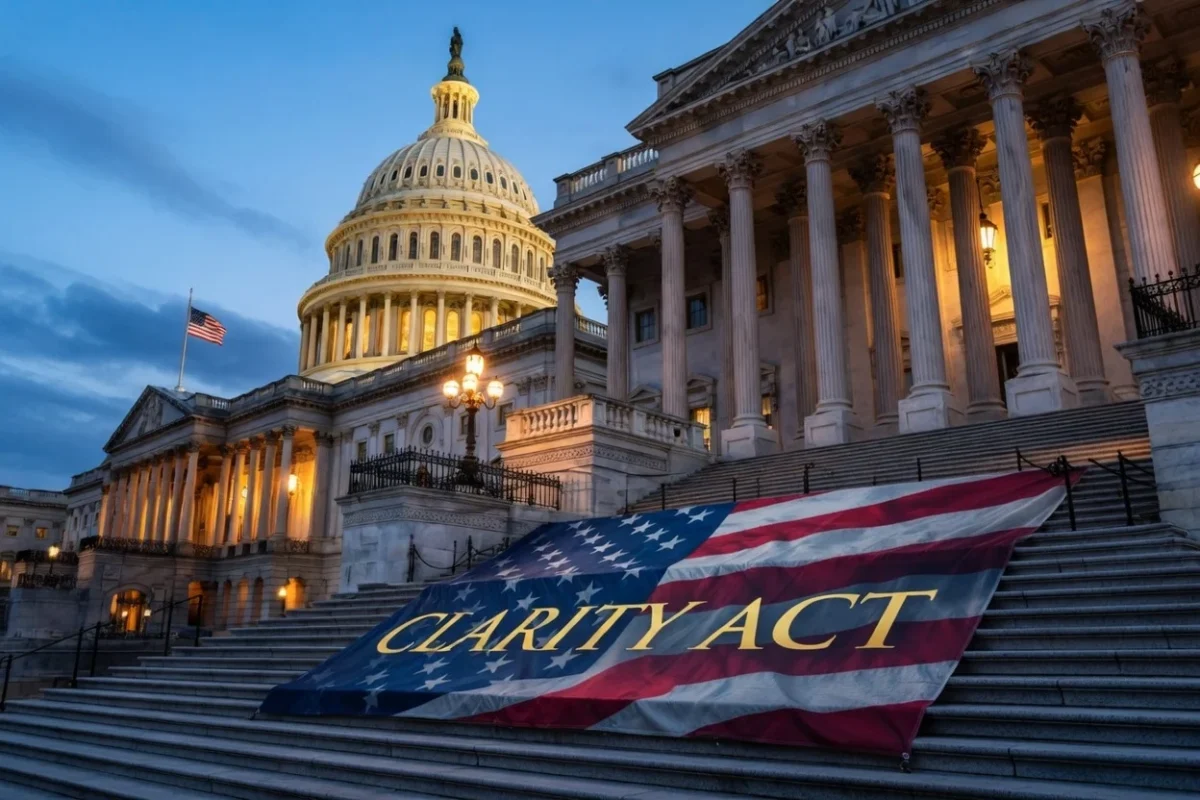
The United States Senate continues to face challenges in advancing the CLARITY Act, a comprehensive crypto market structure bill that successfully cleared the House of Representatives in July 2025. Legislative momentum has slowed considerably amid ongoing disputes between traditional banking institutions and digital asset advocates, while the legislative calendar continues to shrink.
During an April 22 appearance before a Washington, D.C. audience, Senator Bernie Moreno indicated that committee markup would occur “by the end of May.” He dismissed banking sector concerns about stablecoin yields as “a lot of noise in the system” that is “completely fake.”
Senator Thom Tillis has advised Senate Banking Committee Chairman Tim Scott to schedule the markup session for May, acknowledging that negotiators require additional time to broker an agreement between traditional banks and cryptocurrency firms regarding stablecoin yield provisions.
Crypto advocates are mounting resistance to further delays. Senator Cynthia Lummis alongside industry organization The Digital Chamber have called on the Senate Banking Committee to expedite the markup scheduling process.
On Tuesday, the American Bankers Association submitted correspondence to multiple federal agencies including the Treasury Department, FDIC, FinCEN, and the Treasury’s Office of Foreign Assets Control. The letter requested an additional 60-day comment period for regulations connected to the GENIUS Act stablecoin legislation, which became law in July 2025.
The banking association argued that other agencies’ rulemaking processes are substantially dependent on the finalization of Office of the Comptroller of the Currency regulations, making substantive commentary premature until those rules are completed.
Betting markets have adjusted their forecasts following these postponements. Polymarket currently indicates a 38% probability of CLARITY Act passage in 2026, reflecting a 23-point decline. Kalshi assigns 14% odds for passage before July and 39% before August.

The likelihood of President Trump affixing his signature to the legislation before 2027 has edged upward to 58%, compared to 53% recorded earlier in the week.
What Galaxy Digital Is Saying
Digital asset firm Galaxy Digital estimates roughly even odds—approximately 50%—for the bill’s passage this year. Alex Thorn, the firm’s Head of Research, identified several outstanding issues including stablecoin yield language, decentralized finance regulations, ethics requirements, and developer liability protections.
The legislation must navigate several procedural hurdles: clearing the Senate Banking Committee, securing 60 votes on the Senate floor, and undergoing reconciliation with versions originating from the Agriculture Committee and the House of Representatives.
The Senate Calendar Problem
Galaxy Digital highlighted the compressed nature of the Senate’s working schedule leading up to the August recess. Senators maintain session throughout April, reconvene from May 11 through May 22, and face only three working weeks each in June and July before entering a five-week August recess.
Thorn cautioned that markup delays extending beyond mid-May would significantly diminish the probability of 2026 passage.
TD Cowen enumerated five additional complications: insufficient commissioner appointments at the Commodity Futures Trading Commission, unresolved prediction market regulations, heightened scrutiny of Trump-associated World Liberty Financial, Iran’s alleged cryptocurrency usage for Strait of Hormuz transit fees raising anti-money laundering red flags, and the Credit Card Competition Act.
Senator Lummis has issued warnings that failure to pass the legislation this year could result in no further action until 2030.
Get 3 Free Stock Ebooks
Discover top-performing stocks in AI, Crypto, and Technology with expert analysis.
- Top 10 AI Stocks - Leading AI companies
- Top 10 Crypto Stocks - Blockchain leaders
- Top 10 Tech Stocks - Tech giants


