


Key Points
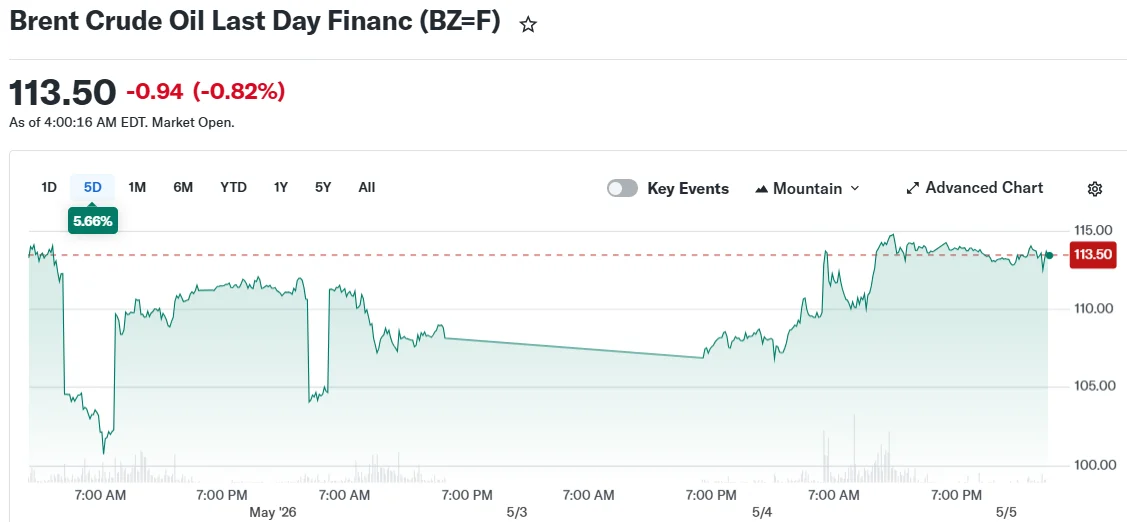
- Brent crude stabilized just under $114 per barrel on Tuesday following Monday’s 5.8% surge amid renewed U.S.-Iran military confrontations
- Military clashes between Washington and Tehran ended a nearly month-long pause in hostilities
- Iranian forces targeted UAE infrastructure, including a Fujairah port oil facility, while the Emirates intercepted incoming cruise missiles
- Washington initiated “Project Freedom” operation to provide naval escort for commercial shipping through the strategic waterway
- Long-term U.S. Treasury rates surpassed 5% threshold amid concerns the Federal Reserve may tighten monetary policy to combat rising inflation
Oil prices experienced modest declines on Tuesday following the previous session’s dramatic gains, as global energy markets monitored the deterioration of a temporary Middle Eastern truce.
Brent crude futures retreated 0.3% to settle at $114.05 per barrel during Asian trading hours. West Texas Intermediate crude fell 1.2% to $105.06. Monday’s trading session saw both oil benchmarks post substantial gains — Brent climbed over 4% while WTI jumped approximately 6%.
The market pullback came after fresh military confrontations erupted between American and Iranian armed forces in the Persian Gulf region on Monday. The adversaries engaged in combat operations while vying for strategic dominance over the Strait of Hormuz, the crucial chokepoint responsible for transporting a substantial portion of global oil supplies.
These hostile actions effectively terminated a cessation of hostilities between Washington and Tehran that had remained intact for approximately four weeks.
Tehran’s military targeted critical infrastructure within the United Arab Emirates, striking an oil terminal located at Fujairah port, an important energy facility positioned beyond the Persian Gulf proper. UAE defense systems successfully intercepted Iranian cruise missiles, prompting authorities to issue their first missile warnings to civilians since the ceasefire took effect.

On Tuesday, vessel tracking data revealed hundreds of commercial ships congregating near Dubai, repositioning away from the Strait of Hormuz as Iranian forces attempted to expand their operational control over the contested passage.
U.S. military officials confirmed they had secured a transit corridor through the strategic strait. CBS News reported that two American naval destroyers successfully navigated into the Persian Gulf.
Washington Unveils “Project Freedom” Initiative
President Trump unveiled a new military operation designated “Project Freedom,” designed to provide armed escort services for commercial maritime traffic navigating the Strait of Hormuz while working to restore normal shipping operations.
The Pentagon confirmed that escort operations had already commenced under the new program. Market experts warned that any positive impact would likely prove temporary.
“Any relief from stranded vessels making their way through the Strait will be temporary, with very few inbound vessels moving into the Persian Gulf,” ING analysts wrote.
Brent crude prices have climbed more than 80% year-to-date as the regional conflict has eliminated hundreds of millions of barrels from global supply chains.
Inflation Concerns Intensify
Surging energy prices are fueling anxiety about accelerating inflation across the economy. Within U.S. Treasury markets, 30-year bond yields broke above the 5% threshold for the first time since July, reflecting growing market expectations that the Federal Reserve may implement interest rate increases.
Iranian Foreign Minister Abbas Araghchi indicated that diplomatic discussions with Washington were “making progress” while cautioning against becoming “dragged back into quagmire.”
President Trump projected the conflict could extend for an additional two to three weeks. Defense Secretary Pete Hegseth was scheduled to conduct a press briefing at the Pentagon on Tuesday.
“Escalation seems to be the path,” said Carl Larry, oil and gas analyst at Enverus. “Peace is dimming.”
Get 3 Free Stock Ebooks
Discover top-performing stocks in AI, Crypto, and Technology with expert analysis.
- Top 10 AI Stocks - Leading AI companies
- Top 10 Crypto Stocks - Blockchain leaders
- Top 10 Tech Stocks - Tech giants


