



Key Highlights
- Brent crude advanced 1.7% to reach $106.88 per barrel; WTI climbed 1.4% to $97.21 per barrel during Friday trading
- Both oil benchmarks headed toward their most substantial weekly increase since the beginning of March
- Critical Strait of Hormuz passage stays virtually closed, eliminating approximately 20% of worldwide oil transportation
- President Trump indicated no urgency to finalize lasting agreement with Iran, intensifying market concerns
- Goldman Sachs projects Persian Gulf production declined by approximately 14.5 million barrels daily, representing over half of April’s regional output
Energy markets experienced significant upward momentum on Friday following President Donald Trump’s declaration that resolving the current U.S.-Iran confrontation wasn’t an immediate priority, injecting additional volatility into an already volatile commodity landscape.
Brent crude contracts advanced 1.7% to settle at $106.88 per barrel. Meanwhile, U.S. West Texas Intermediate futures increased 1.4% to touch $97.21 per barrel. Both key oil indicators are positioned to record their strongest weekly performance since the first week of March.
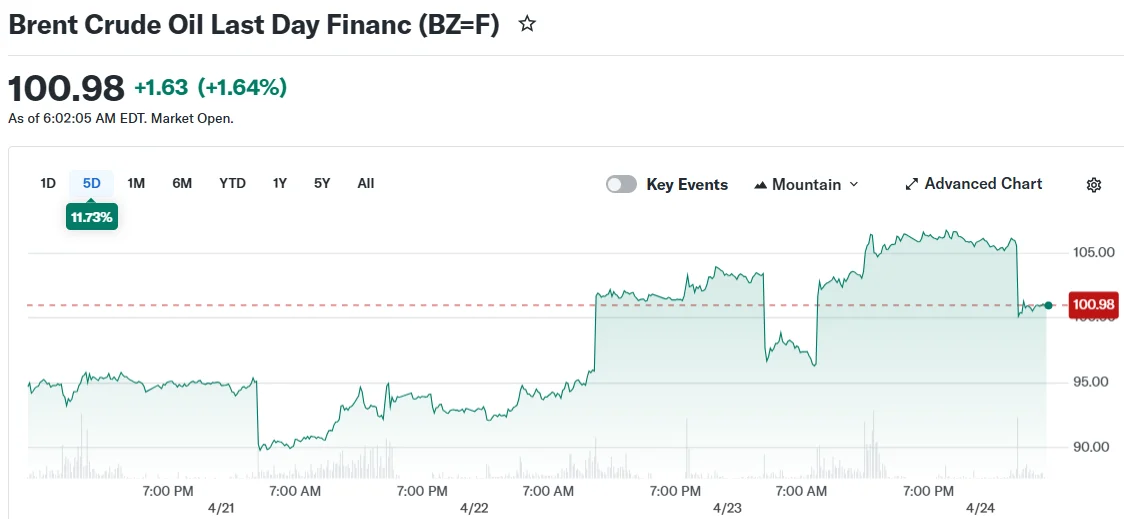
The price surge follows continued disruption at the Strait of Hormuz — a critical maritime chokepoint along Iran’s southern coastline — which remains largely inaccessible to oil tanker vessels. Approximately 20% of the world’s petroleum passes through this strategic corridor.
The passageway has been essentially blocked for multiple weeks. Leading Gulf oil exporters such as Saudi Arabia and Qatar have attempted to establish alternate maritime channels, though these haven’t successfully compensated for the closure.
Iranian forces intercepted multiple vessels attempting passage through the strait during the current week. Simultaneously, American military personnel boarded a large oil tanker transporting Iranian crude in the Indian Ocean as naval forces intensified the blockade around Iranian harbors.

Thursday saw Trump announce via Truth Social that he had commanded the U.S. Navy to “shoot and kill” any Iranian ships discovered deploying mines within the strait. Tehran responded by publishing footage showing its special forces boarding a commercial vessel and highlighting its rapid-response boat capabilities.
Diplomatic Efforts Remain Frozen
Attempts to restart diplomatic channels continue to face significant obstacles. Two government officials briefed on the situation informed Bloomberg that Trump’s public statements and the active naval blockade have hindered negotiations being facilitated by nations such as Pakistan.
Trump addressed the media Thursday, stating his preference to avoid hastily concluding a permanent agreement, asserting that American forces had severely damaged Iran’s military infrastructure and left the nation in chaos.
An open-ended ceasefire extension between Washington and Tehran was announced earlier this week, though petroleum markets showed minimal positive response. The Lebanon-Israel ceasefire received a three-week extension following diplomatic discussions in the capital.
A sanctions-targeted supertanker loaded with Iranian petroleum was observed apparently trying to navigate the Strait of Hormuz on Friday, while general tanker movement through the waterway has essentially ceased.
Goldman Forecasts Extended Supply Constraints
Goldman Sachs researchers, led by Daan Struyven, wrote in an April 23 analysis that crude production from the Persian Gulf region might require “a few months” to substantially normalize — contingent upon complete Hormuz reopening and cessation of military operations.
The investment firm calculates that regional production has dropped by approximately 14.5 million barrels each day, comprising more than half of the area’s typical April supply volumes.
“Oil is rising more because of the physical supply shock rather than a geopolitical risk premium alone,” said Charu Chanana, chief investment strategist at Saxo Markets. “The war risk may be fading at the margin, but the flow risk has not gone away.”
Mona Yacoubian of the Center for Strategic and International Studies noted the disruption is proving hard to ignore. “The longer this continues, the more it becomes clear that the disruptive effects of this conflict are going to reverberate for months, if not longer,” she said.
Brent crude was positioned for approximately 17% weekly appreciation by Friday morning trading.
Get 3 Free Stock Ebooks
Discover top-performing stocks in AI, Crypto, and Technology with expert analysis.
- Top 10 AI Stocks - Leading AI companies
- Top 10 Crypto Stocks - Blockchain leaders
- Top 10 Tech Stocks - Tech giants


