



Key Takeaways
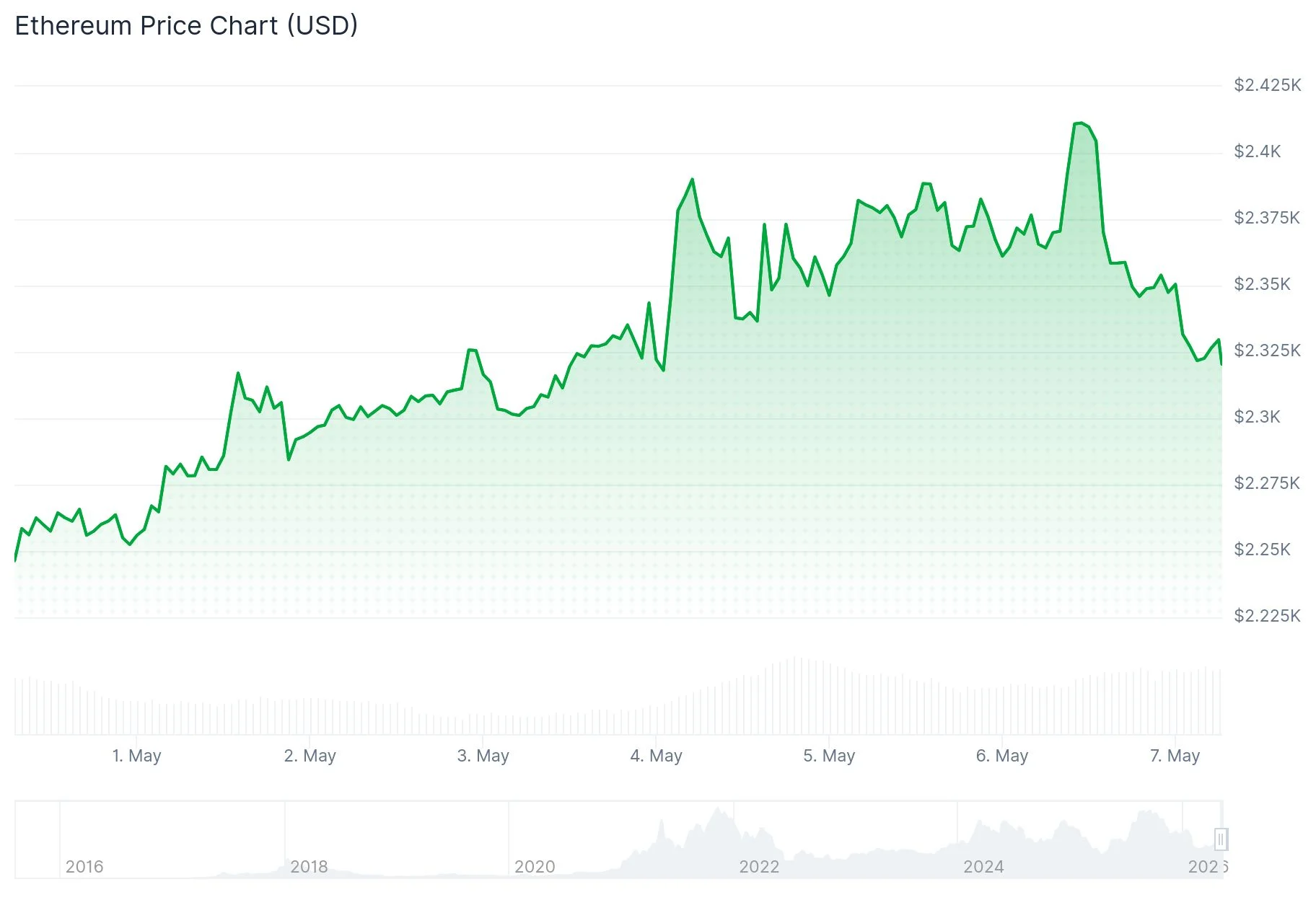
- Current ETH price sits around $2,324 with approximately $280 billion market capitalization
- Baseline five-year projection points to $6,500, implying roughly $785 billion valuation
- Optimistic scenario envisions $12,000 price level driven by accelerated institutional adoption
- Bearish outlook suggests $1,800 floor if Layer-2 ecosystems reduce mainnet value accrual
- Primary catalysts include proof-of-stake rewards, spot ETF flows, tokenized RWAs, and protocol enhancements
Ethereum (ETH) is presently valued at approximately $2,324 per token. Given a circulating supply near 120.7 million coins, the network commands a market capitalization approaching $280 billion.
As the dominant infrastructure for decentralized finance protocols, stablecoin issuance, non-fungible token platforms, and scaling solutions, Ethereum’s trajectory hinges on a critical factor: whether ETH can maintain its position as the settlement foundation for digital finance.
While Bitcoin operates with a hard-capped supply, ETH features a dynamic issuance model. The EIP-1559 fee-burning mechanism introduces deflationary characteristics during periods of elevated network usage, permanently removing tokens from circulation.
A measured baseline projection for the five-year horizon establishes $6,500 as a reasonable target, predicated on sustained expansion across exchange-traded products, validator staking participation, Layer-2 transaction volume, stablecoin circulation, and real-world asset integration. This valuation would translate to approximately $785 billion in total market value.
Catalysts Supporting Upside Scenarios
The optimistic forecast establishes $12,000 as a potential price level, corresponding to a market capitalization around $1.45 trillion.

Reaching this threshold would require Ethereum to solidify its position as the dominant settlement infrastructure for tokenized traditional financial instruments. The launch of BlackRock’s iShares Staked Ethereum Trust ETF demonstrates that leading asset management firms are actively developing Ethereum-based investment vehicles.
In March 2026, regulatory authorities provided updated guidance regarding how federal securities regulations intersect with protocol staking activities and non-security digital assets. Enhanced regulatory frameworks could facilitate broader institutional engagement.
Under this bullish framework, spot ETF capital inflows accelerate significantly, staking mechanisms lock substantial token supply, and tokenized traditional assets migrate to Ethereum infrastructure at unprecedented scale.
Factors Presenting Downside Risks
The conservative scenario establishes $1,800 as a potential floor, representing a market capitalization near $217 billion.
This outcome assumes that Layer-2 scaling solutions capture transaction activity and economic value away from Ethereum base layer operations, diminishing fee generation. Competing Layer-1 blockchains like Solana capture meaningful market share. Institutional demand through ETF products plateaus, and the broader cryptocurrency sector experiences extended consolidation.
The primary structural challenge lies in the possibility that while rollup networks benefit from Ethereum’s security guarantees, the majority of transaction fees and economic activity remains captured within those secondary environments rather than accruing to ETH holders.
Recent protocol improvements including the Pectra and Fusaka upgrades have focused on account abstraction capabilities, blob storage capacity, validator operational efficiency, and data availability for Layer-2 systems. These technical enhancements aim to preserve Ethereum’s competitive positioning as a settlement foundation.
Current market conditions show ETH trading near the $2,324 level, with institutional interest expanding through regulated ETF products and regulatory bodies actively developing comprehensive frameworks for digital asset activities including staking mechanisms.
Get 3 Free Stock Ebooks
Discover top-performing stocks in AI, Crypto, and Technology with expert analysis.
- Top 10 AI Stocks - Leading AI companies
- Top 10 Crypto Stocks - Blockchain leaders
- Top 10 Tech Stocks - Tech giants


