


TLDR
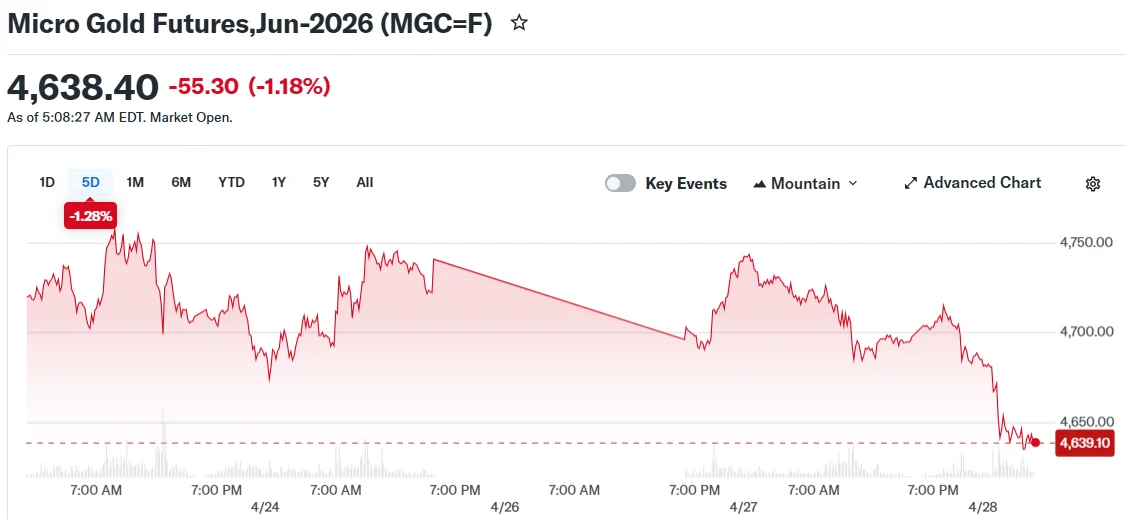
- Precious metals retreated sharply, with gold declining 1.2% to approximately $4,625 per ounce following diplomatic breakdown
- Tehran proposed reopening the Strait of Hormuz in return for ending the American port blockade, but U.S. officials remain doubtful
- Japan’s central bank maintained current rates while cautioning about inflationary pressures linked to energy costs
- Federal Reserve policy meeting scheduled for Wednesday could mark Jerome Powell’s final session as Chairman
- The yellow metal has shed approximately 12% of its value since hostilities erupted in late February
Precious metal markets experienced significant downward pressure on Tuesday following the collapse of diplomatic initiatives aimed at resolving the U.S.-Iran military confrontation, while major central banks worldwide expressed mounting concerns over accelerating inflation.
Spot gold declined approximately 1.2% to reach $4,624.99 per ounce during Asian trading hours. Futures contracts for the precious metal similarly retreated roughly 1% to settle at $4,646.90 per ounce. Silver experienced an even more pronounced selloff, plunging 3.3% to trade near $73 per ounce. Both platinum and palladium posted losses as well.
The strategically vital Strait of Hormuz, through which a substantial portion of worldwide energy supplies typically flow, continues to operate at a virtual standstill. Traffic passing through this critical chokepoint has plummeted to essentially zero since military hostilities commenced approximately eight weeks prior.
Tehran advanced a fresh diplomatic initiative earlier in the week. Iranian authorities proposed lifting restrictions on the Hormuz passage provided Washington terminates its naval blockade of Iranian coastal facilities. The White House is anticipated to deliver its response within the next several days.
Nonetheless, intelligence suggests the Trump administration’s national security apparatus harbors considerable reservations. A primary obstacle involves Iran’s insistence on postponing discussions regarding its atomic energy program, a concession Washington appears disinclined to grant.

Weekend diplomatic sessions between the conflicting nations collapsed after neither party agreed to convene in Pakistan. The trajectory of subsequent negotiation efforts remains ambiguous.
Global Monetary Authorities Compound Pressure on Gold
The Bank of Japan preserved its policy rate at 0.75% during Tuesday’s announcement, though adopted a noticeably hawkish posture. Japanese monetary officials elevated their inflation projections for fiscal year 2026 and indicated that additional rate increases appear probable should price pressures prove persistent.
The institution specifically cited elevated oil and energy commodity prices as the principal catalyst behind accelerating inflation. These remarks weighed heavily on gold, which typically becomes less attractive to investors when borrowing costs are anticipated to climb.
The Federal Reserve concludes its two-day policy deliberation on Wednesday. Financial markets broadly anticipate the Fed will maintain current rates, though apprehension exists that officials might similarly adopt a more restrictive tone given recent inflation statistics.
March consumer price data revealed a substantial acceleration in inflationary momentum across the United States. The greenback maintained strength, creating additional headwinds for gold pricing.
Powell’s Concluding Fed Session
Wednesday’s Federal Reserve gathering is widely expected to represent the final policy meeting overseen by Jerome Powell. His tenure as Chairman concludes on May 15.
Former Fed governor Kevin Warsh is positioned to assume leadership. Warsh appeared before Congressional committees last week for confirmation proceedings.
Market participants are closely monitoring this week’s monetary policy decisions spanning the United States, European Union, United Kingdom, and Canada.
Marc Loeffert, a trading specialist at Heraeus Precious Metals, noted that the ongoing closure of Hormuz “prolongs market uncertainty.” He suggested that elevated inflation combined with economic sluggishness might ultimately provide support for gold over extended timeframes, though immediate prospects remain constrained by concerns surrounding interest rate trajectories.
Gold has now surrendered approximately 12% of its value since military confrontation between the United States and Iran commenced at February’s conclusion.
Get 3 Free Stock Ebooks
Discover top-performing stocks in AI, Crypto, and Technology with expert analysis.
- Top 10 AI Stocks - Leading AI companies
- Top 10 Crypto Stocks - Blockchain leaders
- Top 10 Tech Stocks - Tech giants


