



Key Takeaways
- Citigroup has increased its near-term Brent crude price target to $120 per barrel from a previous $95
- Goldman Sachs revised its fourth-quarter Brent projection to $90/barrel, representing a nearly $30 increase from pre-crisis levels
- Persian Gulf crude shipments through the Strait of Hormuz have effectively stopped
- Approximately 500 million barrels in aggregate supply have been eliminated since hostilities commenced
- Brent crude prices have surged roughly 50% since late February when the conflict erupted
Following persistent closure of the Strait of Hormuz, both Citigroup and Goldman Sachs have substantially elevated their petroleum price projections. On Monday, Brent crude traded around $108.50 per barrel, marking a 3% intraday increase and extending its winning streak to six consecutive sessions.
Citigroup’s revised outlook places Brent at $120 per barrel within the zero-to-three-month timeframe. The financial institution has also updated its quarterly average predictions to $110, $95, and $80 for Q2, Q3, and Q4 of 2026 respectively. These numbers represent significant increases from earlier estimates of $95, $80, and $75.
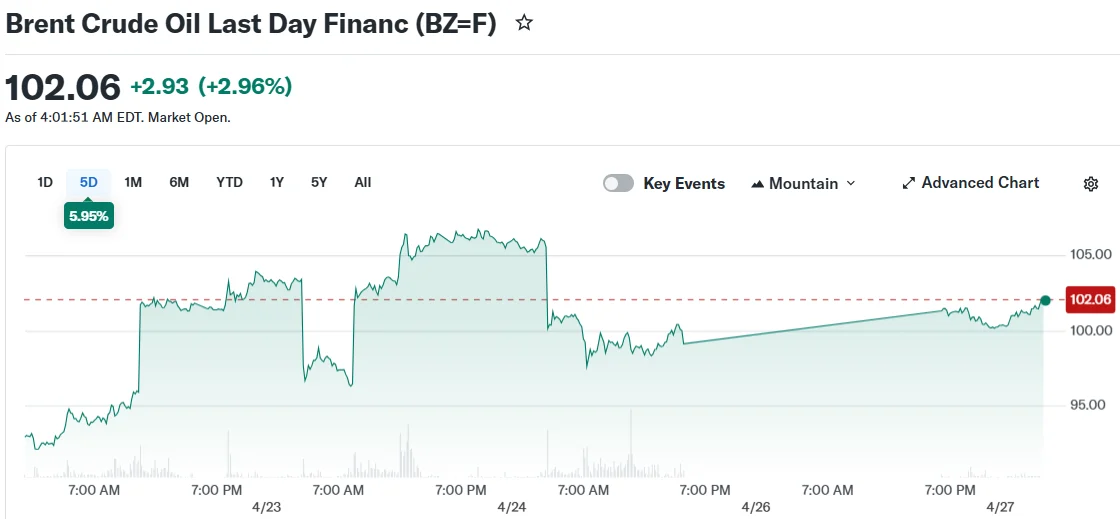
The bank assigns a 50% likelihood to its primary forecast scenario. This baseline projection anticipates the Strait will start reopening by late May, representing a one-month delay compared to Citi’s earlier expectations.
Citi’s research team believes Iran’s leadership possesses both economic and geopolitical motivations to maintain the effective closure of the strategic waterway. According to their analysis, this strategy would constrict worldwide petroleum availability, accelerate reserve depletion, and drive prices upward.
The bank calculates that approximately 500 million barrels in cumulative output have vanished since fighting began. Should the chokepoint remain blocked through May, Citi forecasts aggregate losses could balloon to 1.3 billion barrels.

Goldman Sachs Elevates Price Projections
Goldman Sachs likewise upgraded its oil price forecast on April 27. The investment bank currently anticipates Brent will average $90 per barrel during Q4 2026, up from its prior $80 estimate. Goldman notes this projection stands nearly $30 above pre-crisis levels—what their analysts characterize as the “Hormuz shock.”
Goldman calculates that production losses of 14.5 million barrels daily from Persian Gulf operations are causing worldwide reserves to decline at an unprecedented rate of 11 to 12 million barrels per day throughout April. The firm anticipates a shortfall of 9.6 million barrels daily this quarter. Goldman’s updated forecast places Brent at $100 for the current quarter and $93 for Q3.
Morgan Stanley Maintains Current Outlook
Morgan Stanley has elected to keep its forecasts unaltered. The institution projects Brent will average $110 during the present quarter, $100 in Q3, and $90 in Q4. Morgan Stanley’s calculations suggest Gulf petroleum shipments have plummeted by 14.2 million barrels per day because of the closure.
According to the bank, worldwide inventories have declined by an estimated 4.8 million barrels daily, though reduced consumption accounts for a portion of this discrepancy.
Citigroup’s optimistic scenario, assigned a 30% probability, envisions Brent climbing to $150 per barrel should disruptions persist through June’s conclusion. An extreme bullish case involving damage to critical infrastructure could propel prices to a sustained range of $160–$180 per barrel.
Under Citi’s base case projection, global petroleum stockpiles are expected to fall to their lowest point in more than a decade by the conclusion of July.
Get 3 Free Stock Ebooks
Discover top-performing stocks in AI, Crypto, and Technology with expert analysis.
- Top 10 AI Stocks - Leading AI companies
- Top 10 Crypto Stocks - Blockchain leaders
- Top 10 Tech Stocks - Tech giants


