


TLDR
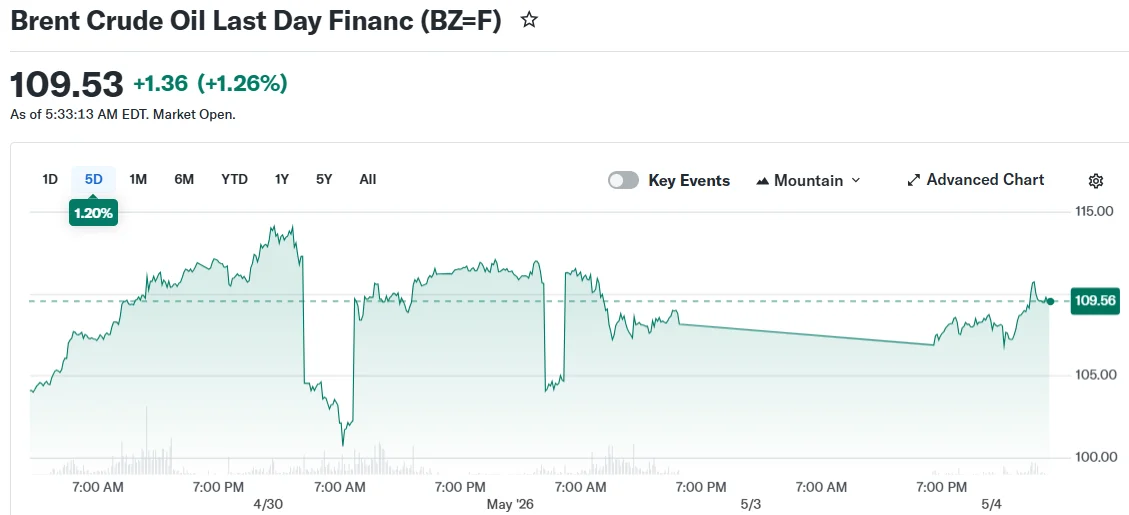
- Brent crude maintained levels above $108 per barrel following a brief 2.4% decline at Monday’s market opening
- White House unveiled initiative to assist commercial vessels stranded in the Strait of Hormuz
- Current strategy excludes direct Navy warship convoy operations for merchant vessels
- Projectiles struck a tanker approximately 78 nautical miles north of Fujairah over the weekend
- Trading community expressed substantial doubt regarding the plan’s ability to effectively reopen shipping lanes
Oil prices maintained stability throughout Monday trading despite initial weakness, as market participants evaluated Washington’s latest proposal to assist vessels trapped in the Strait of Hormuz.
Brent crude traded with minimal movement above the $108 per barrel threshold after experiencing an initial decline of up to 2.4% during opening hours. West Texas Intermediate remained anchored near the $102 per barrel mark.
Through social media channels, President Donald Trump declared that the United States would commence operations to assist neutral merchant ships in departing the strait beginning Monday. “We will use best efforts to get their Ships and Crews safely out of the Strait,” his statement read.
US Central Command verified its commitment to deploy military assets, including guided-missile destroyers, aviation units, and unmanned aerial systems. Nevertheless, the Wall Street Journal disclosed that the current framework excludes Navy warships providing direct physical escort services.
The declaration proved insufficient to sustain upward price momentum. Market experts and trading professionals immediately raised concerns about the strategy’s practical effectiveness.
“The market does not seem convinced by the plan,” analysts at ING said. “Even if this allows vessels to leave the Persian Gulf, we’re likely to see little inbound traffic.”
Haris Khurshid, chief investment officer at Karobaar Capital, said markets have grown tired of Trump’s statements on the conflict. “Trump fatigue is setting in more and more — I don’t think the market’s really taking it seriously,” he said.
Tanker Hit as Tensions Stay High
A commercial tanker sustained impacts from projectile strikes on Sunday, positioned 78 nautical miles north of Fujairah within United Arab Emirates waters. The UK Maritime Trade Operations documented the incident. While the vessel’s identity remains undisclosed, reports indicate all crew members remained unharmed.

Trump also raised the possibility of using force if Iran tried to block ships from leaving. He said US representatives were having “very positive” talks with Tehran but gave no further details.
Iran dismissed the American proposal outright. According to Al Mayadeen, Ebrahim Azizi, chairman of Iran’s parliament’s National Security Commission, stated that any U.S. intervention in the waterway would constitute a ceasefire violation.
Hostilities erupted in late February following coordinated American and Israeli military operations against Iran, justified by nuclear program concerns. Subsequently, a dual blockade emerged, with Tehran preventing vessel departures from the Persian Gulf while Washington intercepts ships traveling to or from Iranian harbors.
Supply Pressures Mount
Treasury Secretary Scott Bessent indicated over the weekend that Iranian oil well shutdowns could commence “in the next week” as the nation’s storage capacity reaches maximum levels.
ANZ Group analysts said supply losses are growing each day the strait stays closed. “With the demand response muted, a significant drawdown in inventories has ensued,” they wrote.
Crude oil has reached its highest valuation since 2022 in recent weeks due to ongoing regional conflict.
OPEC+ reached consensus over the weekend on a modest symbolic quota increase for June production levels, as the organization aimed to demonstrate stability following the United Arab Emirates’ departure from the alliance.
Get 3 Free Stock Ebooks
Discover top-performing stocks in AI, Crypto, and Technology with expert analysis.
- Top 10 AI Stocks - Leading AI companies
- Top 10 Crypto Stocks - Blockchain leaders
- Top 10 Tech Stocks - Tech giants


