


Key Highlights
- Senate Banking Committee published the complete Clarity Act text Monday evening before Wednesday’s committee markup session.
- Legislation features limitations on stablecoin interest payments and safeguards for decentralized finance creators.
- Traditional banking institutions seek stricter controls on stablecoins, citing concerns about deposit migration from conventional banks.
- Ethics provisions addressing cryptocurrency profits by public officials remain absent from current draft — Democrats demand inclusion.
- Prediction markets suggest 64% probability of presidential approval for the Clarity Act in 2025.
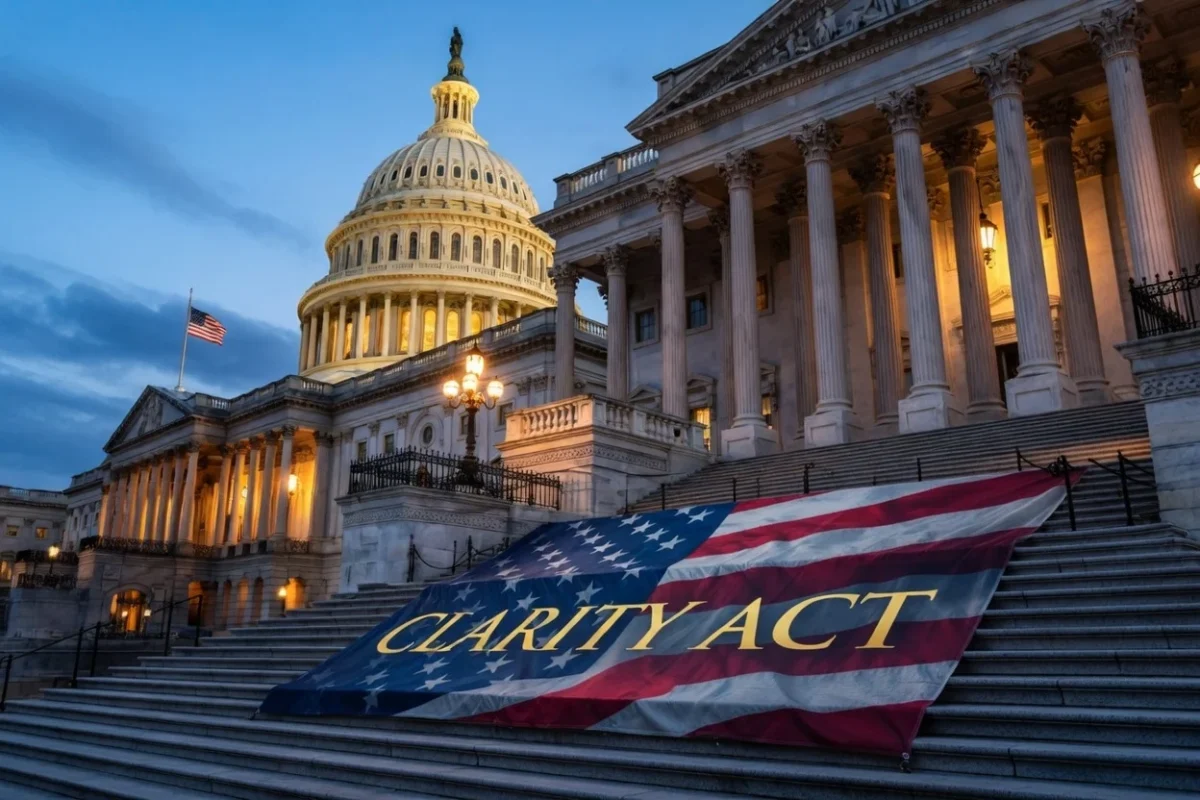
Late Monday evening, the Senate Banking Committee made public the entire Clarity Act text, mere hours ahead of Wednesday’s scheduled markup session on May 14. This legislation represents among the most comprehensive efforts to establish formal regulatory oversight for the digital asset sector in America.
Banking Committee Chair Tim Scott declared the legislation “prioritizes consumer protection, fights financial crime, targets bad actors and hostile nations, and ensures America remains the global leader in financial innovation.”
The 309-page legislative text wasn’t entirely unexpected, as drafts had been shared privately among industry stakeholders. Throughout Monday night, advocacy organizations examined the language to verify their key objectives were reflected in the final version.
The proposed legislation addresses three primary domains: regulations governing stablecoin yields, legal frameworks for DeFi developers, and enhanced enforcement capabilities for authorities investigating cryptocurrency-based financial crimes.
Banking Sector and Crypto Industry Clash Over Stablecoin Interest
Among the most controversial elements involves stablecoin compensation structures. The present draft prohibits digital asset companies from offering interest on dormant stablecoin holdings. Only performance-based incentives receive approval.
Coinbase Chief Executive Brian Armstrong stated Monday that “stakeholders achieved their essential requirements, though compromises were necessary.” He revealed Coinbase is collaborating with no fewer than five major international banking institutions on cryptocurrency service integration.
Traditional banking representatives express dissatisfaction. American Bankers Association Chief Executive Rob Nichols distributed correspondence to banking leaders encouraging contact with senators ahead of the voting session.
Nichols cautioned that existing provisions would “create unnecessary incentives for bank deposits to migrate toward payment stablecoins, threatening both economic expansion and systemic financial stability.”

Banking industry coalitions submitted additional correspondence to Banking Committee members requesting more stringent limitations on stablecoin reward programs.
Analysis from Galaxy countered these apprehensions, contending that stablecoin expansion will predominantly originate from international capital entering American banking systems, rather than domestic deposit transfers.
Conflict-of-Interest Language Creates Legislative Hurdle
The current bill excludes conflict-of-interest language that would restrict government personnel from benefiting financially from cryptocurrency holdings. This provision exists beyond the banking committee’s authority and requires subsequent addition.
Democratic lawmakers have established the ethics amendment as mandatory for their backing. Senator Elizabeth Warren characterized the bill as accelerating “Donald Trump’s cryptocurrency conflicts,” referencing approximately $1.4 billion in digital asset profits accumulated by the president and relatives since assuming office.
Presidential crypto advisor Patrick Witt indicated the administration endorses regulations applicable to all government employees, while opposing measures that target particular officeholders.
Senate Republicans anticipate advancing the measure on party-line support during Wednesday’s markup proceedings. Subsequently, reconciliation with the Senate Agriculture Committee’s parallel version becomes necessary before full chamber consideration.
Sixty affirmative votes are required for Senate passage, necessitating some Democratic cooperation. The administration aims for Independence Day completion. Senator Kirsten Gillibrand forecasted passage by early August.
Polymarket currently indicates 64% likelihood of presidential signature on the Clarity Act during the current year.
Get 3 Free Stock Ebooks
Discover top-performing stocks in AI, Crypto, and Technology with expert analysis.
- Top 10 AI Stocks - Leading AI companies
- Top 10 Crypto Stocks - Blockchain leaders
- Top 10 Tech Stocks - Tech giants


