



Key Highlights
- The SUI token rallied approximately 40% over a seven-day period, climbing from a monthly bottom of $0.8866 to peak at $1.41 on May 11.
- A significant institutional move saw SUI Group Holdings shift 108.7 million SUI tokens into direct staking, effectively locking up around 2.7% of the circulating supply.
- CME Group announced SUI futures contracts launching May 29, providing institutional players with regulated derivative exposure.
- Legendary trader Peter Brandt published a chart analysis calling $0.95 a significant bottom, hinting at further upside potential.
- Open interest surpassed $708 million, though a minor pullback on May 11 indicates some profit-taking activity among traders.
The SUI token delivered an impressive performance over the past week. From its monthly floor of $0.8866, the asset surged to $1.41 on May 11, marking a nearly 40% increase across seven days. Daily trading volume expanded by roughly 20% within a 24-hour window, reaching $2.21 billion.
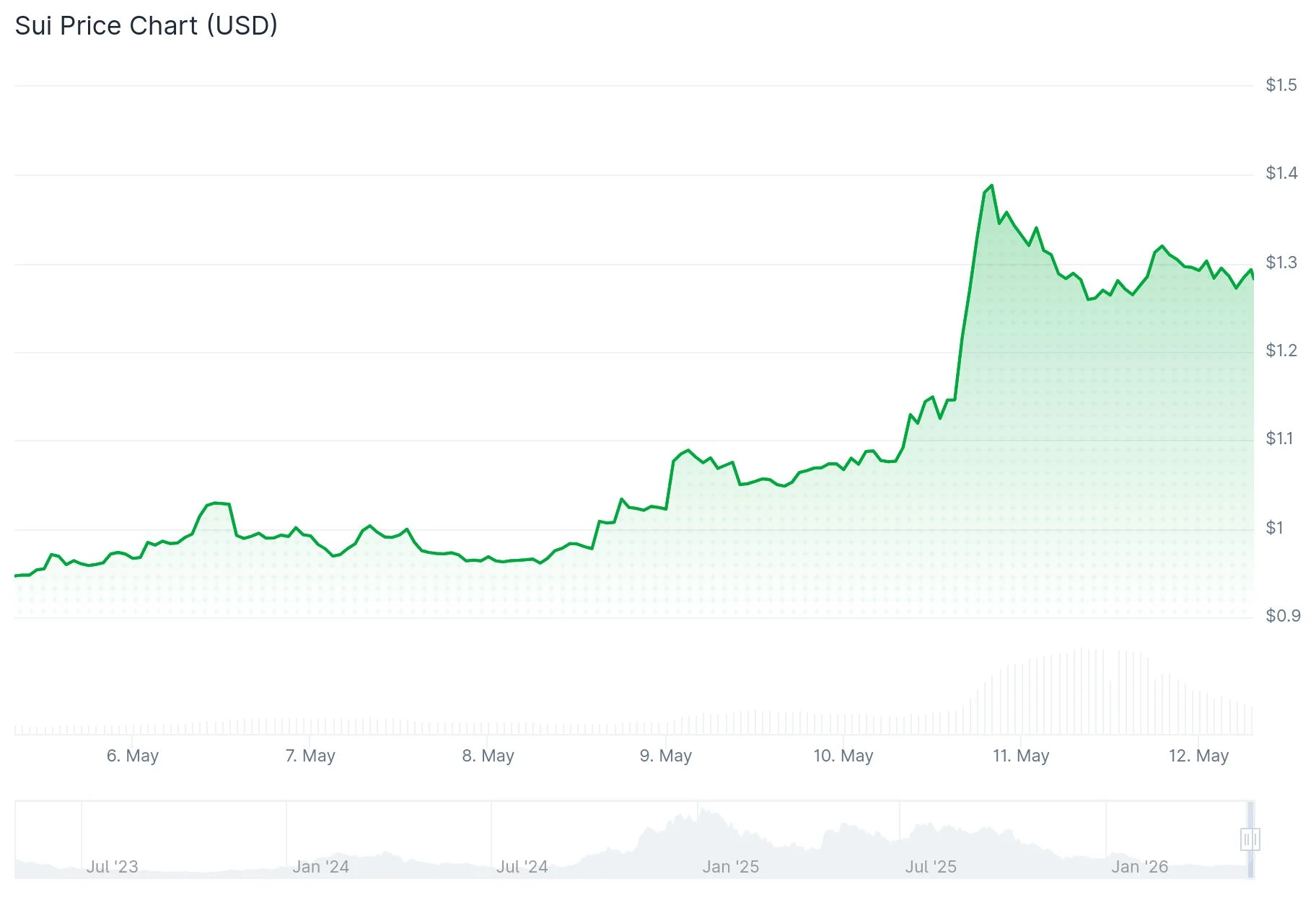
This price movement caught the eye of blockchain analytics platform Santiment, which attributed the rally to a substantial institutional staking operation. On May 10, SUI Group Holdings executed a complete withdrawal of its 108.7 million SUI treasury from DeFi protocols, reallocating the entire position into direct staking mechanisms.
This strategic shift effectively withdrew approximately 2.7% of SUI’s circulating supply from the trading market. Given that roughly 74% of the total token supply was already staked prior to this action, the additional commitment further constrained available market liquidity.
Santiment emphasized that this rally displays characteristics distinct from typical retail-fueled price spikes. The analytics platform identified growing institutional conviction rather than social media hype as the primary force behind the upward momentum.
CME Derivatives Launch and Growing Institutional Adoption
A major development on the horizon is the May 29 launch of SUI futures contracts by CME Group. According to CME’s announcement, both Avalanche and SUI futures became available for trading on May 6, with initial block trades executed between FalconX and G-20 Group.

Institutional market participants typically interpret CME listings as validation of an asset’s credibility and market maturity. The introduction of this futures product is anticipated to enhance market liquidity while offering larger investors a compliant platform for gaining exposure and implementing hedging strategies.
Trading veteran Peter Brandt contributed to the bullish narrative by publishing a SUI price analysis on X. He identified the $0.95 level as a critical bottom formation and indicated the token could advance “substantially higher” from its current valuation. Brandt’s chart analysis highlighted a clear breakout pattern, and his commentary attracted significant attention from market participants seeking directional guidance.
Chart Analysis and Strategic Partnership Developments
From a technical perspective, SUI successfully escaped a three-month consolidation pattern that had restricted price action below the $1.05 threshold throughout April and early May. This $1.05 level has now transformed into a support zone.
Immediate support currently rests near the $1.20 mark, while resistance is positioned around $1.35. A confirmed daily close above $1.35 could establish $1.50 as the next upside objective. Data from CoinGlass revealed open interest exceeding $708 million, accompanied by 24-hour futures volume surpassing $2.5 billion.
Additional momentum came from a strategic alliance with Paga Group, a prominent Nigerian fintech company that processed more than $11 billion in payments and facilitated 169 million transactions throughout 2025. Paga announced plans to integrate Sui Dollar (USDsui) and adopt Sui as its primary blockchain infrastructure across both enterprise solutions and consumer-facing products.
Notably, open interest experienced approximately a 2.5% decline on May 11, dropping below $1 billion. This reduction suggests that some market participants opted to realize gains following the sharp price appreciation.
Get 3 Free Stock Ebooks
Discover top-performing stocks in AI, Crypto, and Technology with expert analysis.
- Top 10 AI Stocks - Leading AI companies
- Top 10 Crypto Stocks - Blockchain leaders
- Top 10 Tech Stocks - Tech giants


