


Key Highlights
- SOL surged approximately 5% in a single session, reaching the $90 threshold with a 10% weekly increase
- Alpenglow network upgrade may roll out next quarter, focusing on enhanced transaction confirmation speeds
- Derivatives open interest jumped 10% to reach $5.55 billion; options trading volume exploded by 194%
- Short sellers faced over $16 million in liquidations within 24 hours
- Critical resistance zone identified at $90–$92; primary support established at $85
Solana (SOL) emerged as one of the standout performers among alternative cryptocurrencies this week, approaching the $90 price point with a roughly 5% single-session gain. This upward movement coincides with renewed strength across the broader digital asset market, where Bitcoin maintains levels above $81,000 and Ethereum trades near $2,300.
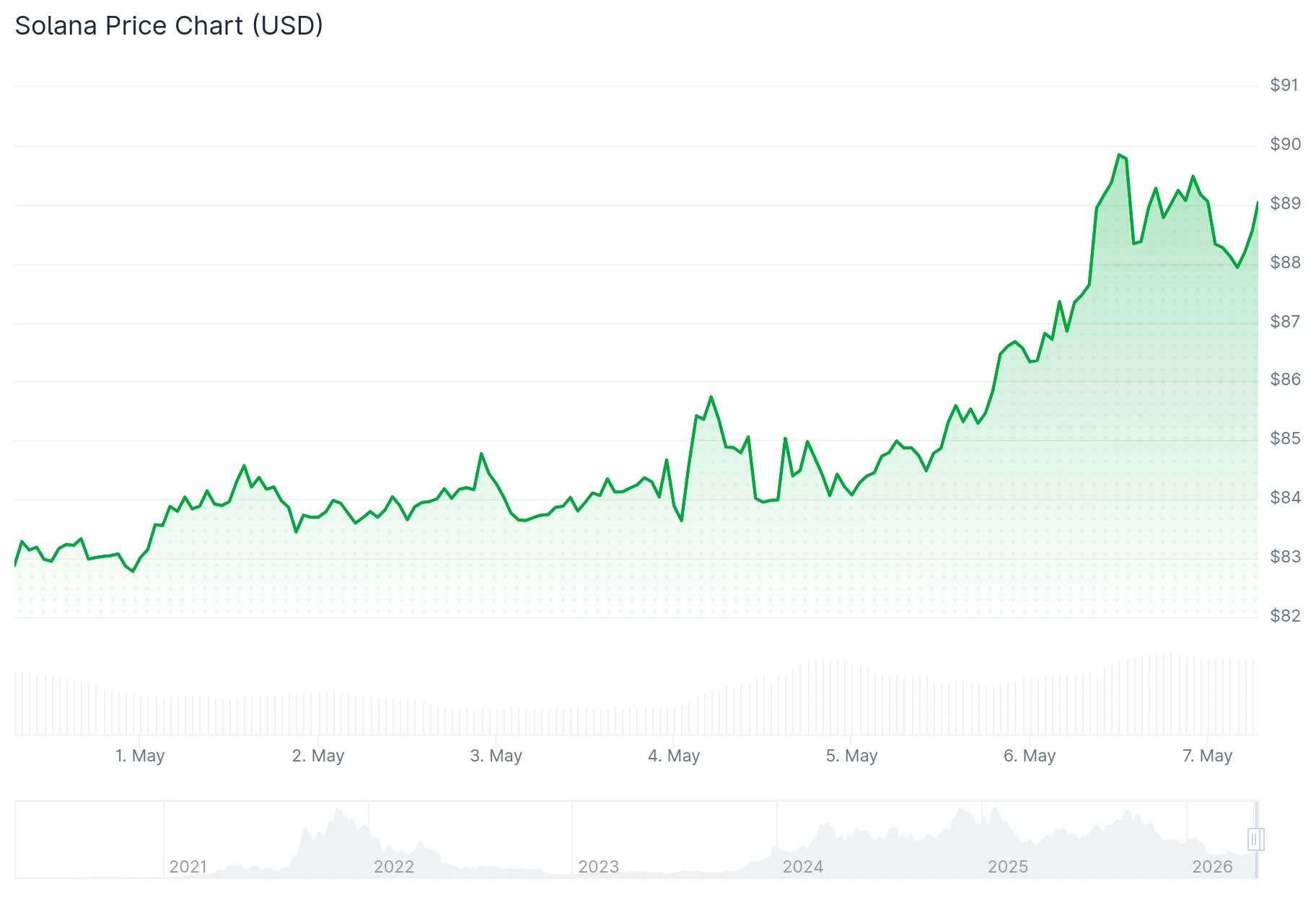
SOL’s trading volume experienced a substantial 30% increase, reaching approximately $6 billion during the session that challenged the $90 resistance. This volume represents more than 11% of the token’s circulating market capitalization, signaling robust accumulation at this price level.
Market analyst Ali Charts shared observations on social media indicating that SOL is “in the middle of a bullish breakout.” Meanwhile, Rand Group highlighted that the token appeared to be breaking through a yearly downtrend resistance level — a technical barrier that market participants had been monitoring for several months.
Derivatives market activity showed significant expansion, with open interest across exchanges rising 10% to $5.55 billion. The options segment witnessed the most dramatic movement, skyrocketing 194% to $17.72 million. Overall trading volume reached $12.92 billion, representing a 78.75% session-over-session increase.
Massive Short Liquidation Wave
The cryptocurrency derivatives market saw over $400 million in short position liquidations throughout a 24-hour period. Solana alone accounted for $16 million of these forced closures, marking the largest single-day short liquidation event for the asset since April 15, when prices similarly tested the $90 level.

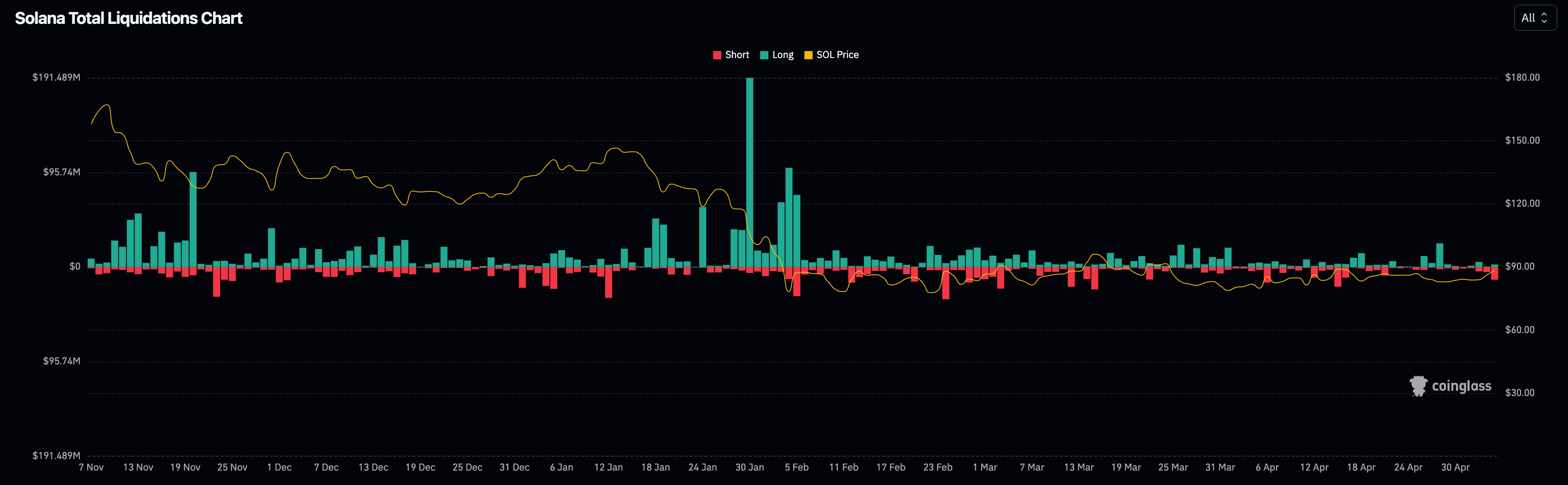
Notably, Bitcoin comprised less than half of the total liquidation volume. This distribution suggests that alternative cryptocurrencies are gaining more traction and participating more actively in the current market upswing.
Year-to-date performance shows SOL up 6.5%, trailing Bitcoin’s 17% gain and Ethereum’s 10% advance. This performance differential reflects investor hesitation during a period marked by macroeconomic volatility and geopolitical tensions. The Crypto Fear and Greed Index currently registers at 52, indicating neutral market sentiment.
Alpenglow Network Enhancement Approaches
Solana co-founder Anatoly Yakovenko discussed the forthcoming Alpenglow upgrade during his appearance at Consensus Miami 2026. He outlined that this enhancement specifically aims to achieve faster and more reliable transaction confirmations, minimizing delays and reducing uncertainty for network users.
Yakovenko indicated the upgrade could potentially deploy as soon as the following quarter if development maintains its current pace, with a definitive deadline set before year-end. The primary objective is to align confirmation times more closely with actual data transmission capabilities.
Chinese cryptocurrency news platform Wu Blockchain provided additional coverage of the announcement, emphasizing that Alpenglow is engineered to accommodate time-critical applications through enhanced timing accuracy while maintaining Solana’s existing high-throughput infrastructure.
From a technical analysis perspective, the 4-hour chart RSI climbed to 71, reflecting strong bullish momentum. The MACD indicator also displayed a bullish crossover signal. Near-term resistance is positioned at $92, with subsequent targets at $96 and $100. Downside support remains firm at $85.
On-chain metrics show network fees staying relatively subdued, with Solana decentralized applications generating approximately $15 million in fees last week, a significant decline from the $410 million recorded in January 2025.
Get 3 Free Stock Ebooks
Discover top-performing stocks in AI, Crypto, and Technology with expert analysis.
- Top 10 AI Stocks - Leading AI companies
- Top 10 Crypto Stocks - Blockchain leaders
- Top 10 Tech Stocks - Tech giants


