



Key Takeaways
- Stock futures declined Monday following Iranian media claims of missile strikes targeting a US naval vessel near the Strait of Hormuz
- US military officials quickly refuted the Iranian reports, helping to stabilize markets after initial volatility
- Energy markets responded with oil prices climbing more than 3%, pushing Brent crude near $112 per barrel
- President Trump unveiled “Project Freedom” to provide naval escorts for commercial shipping; Iran issued counter-threats
- Friday’s April employment report is anticipated to show a significant slowdown with just 60,000 jobs added
Equity futures pulled back during Monday’s pre-market session after Iranian state-controlled media outlets claimed that missiles had successfully hit a US naval vessel operating near the strategically vital Strait of Hormuz. The allegations sparked immediate market concern before American officials issued denials.
Contracts linked to the Dow Jones Industrial Average declined approximately 204 points, representing a 0.4% decrease. Futures tracking the S&P 500 retreated 0.2%, while Nasdaq 100 futures edged down 0.1%.
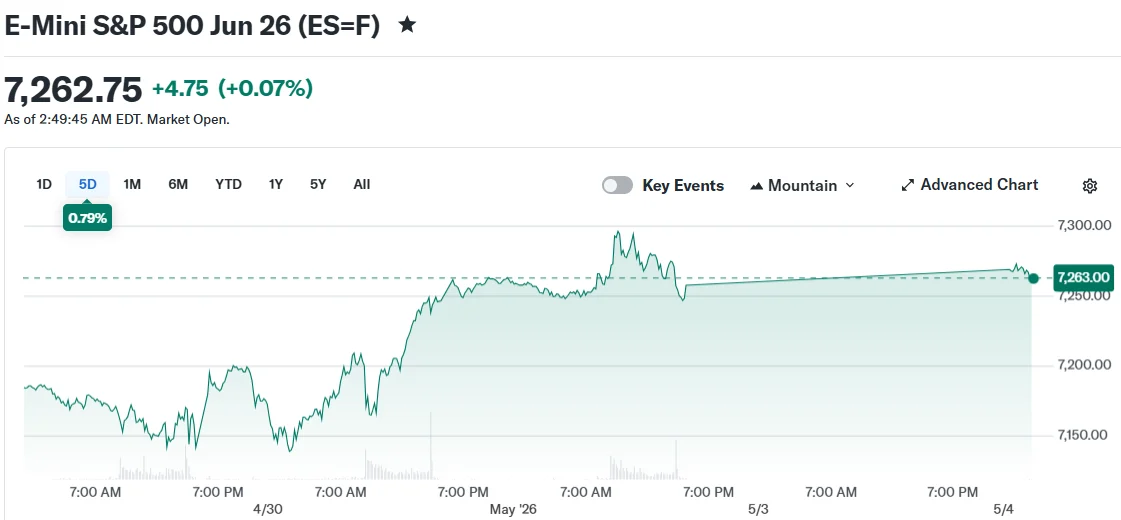
Both the S&P 500 and Nasdaq had achieved fresh all-time highs during Friday’s session, concluding their strongest five-week performance period since May 2020. However, that bullish trajectory encountered resistance Monday amid escalating geopolitical developments.
According to Iran’s Fars News Agency, two missiles successfully struck a US frigate that allegedly disregarded warnings against entering the Strait of Hormuz. US Central Command responded via social media platform X, categorically stating that no naval vessels had sustained any damage.
The Pentagon’s swift rebuttal provided some market reassurance, though heightened uncertainty persisted. Market participants rotated toward traditional safe-haven investments, driving the US dollar index up 0.3% relative to major global currencies.

Yields on benchmark 10-year Treasury notes climbed 4 basis points to reach 4.41%, reflecting investor preference for lower-risk asset classes during periods of geopolitical instability.
Energy Markets Surge on Distribution Concerns
Oil markets demonstrated pronounced sensitivity to the developing situation. Brent crude futures surged 3.4% to reach $111.80 per barrel, while West Texas Intermediate advanced 3.5% to $105.35 per barrel during early morning trade.
The Strait of Hormuz represents a critical chokepoint in global energy distribution networks. Approximately one-fifth of worldwide petroleum consumption transits through this narrow waterway, making any potential military confrontation there an immediate threat to international energy security.
“Project Freedom” Initiative Escalates Regional Tensions
During weekend remarks, President Trump announced that American forces would commence escort operations for commercial vessels currently stranded in the contested waterway. The administration branded this initiative “Project Freedom.”
Trump issued a stern warning through social media channels that any attempts to obstruct these operations would face “forceful” responses. Iranian authorities countered with their own threats against US naval assets operating in regional waters.
The escalating rhetoric between Washington and Tehran elevated the probability of direct military engagement and sustained market nervousness throughout the trading day’s opening hours.
On the corporate front, quarterly earnings announcements continue this week. Investors await financial results from semiconductor sector participants including Lattice Semiconductor, Advanced Micro Devices, and Arm Holdings.
Palantir and Paramount Skydance are additionally scheduled to release earnings reports in the coming days.
The April employment situation report arrives Friday. Analyst consensus projects a modest 60,000 job additions, representing a substantial deceleration from March’s 178,000 figure. The unemployment rate is forecast to remain steady at 4.3%.
US Central Command’s rapid dismissal of Iran’s strike allegations proved instrumental in preventing more severe futures declines during Monday’s early trading activity.
Get 3 Free Stock Ebooks
Discover top-performing stocks in AI, Crypto, and Technology with expert analysis.
- Top 10 AI Stocks - Leading AI companies
- Top 10 Crypto Stocks - Blockchain leaders
- Top 10 Tech Stocks - Tech giants


