



Key Takeaways
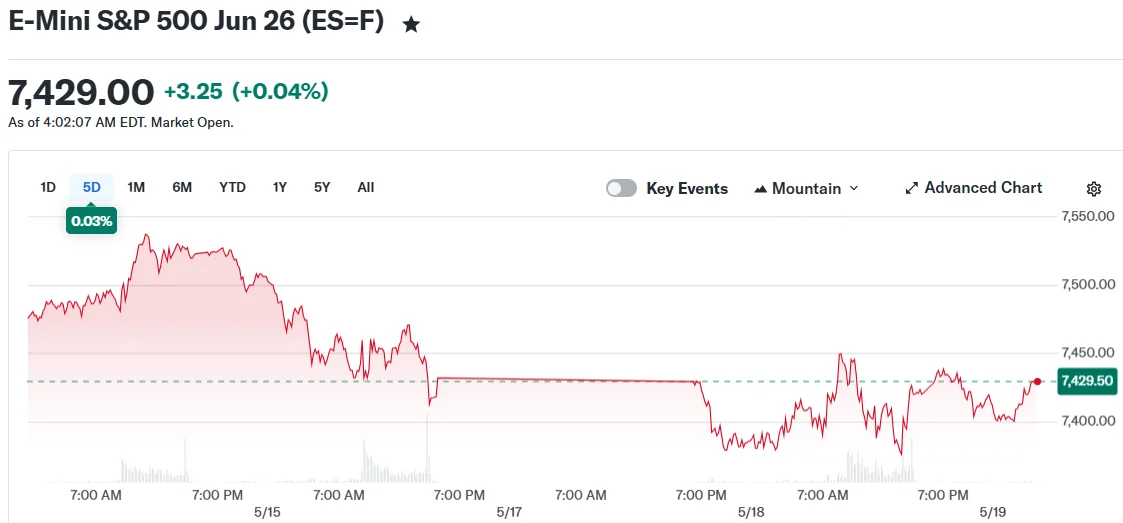
- Nasdaq 100 futures declined approximately 0.8% during Tuesday’s pre-market session, while S&P 500 futures retreated 0.4% and Dow futures edged down 0.2%
- Treasury yields pushed higher with the 10-year note surpassing 4.6%, intensifying headwinds for technology and growth-oriented equities
- Crude prices retreated following President Trump’s announcement of halting military action against Iran while pursuing diplomatic solutions
- Wednesday’s Nvidia earnings report represents a critical moment for artificial intelligence investments and overall market sentiment
- A recent Bank of America survey identified global semiconductor stocks as the market’s most overcrowded position
Equity futures traded lower during Tuesday’s early hours, building on Monday’s negative momentum. Technology shares spearheaded the downturn, with Nasdaq 100 contracts falling roughly 0.8%. Futures tied to the S&P 500 decreased 0.4%, while Dow-linked contracts dipped 0.2%.
Bond markets saw yields advance, with the benchmark 10-year Treasury note pushing beyond the 4.6% threshold once again. This dynamic creates challenging conditions for equity markets, as elevated borrowing costs typically diminish investor enthusiasm for high-growth companies, especially within the technology arena.
Inflation anxieties continue fueling the yield surge. Supply chain disruptions at the Strait of Hormuz have contributed to crude price increases in recent trading sessions, stoking worries about persistent price pressures and potential Federal Reserve policy responses.
Market participants remain divided on the central bank’s trajectory. Any move toward tightening would present significant obstacles for artificial intelligence and growth-focused equities, which derive much of their valuation from projected future profitability.
Middle East Tensions Show Signs of Easing
During Monday remarks, President Trump revealed that “serious negotiations” are progressing with Iranian officials, expressing optimism about reaching an agreement on nuclear program limitations. He confirmed postponing planned military operations against Iran following appeals from Gulf state partners.
This development triggered a pullback in oil prices. Brent crude contracts decreased 1.4% to settle at $110.43 per barrel, while West Texas Intermediate fell 0.7% to $103.67. Despite these declines, both benchmarks continue trading more than 50% above pre-conflict levels.

Treasury markets also responded favorably to the diplomatic news. Two-year yields declined 1.8 basis points to 4.071%, while the 10-year note yield retreated 1.4 basis points to 4.608%.
Research analysts at ING observed that crude markets “remain extremely sensitive to Iran-related headlines” and continue experiencing substantial volatility.
Digital assets including Bitcoin posted modest gains as energy prices and government bond yields moderated, according to preliminary trading data.
Nvidia Results Take Center Stage Wednesday
Nvidia will release quarterly earnings Wednesday in what represents the most anticipated event of the trading week. Market participants anticipate impressive financial performance, though the chipmaker faces elevated expectations following previous outstanding results.
Given that competing semiconductor manufacturers have already disclosed their quarterly figures, Nvidia’s numbers could establish the trajectory for AI-related investments heading into summer months. According to a Bank of America fund manager poll, global semiconductor exposure currently ranks as the market’s most concentrated bet.
Approximately half of surveyed fund managers in the BofA study still anticipate Federal Reserve rate reductions over the coming year. Portfolio managers are increasingly shifting capital toward commodities, utility companies, and emerging market assets amid growing technology sector uncertainty.
The dollar index registered a 0.1% decline versus major trading partners’ currencies. Investor caution prevails ahead of Wednesday’s highly-watched earnings announcement.
Get 3 Free Stock Ebooks
Discover top-performing stocks in AI, Crypto, and Technology with expert analysis.
- Top 10 AI Stocks - Leading AI companies
- Top 10 Crypto Stocks - Blockchain leaders
- Top 10 Tech Stocks - Tech giants


