



Key Takeaways
- BitMEX co-founder Arthur Hayes forecasts Bitcoin reaching $126,000 before year-end
- The prediction centers on artificial intelligence infrastructure investment, US-Iran military engagement, and worldwide monetary expansion
- According to Hayes, Bitcoin established its floor at $60,000 during the first quarter and has since outpaced gold returns
- The $90,000 threshold represents a critical breakout point where momentum could intensify dramatically
- Maelstrom fund is adopting a “maximum risk” stance with positions in HYPE, ZEC, and NEAR
On May 12, Arthur Hayes—BitMEX co-founder and chief investment officer at Maelstrom—released an extensive analysis declaring that Bitcoin’s bullish phase has already commenced.
In his essay titled “The Butterfly Touch,” Hayes outlined how three converging dynamics—artificial intelligence infrastructure buildout, the US-Iran military confrontation, and a worldwide pivot away from dollar-denominated holdings—are compelling governments toward expansionary monetary policies and increased currency creation.
“The bullish cycle commenced in full force when the United States launched strikes against Iran on February 28th,” Hayes stated.
Over the last seven days, Bitcoin has fluctuated between $79,467 and $82,496, per CoinGecko data. As of Wednesday, it hovered around $81,000, representing more than a 31% climb from its February 6 bottom of $62,822.
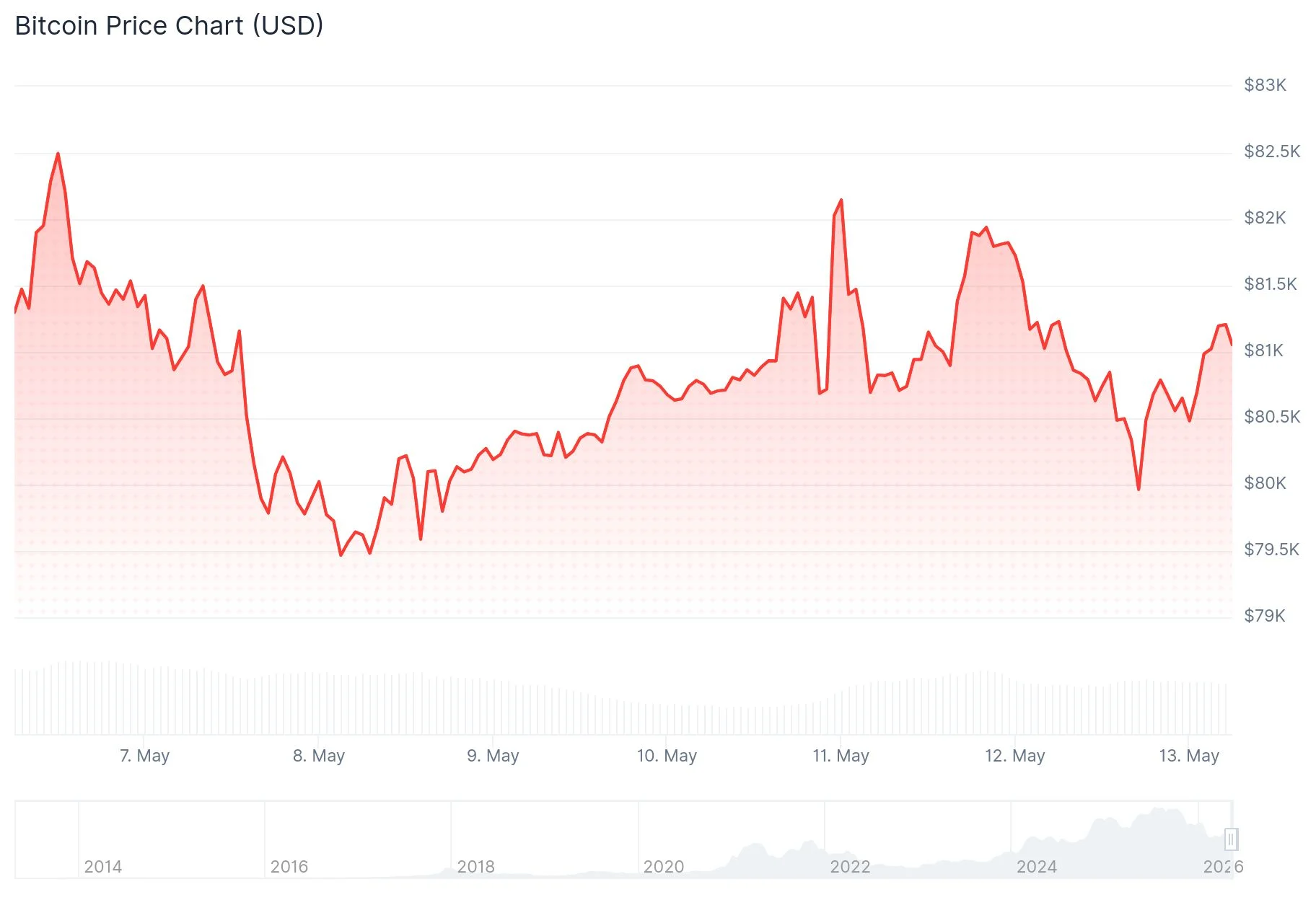
Hayes emphasizes that this recent strength relative to gold—which appreciated approximately 2% during the comparable timeframe—demonstrates Bitcoin’s heightened responsiveness to the evolving political landscape surrounding currency issuance.
Artificial Intelligence Competition Driving Currency Creation
Hayes positioned artificial intelligence as a matter of national security for both America and China. This dynamic, he contends, prevents either nation from implementing restrictive monetary policy while its rival aggressively funds AI development.

He noted that AI investment is penetrating the credit system, compelling financial institutions and central banks to facilitate expenditure on computing infrastructure, power generation, and processing capabilities. Hayes referenced the Jevons Paradox alongside the “Red Queen Effect” to support his thesis that AI capital deployment creates a self-perpetuating cycle—reduced costs for computational intelligence stimulate greater utilization, demanding additional investment.
“Tomorrow’s fiat currency supply will vastly exceed today’s, with the growth rate accelerating as annual AI and electrification capital expenditures rapidly expand,” Hayes explained.
$90,000 Identified as Critical Resistance Zone
Hayes maintains that Bitcoin established its cycle low at $60,000 earlier this year, designating $126,000 as his price objective and characterizing it as a “foregone conclusion.”
He highlighted $90,000 as a pivotal level where derivatives traders holding short call options may be compelled to cover their positions, potentially triggering accelerated upward momentum.
“I anticipate the rally will gain intensity and skeptics will retreat as Bitcoin’s ascent becomes parabolic following a decisive break above $90,000,” Hayes wrote.
He confirmed that Maelstrom will maintain its “maximum risk” positioning barring significant changes to underlying conditions.
Hayes further suggested that nations previously accumulating US Treasury securities may reallocate resources toward defense capabilities, energy independence, and tangible infrastructure—creating incentives for American policymakers to sustain accommodative financial conditions. He mentioned potential dollar swap facilities and eased banking capital requirements as probable mechanisms.
Hayes concluded by disclosing that Hyperliquid’s HYPE token and Zcash’s ZEC comprise substantial portfolio allocations, with NEAR Protocol designated as his next strategic entry point.
Get 3 Free Stock Ebooks
Discover top-performing stocks in AI, Crypto, and Technology with expert analysis.
- Top 10 AI Stocks - Leading AI companies
- Top 10 Crypto Stocks - Blockchain leaders
- Top 10 Tech Stocks - Tech giants


