



Key Highlights
- U.S. forces conducted targeted “defensive” operations in southern Iran, hitting missile installations and vessels deploying mines
- State Department chief Rubio indicated the Strait of Hormuz reopening may require “a few days” but assured it would occur “one way or another”
- Bitcoin tumbled beneath the $77,000 threshold as geopolitical tensions prompted investors to move capital into traditional safe havens including gold and the U.S. dollar
- American spot Bitcoin ETFs experienced net capital withdrawals following a period of robust institutional accumulation
- Alternative cryptocurrencies declined broadly on Tuesday, including Solana shedding 1.4%, Dogecoin dropping 1.3%, and XRP declining 0.7%
On Monday, American military forces executed operations against strategic locations in southern Iran. The targets included missile launching facilities and watercraft engaged in mine deployment activities, as confirmed by CENTCOM spokesperson Tim Hawkins.
Hawkins characterized these operations as “defensive measures” and emphasized they should not be interpreted as terminating the ceasefire arrangement with Iran. “U.S. Central Command remains committed to protecting our forces while exercising restraint throughout the current ceasefire period,” he stated.
Ebrahim Azizi, who chairs Iran’s parliament national security committee, issued warnings of potential retaliation. Whether Iran has launched any countermeasures remained uncertain at the time of reporting.
Marco Rubio, serving as Secretary of State, projected that an agreement to restore access through the Strait of Hormuz might require “a few days” for finalization, though he expressed confidence the crucial shipping lane would resume operations “one way or another.”
Weekend intelligence suggested Washington and Tehran were approaching consensus on a preliminary framework. The proposed arrangement would restore passage through the Strait while securing Iranian assurances regarding nuclear weapons development.

Bitcoin Retreats as Risk-Off Sentiment Takes Hold
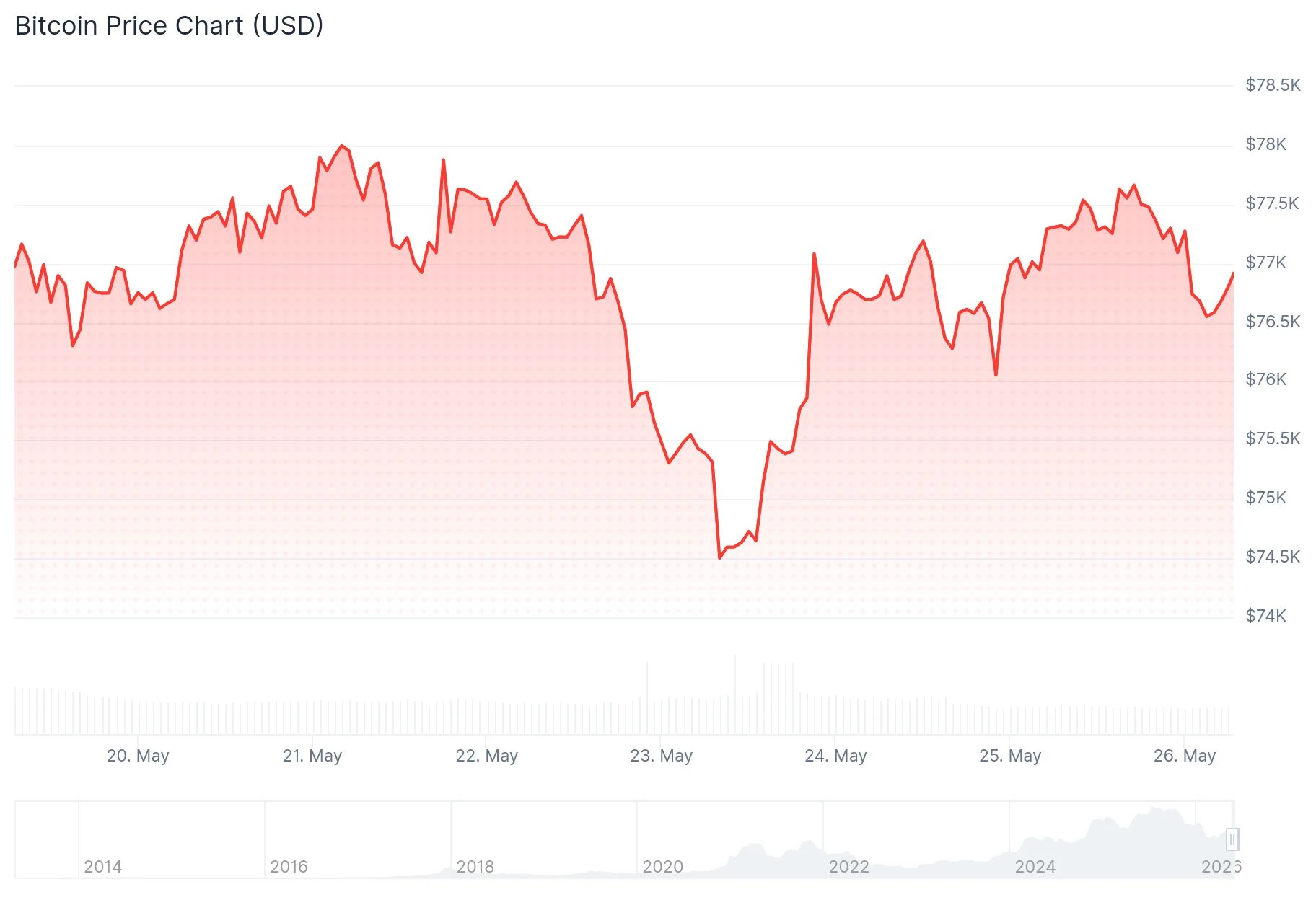
Bitcoin declined beneath the $77,000 level during Tuesday’s session, registering a 0.6% decrease to reach $76,946. The renewed military operations reignited market uncertainty, driving capital flows toward traditional safe-haven instruments such as the dollar and precious metals.
Crude oil valuations rebounded approximately 2% during Asian market hours, maintaining inflationary pressures as a central concern for investors.
The decline extends Bitcoin’s recent volatility pattern. Market participants have been adjusting positions dynamically in response to evolving developments surrounding potential U.S.-Iran diplomatic negotiations.
Bitcoin ETF inflows, which served as a primary catalyst for price appreciation throughout the year, demonstrated signs of weakening momentum. American spot Bitcoin ETFs registered net withdrawals after experiencing substantial institutional demand during the earlier portion of the quarter.
Market analysts highlighted elevated Treasury bond yields and ongoing inflation anxieties as contributing factors weighing on digital assets. Additionally, traders are moderating their expectations regarding imminent Federal Reserve interest rate reductions.
Alternative Cryptocurrencies Follow Downward Trajectory
The broader altcoin market experienced widespread declines on Tuesday. Ethereum retreated 0.3% to settle at $2,101. XRP registered a 0.7% decline to $1.35.
Solana experienced a 1.4% decrease while Cardano shed 0.7%. Dogecoin slipped 1.3% lower. Polygon stood as a notable outlier, advancing 1.4%.
Market participants are now directing attention toward Thursday’s release of personal consumption expenditures (PCE) figures, representing the Federal Reserve’s preferred inflation gauge. These results could materially influence rate cut projections and subsequently impact cryptocurrency valuations.
President Trump remarked Monday that Iran’s stockpile of enriched uranium would either be transferred to American custody or eliminated. He separately noted earlier in the day that diplomatic discussions with Iran were “proceeding nicely.”
The resolution of these negotiations continues to represent the primary variable commanding market attention.
Get 3 Free Stock Ebooks
Discover top-performing stocks in AI, Crypto, and Technology with expert analysis.
- Top 10 AI Stocks - Leading AI companies
- Top 10 Crypto Stocks - Blockchain leaders
- Top 10 Tech Stocks - Tech giants


