


Over the past week, Robbyant, Ant Group’s embodied AI arm, has executed a massive model release, unveiling a comprehensive suite of six embodied AI models.
This coordinated rollout marks a definitive shift in how the industry approaches autonomous robotics, representing a critical milestone in the transition toward scalable, real-world intelligence.
Take today’s debut of LingBot-VA 2.0, for example. Over the past two years, integrating world models with embodied AI has been a highly contested frontier.
Industry players have attempted to retrofit video generation models—originally designed for digital content creation—into robot control systems.
However, because digital video prioritizes visual aesthetics while robotics demands strict physical accuracy and execution efficiency, this forced adaptation frequently results in knowledge forgetting and poor generalization.
To address this challenge, LingBot-VA 2.0 is not merely a single model iteration; instead, it takes a fundamentally different approach.

By pre-training from scratch using an autoregressive architecture, the model is designed to inherently understand how an action will change the environment and to decide its next step based on causal prediction.
A Comprehensive Six-Model Stack
LingBot-VA 2.0 serves as the capstone of this launch week, completing a suite of six models that form a comprehensive full-stack for perception, world simulation, and action. Beyond VA 2.0, the series includes:
- LingBot-Depth 2.0: A spatial perception model trained on 150 million samples that tops 12 out of 16 depth completion benchmarks. It excels in handling mirrors, glass, and transparent objects, and has been certified for commercial use by Orbbec.
- LingBot-Vision: The visual foundation model powering LingBot-Depth 2.0, and the first in the industry to use boundary structure as a pre-training objective, trained on 160 million images.
- LingBot-VLA 2.0: A vision-language-action model pre-trained on 60,000 hours of real-world robot interaction data across 20 robot types. Covering single-arm, dual-arm, bipedal, and wheeled configurations, its commercial pilots are already underway.
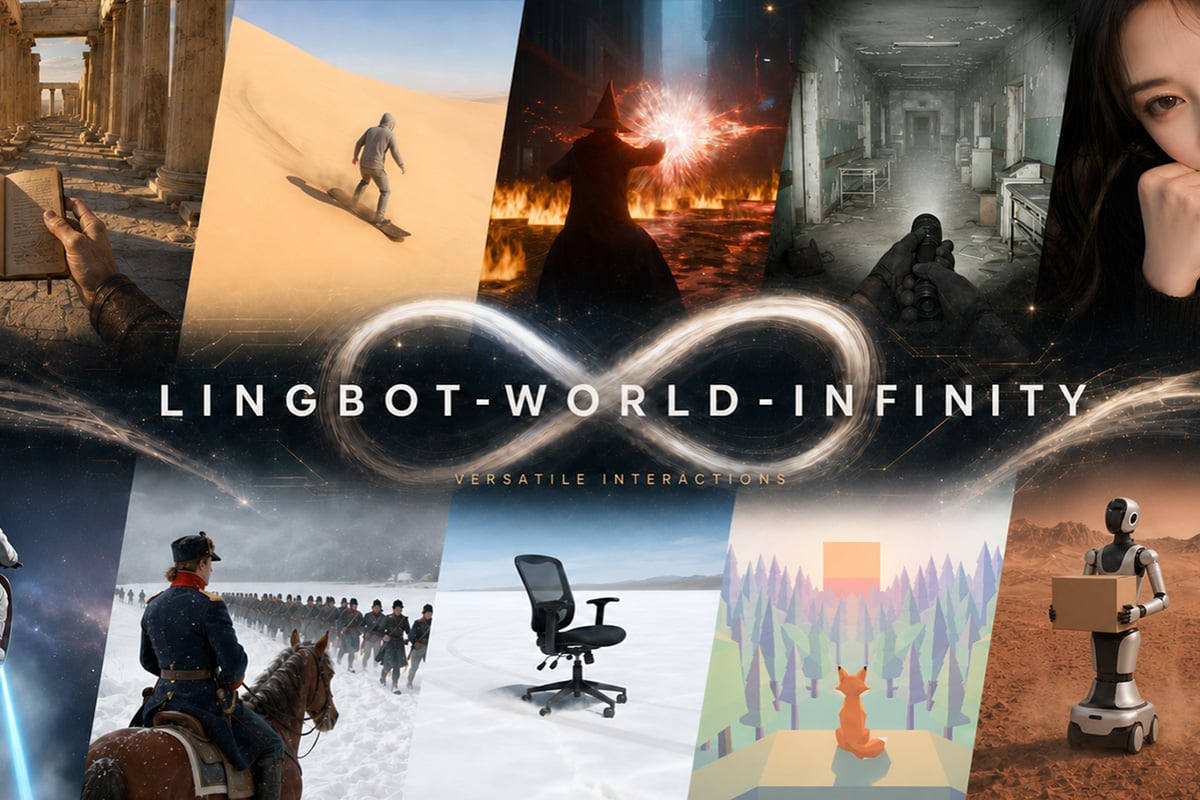
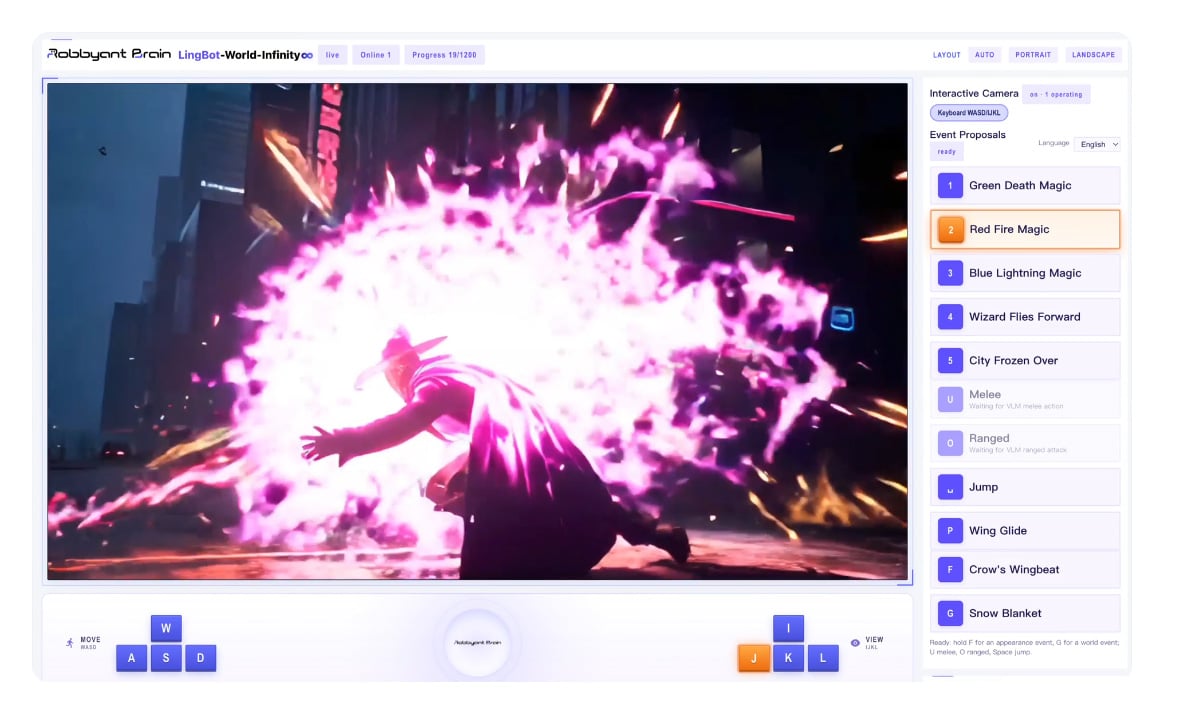
- LingBot-World 2.0: An interactive world model supporting up to 60 minutes of continuous generation at 720p/60fps with zero quality drift. It features a built-in dual-agent system for dynamic event triggering and supports multi-user exploration in persistent AI-generated environments.
- LingBot-Video: The first video generation model built on a Mixture-of-Experts (MoE) architecture designed specifically for embodied intelligence, targeting improvements in inference efficiency and physical plausibility to bridge the sim-to-real gap.
- Redefining the Universal Robot Brain
Together, these six models represent Robbyant’s ambitious vision to build a “universal brain” for robots, systematically addressing three foundational challenges: seeing more clearly, thinking more intelligently, and acting more efficiently.
To achieve clearer vision, Robbyant is establishing native spatial intelligence directly from sensors through LingBot-Vision and LingBot-Depth 2.0. To enable smarter thinking, the company is redefining model architectures and training paradigms. LingBot-Video balances massive scale with fast inference via MoE, while LingBot-World 2.0 uses causal pre-training to ensure strict physical logic. LingBot-VA 2.0 acts as the ultimate synthesis of these technologies. Finally, to ensure efficient action, LingBot-VLA 2.0 leverages native physical data to drive real-world execution.
Just as digital world models thrived on internet-scale data, Robbyant is actively catalyzing industry-wide collaboration to build the robust physical datasets required for the next leap in AI.
Accelerating the Next Era of Physical AI
For the development of robotics and embodied AI, this comprehensive release is a pivotal moment. By delivering a complete, foundational cognitive infrastructure, Robbyant is effectively lowering the barriers to entry for the broader ecosystem. As Robbyant CEO Zhu Xing noted, the company’s goal is to accelerate the development of an open ecosystem to expedite robot deployment in industrial and real-world settings.
Ultimately, this full-stack release signals a broader industry transition: the era of isolated, hardware-centric robotics demos is drawing to a close. By decoupling the “brain” from the “body,” Robbyant is paving the way for universally intelligent machines capable of navigating, understanding, and seamlessly adapting to the complexities of the real world.
Get 3 Free Stock Ebooks
Discover top-performing stocks in AI, Crypto, and Technology with expert analysis.
- Top 10 AI Stocks - Leading AI companies
- Top 10 Crypto Stocks - Blockchain leaders
- Top 10 Tech Stocks - Tech giants


