


Key Highlights
- Brian Armstrong, CEO of Coinbase, has publicly backed the newest iteration of the Digital Asset Market Clarity Act before Thursday’s Senate committee review
- David Sacks, serving as White House crypto advisor, described the upcoming markup as “a monumental step” in shaping cryptocurrency policy in America
- The proposed legislation addresses regulatory frameworks for stablecoins, decentralized finance protocols, trading platforms, and on-chain tokenized securities
- A bipartisan agreement on stablecoin interest payments, negotiated by Senators Tillis and Alsobrooks, resolved the impasse that delayed the bill’s progress since January 2025
- Public opinion research by HarrisX revealed that 52% of registered voters in the US favor enacting the CLARITY Act
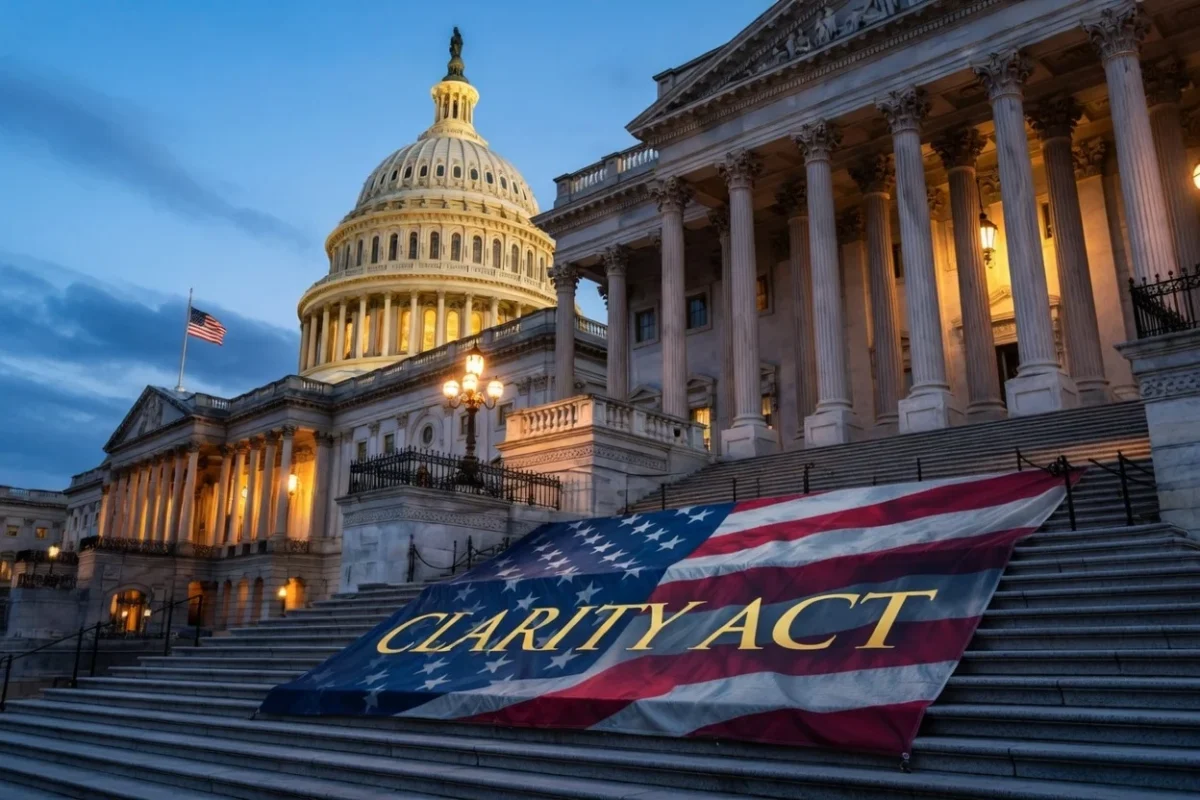
On May 14, 2026, the Senate Banking Committee will convene to deliberate on the Digital Asset Market Clarity Act. This comprehensive legislation, commonly referred to as the CLARITY Act, aims to establish a nationwide regulatory structure for cryptocurrency markets across the United States.
Brian Armstrong, who leads Coinbase as its chief executive, publicly endorsed the revised draft of the legislation prior to the scheduled committee markup. According to Armstrong, the bill has achieved its “strongest and most bipartisan position” following extensive negotiations spanning several months between traditional banking institutions and cryptocurrency industry representatives.
Armstrong characterized the outcome as a “healthy compromise” regarding the contentious issue of stablecoin yield generation. This breakthrough agreement, facilitated through the efforts of Senators Tillis and Alsobrooks, successfully addressed a critical obstacle that had prevented the bill’s advancement in January 2025.
The current draft incorporates revised language addressing decentralized finance ecosystems, tokenized equity instruments, and expanded regulatory powers for the Commodity Futures Trading Commission in supervising digital asset markets.
Presidential Administration Endorses Legislation
David Sacks, holding the position of White House crypto policy director, expressed his endorsement on social media before Thursday’s committee session. He characterized the markup as a pivotal moment in establishing the United States as the “Crypto Capital of the World.”
Sacks emphasized that approximately 50 million American citizens currently own or actively utilize crypto assets. He stated the legislation would empower the cryptocurrency sector to “innovate and flourish for years to come.”

He acknowledged Senate Banking Committee Chairman Tim Scott, White House crypto director Patrick Witt, and the wider digital asset community for their contributions in advancing the legislative effort.
Chairman Scott emphasized that families, entrepreneurs, investors, and innovators all require transparent regulatory guidelines for digital assets.
Core Provisions of the Legislation
Should the CLARITY Act receive congressional approval, it would establish regulatory requirements for digital asset trading venues, intermediaries, and market makers. These participants would be subject to Bank Secrecy Act obligations, encompassing anti-money laundering protocols and know-your-customer verification procedures.
The legislation would prohibit interest accrual on dormant stablecoin holdings. Nevertheless, incentive programs linked to transaction-based participation would remain permissible under the Tillis-Alsobrooks negotiated framework.
The bill establishes criteria for determining when decentralized finance applications qualify as genuinely decentralized. Platforms failing to satisfy these standards would face compliance requirements identical to conventional financial institutions.
Traditional securities converted to blockchain-based tokens would retain their classification under existing securities regulations, according to the bill’s provisions.
The Senate draft spans 309 pages and encompasses transparency requirements, digital security safeguards, regulations against insider trading, consumer protection measures, and specifications for post-quantum cryptographic standards.
Traditional banking industry associations continue to express concerns that the stablecoin compromise language might still impact conventional bank deposits, despite the prohibition on idle balance compensation.
The House of Representatives approved its corresponding version of the legislation in July 2025. The Senate iteration requires additional support before progressing to subsequent legislative stages.
Public opinion data from HarrisX indicates 52% of registered American voters favor the CLARITY Act’s passage, with merely 11% expressing opposition. Additional research suggests approximately 20% of Americans hold cryptocurrency investments.
Thursday’s committee markup will reveal whether the extended negotiation period has generated sufficient consensus to advance the bill through the Senate’s legislative process.
Get 3 Free Stock Ebooks
Discover top-performing stocks in AI, Crypto, and Technology with expert analysis.
- Top 10 AI Stocks - Leading AI companies
- Top 10 Crypto Stocks - Blockchain leaders
- Top 10 Tech Stocks - Tech giants


