


Quick Summary
- Crude markets recovered Thursday following Wednesday’s dramatic 5.6% plunge
- President Trump indicated negotiations with Iran are entering “final stages” while threatening military action
- Tehran established new “Persian Gulf Strait Authority” to regulate Hormuz shipping
- American crude stockpiles dropped 7.9 million barrels, almost three times analyst predictions
- Complete restoration of oil flows through Hormuz anticipated no earlier than late 2027
Petroleum markets rebounded Thursday after experiencing heavy losses during the previous session, with uncertainty surrounding American-Iranian diplomatic efforts leaving market participants cautious.
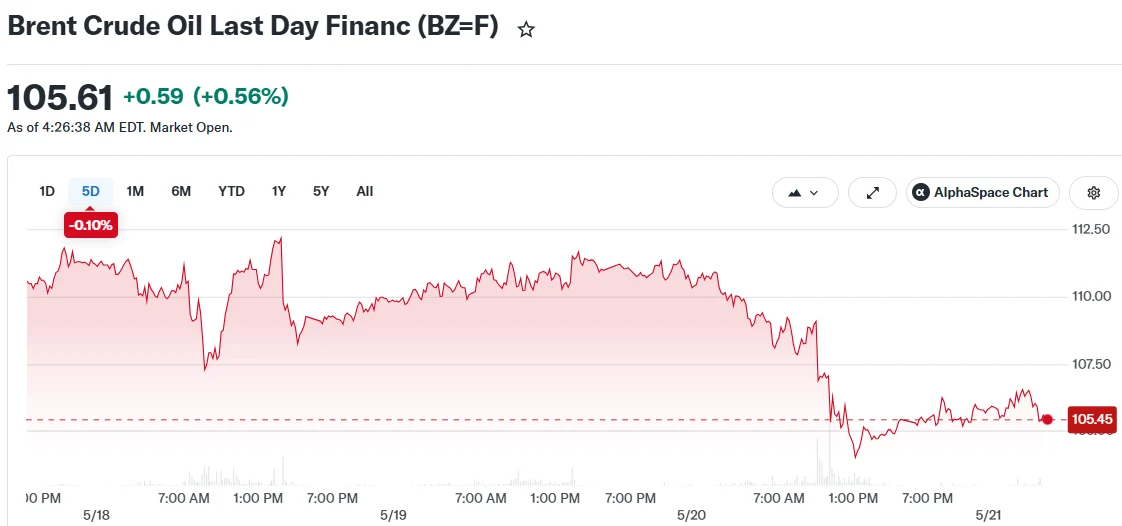
Brent crude approached the $106 per barrel mark after experiencing a 5.6% decline Wednesday. West Texas Intermediate traded above the $99 threshold. These fluctuations occurred amid contradictory messages emerging from both the United States and Iranian leadership.
President Trump informed journalists that Washington has reached the “final stages” of diplomatic discussions with Tehran. Simultaneously, he issued a stern warning that American forces stood ready for military operations should negotiations collapse, characterizing the circumstances as “right on the borderline.”
The President indicated he could hold off “a few days” before escalating actions.
Tehran’s Response and Hormuz Developments
Iranian officials stated they are examining Washington’s most recent draft proposal responding to Iran’s comprehensive 14-point peace framework. Authorities have yet to provide an official reply, based on reports from semi-official Iranian news outlets.
Tehran simultaneously cautioned that additional American or Israeli military operations would provoke countermeasures extending beyond Middle Eastern borders.

Iran inaugurated a new “Persian Gulf Strait Authority” during the week to manage maritime traffic navigating the Strait of Hormuz. The government had earlier disclosed intentions to impose transit fees on ships utilizing the passage.
The strategic waterway remains predominantly inaccessible. Although two Chinese petroleum tankers successfully navigated through Wednesday, overall traffic represents merely a small portion of pre-conflict volumes.
The Strait of Hormuz facilitates approximately 20% of worldwide oil transportation. Sultan Al Jaber, CEO of Abu Dhabi National Oil, stated Wednesday that even with immediate conflict resolution, Middle Eastern petroleum exports would require until late 2027 for complete normalization. He characterized the blockage as the most catastrophic supply interruption in history.
American Stockpile Reduction Intensifies Concerns
Freshly released statistics Wednesday revealed a substantial decrease in American crude reserves. Inventories contracted by 7.9 million barrels during the week concluding May 15, significantly exceeding anticipated reductions of 2.9 million barrels.
The dramatic drawdown resulted from robust American petroleum exports as the government accelerated crude shipments to nations seeking alternatives to Middle Eastern supplies.oil p
Gasoline reserves decreased 1.5 million barrels, falling short of projected 2.1 million barrel reductions. The smaller reduction sparked concerns regarding weakening fuel consumption as pump prices escalate.
Goldman Sachs reported that worldwide reserves of crude and refined products are depleting at unprecedented velocity this month.
Rabobank analysts emphasized that even diplomatic breakthrough would not yield instant supply restoration. “Transportation of oil from the Persian Gulf to final destinations requires up to 55 days,” explained Joe DeLaura, Rabobank’s global energy strategist.
Oil prices remain elevated by more than 40% compared to late February when hostilities commenced.
Three massive oil tankers made passage attempts through the Hormuz strait recently, representing another indication of marginally increasing maritime activity. Iranian authorities claimed 26 vessels transited within a 24-hour period, though this number exceeds figures reflected in vessel-tracking systems.
Get 3 Free Stock Ebooks
Discover top-performing stocks in AI, Crypto, and Technology with expert analysis.
- Top 10 AI Stocks - Leading AI companies
- Top 10 Crypto Stocks - Blockchain leaders
- Top 10 Tech Stocks - Tech giants


