



TLDR
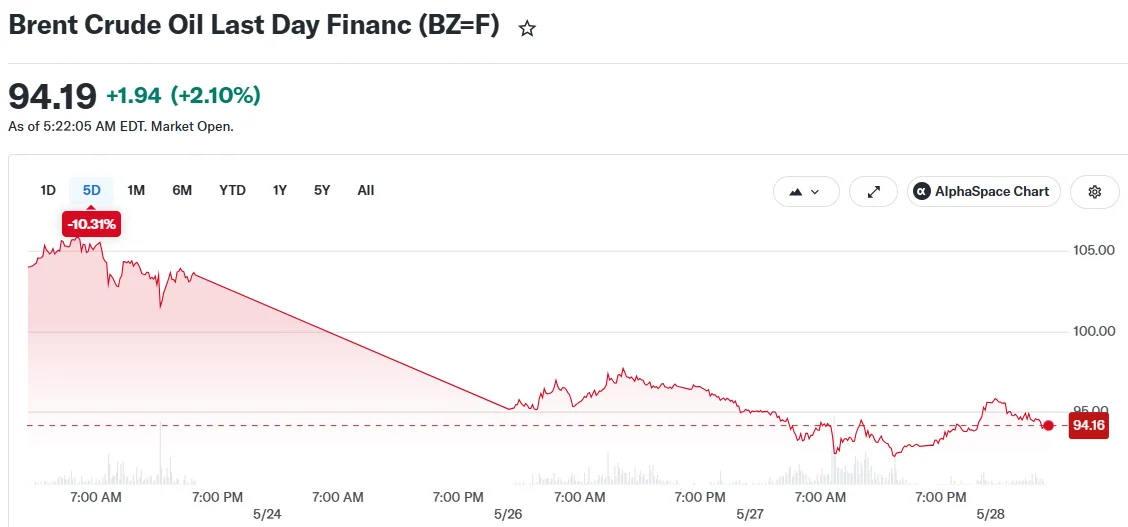
- Brent crude jumped over 2.5% to reach $96.74 while WTI climbed to $90.95 following renewed U.S.-Iran military confrontations
- Iranian Revolutionary Guard forces targeted a U.S. military installation in Kuwait; Kuwaiti officials confirmed defending against aerial attacks
- President Trump rejected claims that Iran would reopen the Strait of Hormuz shipping lane within 30 days
- The strait’s continued blockade is affecting approximately 20% of worldwide oil transport
- Market experts caution that the petroleum sector is entering a critical phase with implications for Iran and global energy security
Energy markets experienced significant upward pressure on Thursday following a renewed military exchange between Washington and Tehran, intensifying concerns that diplomatic resolution remains distant.
Brent crude futures climbed more than 2.5% to reach $96.74 per barrel during early European market hours. Meanwhile, U.S. West Texas Intermediate futures advanced to $90.95 per barrel.
The price surge followed announcements from Iran’s Islamic Revolutionary Guard Corps claiming responsibility for striking a U.S. military facility in Kuwait. Iranian forces characterized the attack as retaliatory action for American military operations targeting the Iranian coastal city of Bandar Abbas.
Kuwaiti authorities acknowledged actively defending their territory against incoming missiles and unmanned aerial vehicles, though they refrained from identifying the attacking force.
These military actions represent a significant return to direct confrontation between the adversaries, contradicting Washington’s ongoing assertions that a ceasefire arrangement remained operative.

President Donald Trump previously rejected media reports suggesting Iran would restore normal commercial maritime operations through the Strait of Hormuz within the next month.
Trump additionally indicated dissatisfaction with the terms of a prospective peace framework, suggesting that any comprehensive agreement may be considerably further from fruition than commodity markets had anticipated.
Oil prices had actually declined the previous day on speculation that a U.S.-Iran agreement was imminent. Trump’s remarks swiftly eliminated that market confidence.
Hormuz Blockage Keeping Supply Tight
The Strait of Hormuz has remained effectively closed for three months due to the ongoing confrontation. This blockade is interrupting approximately one-fifth of the world’s petroleum shipments.
While some maritime vessels have successfully transited the waterway in recent weeks, throughput volumes remain substantially below pre-conflict levels.
Trump also dismissed a diplomatic proposal calling for joint Iranian-Omani administration of the strategic waterway, insisting that no individual nation should exercise exclusive control over the channel.
Market analysts at ANZ observed that petroleum availability continues to face significant constraints and that fundamental disagreements between the two nations remain unresolved.
Research analysts at Yardeni Research issued warnings that the energy market is nearing a dangerous threshold. Their assessment indicates Iran confronts severe oil storage capacity limitations that may compel the nation to halt production operations completely.
They further highlighted that global petroleum infrastructure is operating with minimal supply buffers, creating vulnerabilities that could soon impact pipeline networks and related systems.
Market participants are awaiting the U.S. Energy Information Administration’s inventory report scheduled for Thursday. Supply interruptions have already been generating substantial stockpile reductions.
Commodity market specialists indicate that volatility remains elevated across the energy sector as geopolitical uncertainties persist.
The circumstances remain dynamic, with Washington and Tehran continuing to disagree over Iran’s nuclear program and administrative authority over the strategic waterway.
Get 3 Free Stock Ebooks
Discover top-performing stocks in AI, Crypto, and Technology with expert analysis.
- Top 10 AI Stocks - Leading AI companies
- Top 10 Crypto Stocks - Blockchain leaders
- Top 10 Tech Stocks - Tech giants


