



Key Highlights
- BitMine acquired 27,801 ETH over the past week, pushing its total reserves to 5.77 million ETH valued at approximately $10.25 billion
- US-based spot Ethereum ETFs saw $84.42 million in net inflows, breaking an eight-week streak of capital withdrawals
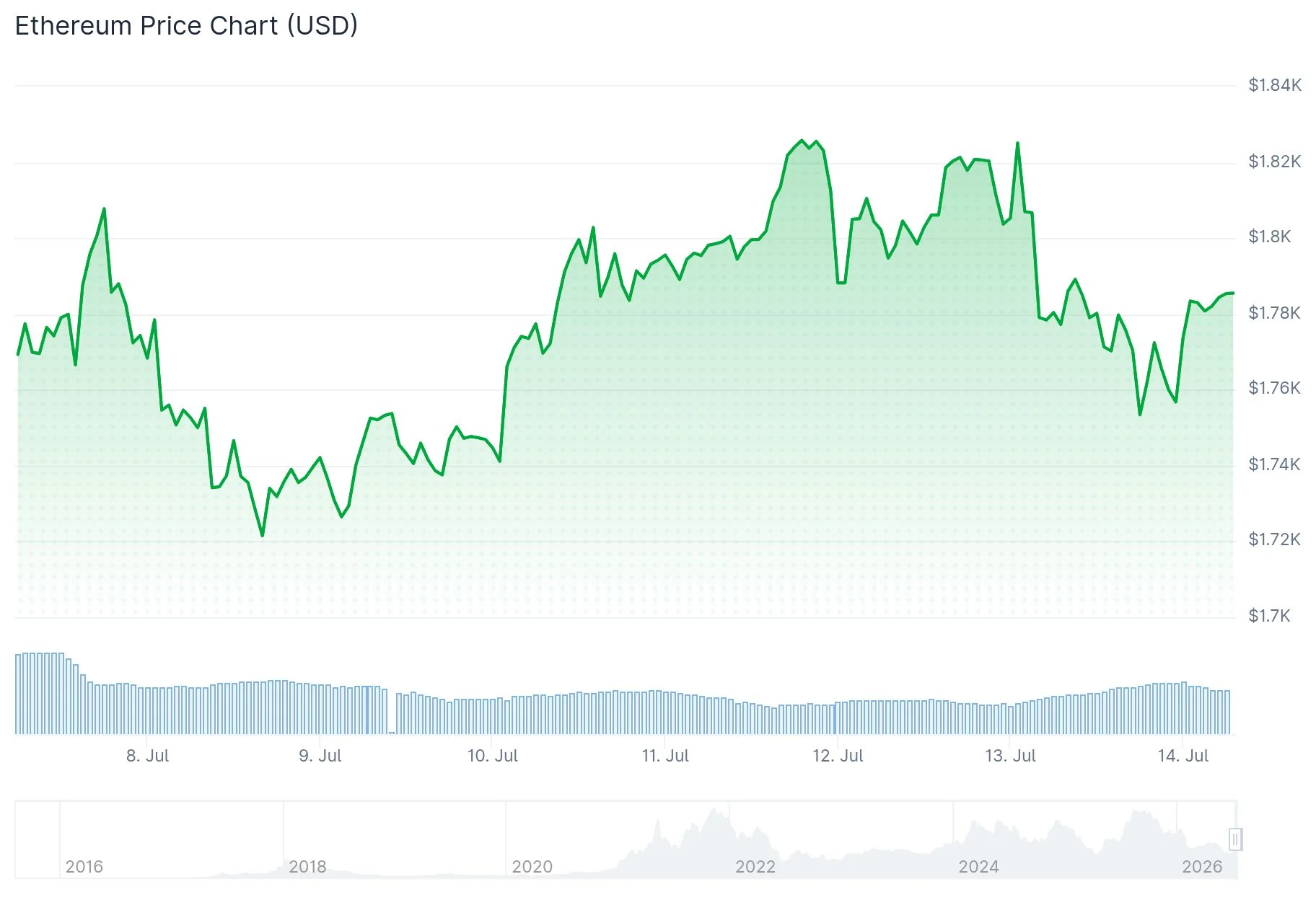
- ETH dipped beneath $1,800 following renewed U.S.-Iran tensions that drove oil prices past $74 and sparked risk-off market behavior
- Critical support zone established at $1,750; a decisive move through $1,825–$1,850 resistance could open pathways toward $2,140 according to daily chart patterns
- Over $81.75 million in leveraged positions were liquidated within 24 hours, predominantly affecting long traders at $57 million
Ethereum is currently changing hands near $1,760 after dipping under the $1,800 threshold amid escalating military tensions between the United States and Iran. Recent American military operations targeting Iran triggered a roughly 4% surge in crude oil prices beyond $74 per barrel, prompting investors to retreat from higher-risk assets such as cryptocurrencies.
Iranian officials announced retaliatory strikes on U.S. military installations across Bahrain, Kuwait, Oman, and Jordan. Growing concerns surrounding the strategic Strait of Hormuz intensified selling pressure across global financial markets.
ETH experienced approximately 3.6% decline from its Monday session peak of $1,837. Despite the downturn, market participants continue to defend the critical $1,750 support zone.
Corporate Accumulation Accelerates
BitMine Immersion Technologies (BMNR) expanded its cryptocurrency treasury by 27,801 ETH throughout the previous week. This acquisition elevates the company’s total holdings to 5.77 million ETH, currently worth approximately $10.25 billion.
BitMine’s Chairman Thomas Lee disclosed that projected annualized staking revenue has reached $242 million. The enterprise has allocated 4.91 million ETH — representing roughly 85% of its total reserves — to its Made in America Validator Network (MAVAN), which is currently generating a 2.70% annualized staking yield based on seven-day performance.

The Nevada-based corporation reports it has achieved 96% progress toward its strategic objective of controlling 5% of ETH’s total circulating supply.
US spot Ethereum ETF products recorded $84.42 million in aggregate net inflows during the previous week, based on SoSoValue tracking data. This marks the first week of positive flows after two consecutive months of withdrawals.
Technical Perspectives from Market Observers
Cryptocurrency analyst Ali Martinez indicated his intention to establish long positions on ETH contingent upon a breakout above $1,850. This threshold corresponds with a substantial concentration of short liquidation orders clustered between $1,840 and $1,860 according to CoinGlass analytics, where forced closing of short positions could trigger accelerated upward momentum.
Analyst Ted Pillows remarked on July 13 that ETH’s ability to maintain levels above $1,750 represents an encouraging development, suggesting that sustained support at this level could facilitate a rally approaching $2,000.
Crypto analyst Michaël van de Poppe (@CryptoMichNL) observed that notwithstanding broader market fragility, ETH appears resilient and is “demonstrating considerable strength” relative to Bitcoin. He highlighted positive momentum in the ETH/BTC trading pair and referenced the forthcoming Clarity Act as a possible bullish catalyst.
Examining the daily timeframe, a prospective double-bottom formation with troughs around $1,505 remains viable. A validated breakthrough above $1,825 would establish a technical price target in the vicinity of $2,140.
ETH continues trading beneath its 50-day exponential moving average at $1,798 and its 100-day exponential moving average positioned at $1,946. The MACD indicator maintains positioning above its signal line, while Chaikin Money Flow registers approximately 0.10, indicating positive accumulation territory.
According to Coinglass data, $81.75 million in aggregate liquidations occurred across the market during the past 24 hours, with long position holders accounting for $57 million of these forced closures.
Get 3 Free Stock Ebooks
Discover top-performing stocks in AI, Crypto, and Technology with expert analysis.
- Top 10 AI Stocks - Leading AI companies
- Top 10 Crypto Stocks - Blockchain leaders
- Top 10 Tech Stocks - Tech giants


