


Key Highlights
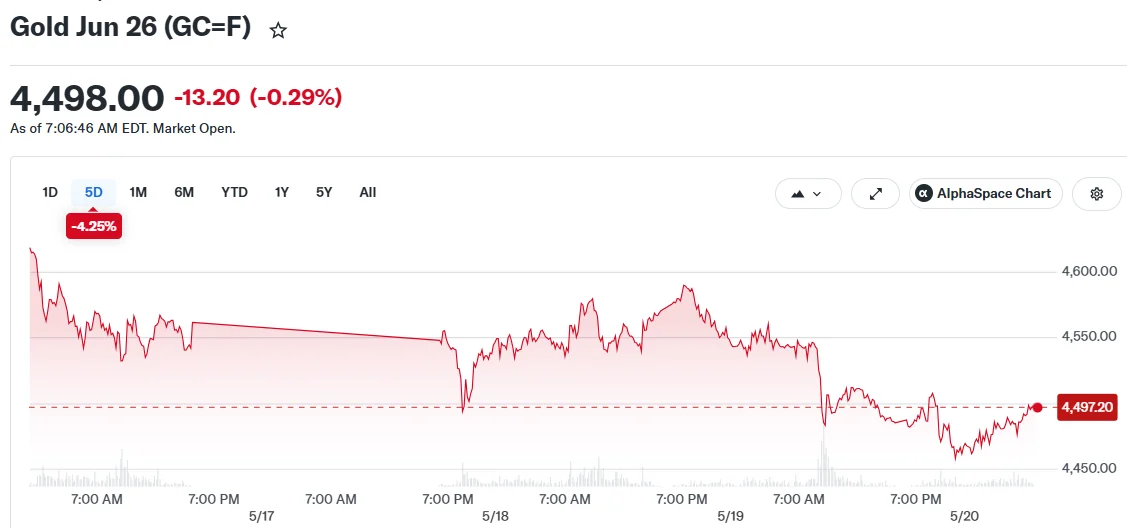
- Gold stabilizes just under $4,500 per ounce following Tuesday’s nearly 2% decline
- U.S. 30-year Treasury yields reach levels not seen since 2007, creating headwinds for precious metals
- Trump administration sends mixed signals on Iran, threatening renewed strikes while suggesting rapid diplomatic resolution
- Silver recovers with gains up to 2.5% following Monday’s steep 5% selloff; platinum and palladium advance
- Gold has declined approximately 15% since U.S.-Israeli military operations against Iran commenced in late February
Precious metals markets found stability on Wednesday following days of volatility, with spot gold hovering just beneath the $4,500 per ounce threshold. After sliding nearly 2% during Tuesday’s session, the yellow metal consolidated as market participants weighed conflicting developments from Middle Eastern geopolitics and fixed-income markets.
The primary headwind facing gold stems from ascending bond yields. U.S. 30-year Treasury yields have climbed to their most elevated level since 2007, just prior to the onset of the global financial crisis. Elevated yields typically diminish the appeal of non-interest-bearing assets such as gold among investors.
Phillip Capital analysts highlighted mounting concerns that an oil price surge connected to Iran tensions could unleash a fresh wave of worldwide inflation, potentially compelling central banks to implement interest rate increases. The Federal Reserve is scheduled to publish minutes from its April policy meeting later Wednesday, which could provide additional insight into future rate trajectory.
The U.S. dollar has also maintained strength near a six-week peak. A stronger dollar typically makes gold more costly for international purchasers.
Middle East Tensions Continue to Drive Market Sentiment
The evolving situation with Iran remains the primary catalyst behind market fluctuations. President Trump informed congressional members Tuesday evening that the conflict might conclude “very quickly.” He revealed that he delayed additional military strikes against Iran following requests from three Gulf nations.

Nevertheless, Trump also cautioned that strikes could resume within days as leverage to secure a diplomatic agreement. Vice President JD Vance indicated that Tehran expressed willingness to reach a settlement.
Iran continues to maintain its fundamental demands, and market observers suggest the pathway to a comprehensive agreement remains ambiguous. Neil Welsh from Britannia Global Markets commented that negotiation prospects “remained uncertain.”
The Strait of Hormuz, a critical petroleum shipping corridor along Iran’s southern coastline, has been essentially blocked to tanker traffic since military operations commenced in late February. Wednesday witnessed two Chinese-flagged supertankers departing the strait, accompanied by a South Korean vessel. Crude oil prices declined on optimism that supply channels might normalize soon, though Brent crude continues trading substantially above pre-conflict levels.
Precious Metal Down 15% Since Conflict Erupted
Gold has maintained a relatively constrained trading range following its sharp initial decline when hostilities began. The precious metal has retreated approximately 15% since the war’s inception in late February.
Ole Hansen from Saxo Bank observed an emerging divergence between short-term traders concentrating on interest rate projections and long-term investors viewing gold as protection against elevated inflation and economic stagnation. He highlighted the absence of significant new capital flowing into gold exchange-traded funds and suggested the market appears to be awaiting more definitive direction.
Silver experienced considerable volatility but rebounded Wednesday, advancing as much as 2.5% after Monday’s 5% plunge. Silver had rallied to approximately $90 per ounce last Wednesday before subsequently declining roughly 16%. Platinum and palladium also registered gains during Wednesday trading.
Spot gold remained relatively unchanged around $4,475 as of late morning hours in London.
Get 3 Free Stock Ebooks
Discover top-performing stocks in AI, Crypto, and Technology with expert analysis.
- Top 10 AI Stocks - Leading AI companies
- Top 10 Crypto Stocks - Blockchain leaders
- Top 10 Tech Stocks - Tech giants


