


Key Takeaways
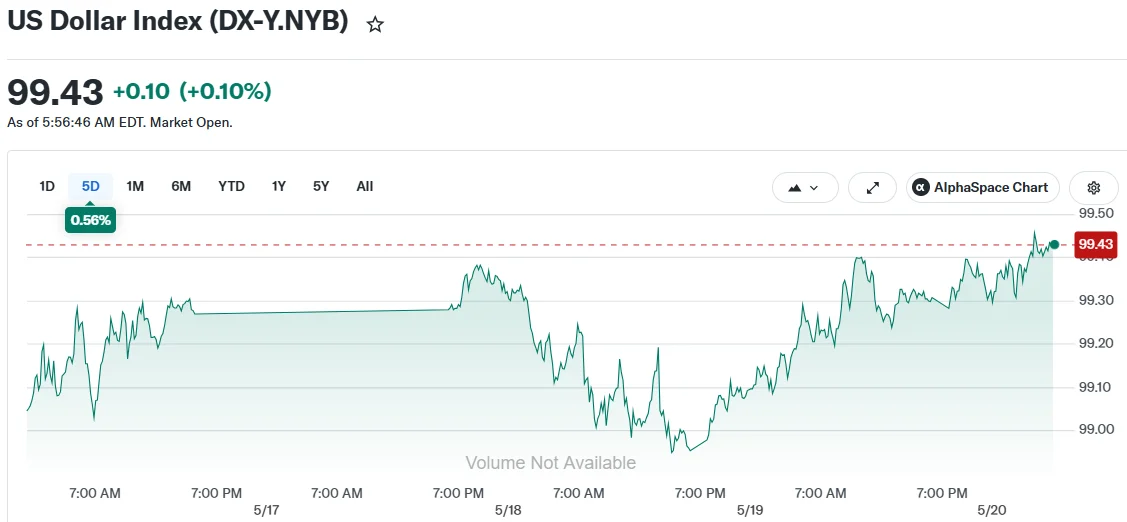
- The dollar index advanced to 99.47 on Wednesday, marking a six-week peak, as traders bet on potential Federal Reserve tightening amid war-fueled inflation concerns.
- Investors now see greater than 50% odds of a Fed rate increase materializing by year-end, according to market pricing.
- Long-dated U.S. Treasury securities witnessed yields climb to levels not seen since 2007, triggering widespread bond market selling.
- Japan’s currency retreated close to the 160-per-dollar threshold, raising prospects of renewed foreign exchange market intervention by Tokyo authorities.
- India’s currency touched an all-time low at 96.784 against the dollar, weighed down by elevated crude oil costs and the nation’s energy import dependency.
The American currency advanced to its strongest position in six weeks during Wednesday’s trading session, as market participants assessed the likelihood of Federal Reserve policy tightening in response to inflationary pressures stemming from the Iran military conflict.
The dollar index, which tracks the U.S. currency’s performance relative to a basket of six major global currencies, gained 0.1% to reach 99.47. This represents the index’s most robust level since April 7. Month-to-date gains for May have now exceeded 1.3%.
Middle East Crisis Sustains Inflation Concerns
The military engagement has disrupted approximately one-fifth of global petroleum shipments by essentially shutting down passage through the Strait of Hormuz. Brent crude futures are currently changing hands near $110 per barrel, representing an increase exceeding 50% compared to pre-conflict levels from late February.
This dramatic escalation in energy costs has directly influenced consumer price metrics, placing the Federal Reserve in a challenging policy position. According to CME FedWatch tool data, market participants now assign better than even odds to a rate increase occurring before the end of December — a dramatic shift from earlier 2025 projections that anticipated two rate reductions.
President Donald Trump indicated the United States might conduct additional military strikes against Iran, while simultaneously suggesting Tehran shows willingness to negotiate. Oil prices experienced modest declines Wednesday following statements from Washington indicating diplomatic progress, though downward movement remained constrained.

Philadelphia Federal Reserve President Anna Paulson remarked Tuesday that market speculation regarding potential rate increases was “healthy,” while characterizing existing monetary policy as suitably restrictive.
The euro declined to a six-week nadir of $1.158, shedding 0.16%. Sterling dropped to $1.338, hovering near its own six-week bottom. The Australian dollar remained largely unchanged at $0.711 following a 0.9% decline the previous session.
Japanese Currency Approaches Critical Threshold
Japan’s yen depreciated back toward the 160-per-dollar mark that prompted government market intervention during the prior month. Japanese authorities entered currency markets in late April and early May attempting to moderate yen weakness, though intervention effects proved temporary.
The yen traded at 159.01 per dollar during Wednesday’s session. U.S. Treasury Secretary Scott Bessent indicated Washington favors additional Bank of Japan rate increases, expressing confidence that the BOJ governor would “do what he needs to do” with adequate policy independence.
Currency analysts cautioned that intervention efforts may merely decelerate dollar-yen appreciation rather than reversing the trend, absent meaningful declines in U.S. Treasury yields and broader dollar weakness. The 30-year U.S. Treasury yield reached its loftiest level since 2007 this week, serving as a primary catalyst for greenback strength.
India’s rupee established a fresh record low at 96.784 per dollar Wednesday. The nation’s substantial energy import requirements render its currency particularly susceptible to petroleum price spikes. Market participants also expressed skepticism regarding the Reserve Bank of India’s capacity to support the currency.
China’s yuan weakened marginally versus the dollar. Cross-strait tensions between China and Taiwan intensified after Trump questioned future American weapons transfers to Taipei and cautioned against independence declarations. Taiwan indicated openness to direct presidential communication.
The Federal Reserve is scheduled to publish minutes from its most recent policy meeting later Wednesday, with investors scrutinizing the document for insights into the central bank’s rate trajectory.
Get 3 Free Stock Ebooks
Discover top-performing stocks in AI, Crypto, and Technology with expert analysis.
- Top 10 AI Stocks - Leading AI companies
- Top 10 Crypto Stocks - Blockchain leaders
- Top 10 Tech Stocks - Tech giants


