


Quick Overview
- SOL is currently valued between $85–$95 with total market capitalization approaching $49 billion
- Moderate scenario projects SOL between $350 and $500 by decade’s end
- Optimistic outlook envisions SOL climbing to $900–$1,200 with broad institutional uptake
- Conservative scenario positions SOL at $70–$120 amid heightened competitive pressure
- Weighted average forecast settles near $485 for 2031
Solana has emerged as a prominent blockchain infrastructure platform within the cryptocurrency landscape. Distinguished by rapid settlement times and minimal transaction costs, it ranks among the busiest smart contract networks alongside Ethereum.
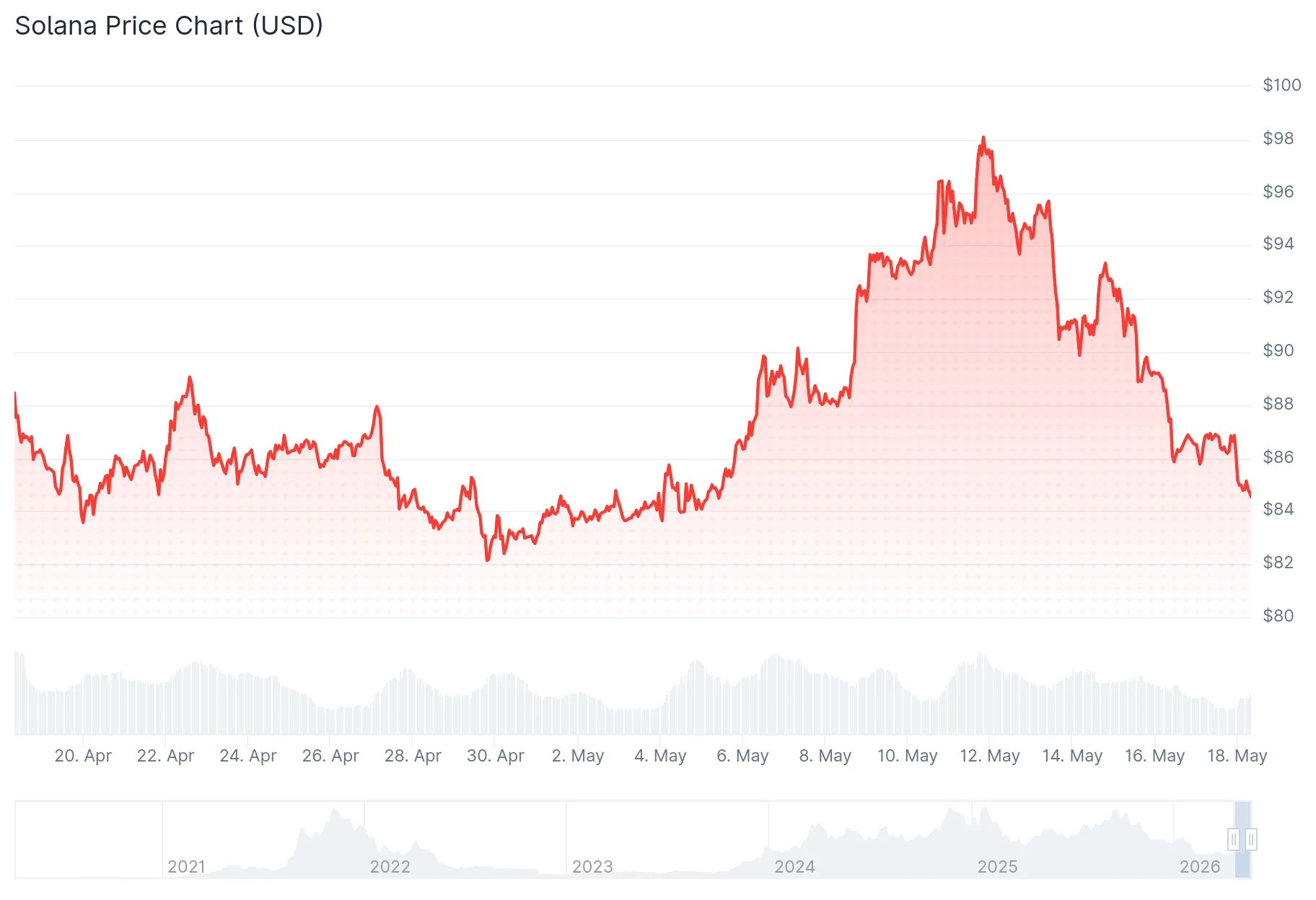
The token currently fluctuates around the $85–$95 mark. With approximately 578 million tokens in circulation, its valuation hovers near $49 billion.
The primary consideration for the coming five years centers on whether Solana can transition from its current status as a leading Layer 1 protocol into a core settlement infrastructure for the broader digital asset economy.
Market analysts have outlined three distinct valuation pathways extending to 2031, each predicated on varying assumptions regarding mainstream adoption, competitive dynamics, and operational consistency.
Moderate Outlook: $350 to $500 Through 2031
The moderate projection assumes consistent expansion throughout the cryptocurrency sector over the next half-decade.

Under this framework, Bitcoin maintains its role as the preeminent value preservation instrument, Ethereum continues as the leading smart contract infrastructure, and Solana secures its niche as the premier high-performance network for consumer applications, payment systems, and exchange activity.
Should Solana reach a valuation between $250 billion and $350 billion, with token supply expanding toward 700 million SOL, pricing would land in the $350 to $500 corridor.
Solana’s competitive edge lies in accessibility. Transactions finalize rapidly, costs remain minimal, and the network has already cultivated a substantial community of retail participants and builders.
Unlike Ethereum, which increasingly emphasizes settlement infrastructure and Layer 2 scaling solutions, Solana maintains a more direct consumer orientation. This creates distinct market positioning.
Solana’s emission schedule also factors into long-term projections. SOL lacks a fixed maximum supply comparable to Bitcoin. Its issuance rate gradually decreases toward a sustained level around 1.5%, while certain transaction fees undergo permanent removal from circulation.
Optimistic Scenario: $900 to $1,200 by 2031
The optimistic framework places Solana within a $900 to $1,200 range by 2031, necessitating market capitalization between $650 billion and $850 billion.
Multiple factors would need to align for this trajectory to materialize.
Primarily, genuine network utilization would need sustained growth — expanded stablecoin transactions, asset tokenization, exchange volume, and application deployment.
Additionally, institutional participation would need significant expansion. Regulatory approval for a spot Solana ETF could establish an important new demand mechanism.
Furthermore, Solana would need to prove sustained operational stability under high-volume conditions.
Under this framework, Solana needn’t overtake Ethereum. It requires only establishing dominance as the preferred high-capacity chain for mainstream users and applications.
Crypto.com has observed that Solana’s current emission rate exceeds Ethereum’s, despite being programmed to decline gradually — a consideration relevant to extended valuation modeling.
The probability-adjusted price projection across all three pathways arrives at approximately $485 by 2031.
Get 3 Free Stock Ebooks
Discover top-performing stocks in AI, Crypto, and Technology with expert analysis.
- Top 10 AI Stocks - Leading AI companies
- Top 10 Crypto Stocks - Blockchain leaders
- Top 10 Tech Stocks - Tech giants


