


TLDR
- Solana rejected at $98 on May 11, falling 15% to trade around $85
- Futures funding rates turned negative at -3%, indicating bearish market positioning
- DEX trading volumes on Solana declined 56% from $25B in January to $11B
- Competing platforms Hyperliquid and Base are gaining traction and market dominance
- Technical analyst Ali Charts suggests a breakdown could drive SOL toward $78
Solana’s SOL token has experienced a significant downturn following its inability to surpass the $98 threshold on May 11. Since that rejection, the cryptocurrency has tumbled approximately 15%, now hovering around the $85 mark.
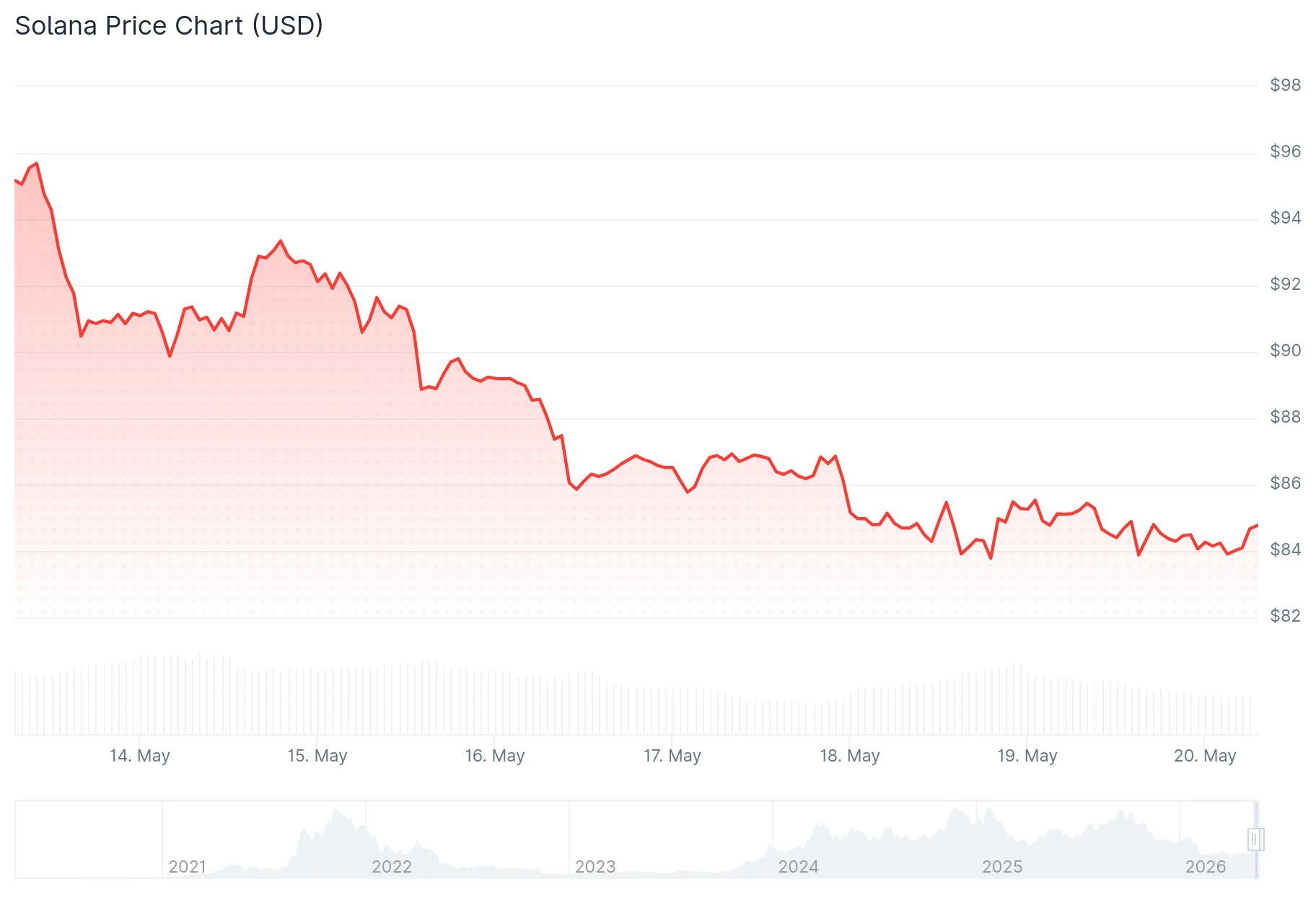
The asset briefly touched a low of $83.35 before finding temporary footing. Currently, SOL remains beneath its 100-hour simple moving average, with technical indicators pointing to a developing bearish trend line acting as resistance around the $85 zone on hourly charts.
Prominent cryptocurrency analyst Ali Charts shared insights on X, noting that SOL’s failure to penetrate the upper boundary of its trading channel at $98 could initiate a decline toward the channel’s lower edge near $78 — a critical threshold now under close observation by market participants.
The immediate resistance level is positioned at $85, followed by $85.80. A more substantial obstacle appears at $88.50, corresponding with the 50% Fibonacci retracement level from the recent downward movement. Should SOL breach the $82 support, attention will shift to the $80 zone, with $75 representing the next significant support if selling pressure intensifies.
Perpetual Futures Funding Shifts Into Negative Territory
The funding rate for SOL perpetual futures contracts plummeted to -3% on Tuesday, a stark contrast from the +8% recorded on Saturday. Typically, this metric hovers around +9% under balanced market conditions. When the funding rate turns negative, it indicates traders are compensating others to maintain short positions, revealing an oversupply of bearish bets.

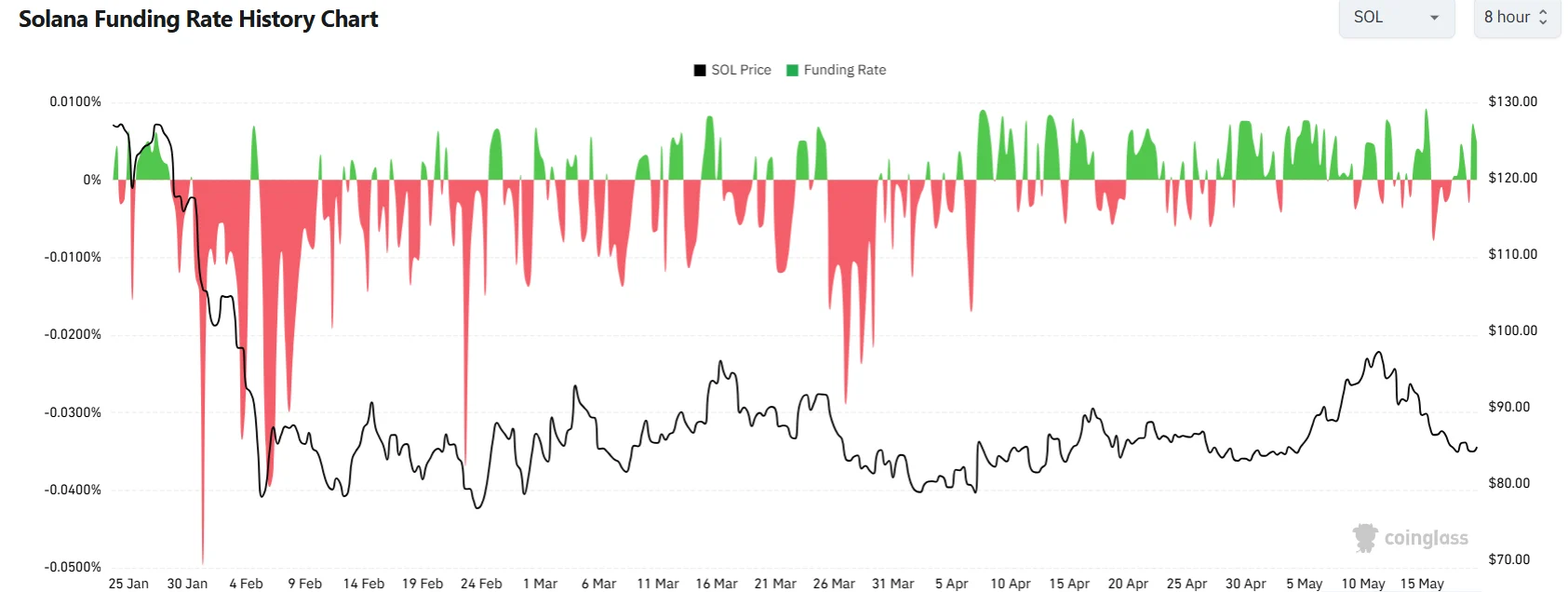
Appetite for leveraged long positions has essentially evaporated after SOL fell beneath the $90 level during the weekend trading session.
Declining DEX Volumes and Network Revenue
Decentralized exchange activity on Solana has contracted by 56% since the beginning of January. Current weekly DEX volumes measure approximately $11 billion, down from the $25 billion recorded at year’s start.
DApp revenue across the Solana ecosystem has similarly deteriorated, falling from approximately $35 million weekly in January to roughly $20 million per week presently. The primary revenue contributors on Solana include Pump, Axiom Pro, Phantom, and Jupiter, collectively commanding approximately 65% of the network’s DApp revenue share.
Despite these challenges, Solana has maintained its position as the second-largest blockchain by total value locked (TVL) with $5.9 billion, surpassing BNB Chain’s $5.5 billion and Base’s $4.5 billion.
Hyperliquid has positioned itself as a formidable challenger through its commanding presence in the perpetual contracts market. Meanwhile, Ethereum layer-2 solution Base continues expanding its footprint through strategic integration with the Coinbase platform.
A detailed examination shared by X user lukecannon727 raised concerns about potential volume manipulation on PreStocks, a synthetic asset protocol operating on Solana. The investigation revealed that 1,600 wallet addresses generated nearly 63% of the platform’s trading volume, exhibiting patterns that could suggest either sophisticated arbitrage strategies or artificially inflated activity metrics.
SOL is currently changing hands near $85, with market participants closely monitoring the $82–$83.50 range as crucial near-term support.
Get 3 Free Stock Ebooks
Discover top-performing stocks in AI, Crypto, and Technology with expert analysis.
- Top 10 AI Stocks - Leading AI companies
- Top 10 Crypto Stocks - Blockchain leaders
- Top 10 Tech Stocks - Tech giants


