


Key Highlights
- Nasdaq 100 futures decline 0.7% while S&P 500 futures drop 0.4% in Tuesday’s pre-market trading
- Investors await April’s Consumer Price Index, with economists forecasting 3.7% annual inflation
- President Trump described the U.S.-Iran ceasefire as being on “massive life support,” supporting elevated energy prices
- West Texas Intermediate crude jumped more than 3.7%, breaking above the $101 per barrel threshold
- Risk assets including Bitcoin retreat as geopolitical tensions in the Middle East persist
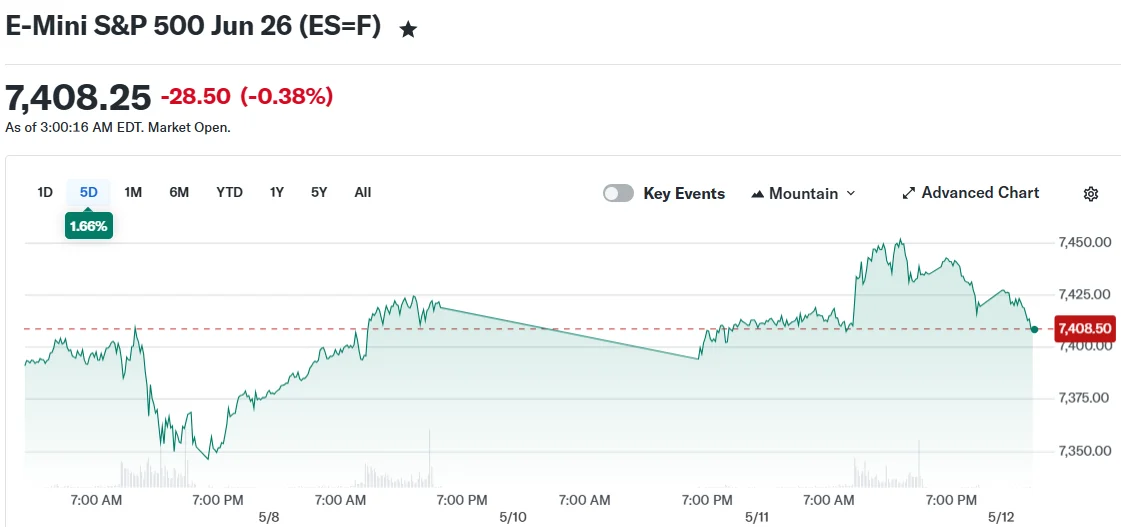
American equity futures declined in early Tuesday trading as market participants prepared for April’s Consumer Price Index release while monitoring ongoing tensions between the United States and Iran.
The Nasdaq 100 futures posted the steepest losses, declining 0.7%. Futures tied to the S&P 500 fell 0.4%, and Dow futures edged down approximately 0.1%. These losses came after both the S&P 500 and Nasdaq finished Monday’s session at all-time closing highs.
April’s CPI report represents the market’s primary focus today. Analysts anticipate headline inflation will show a 3.7% increase compared to the same period last year. Market participants will scrutinize the data for indications that elevated energy costs, stemming from the Strait of Hormuz blockade, are spreading into wider consumer price increases.
Should inflation come in hotter than anticipated, it could reshape market expectations regarding Federal Reserve monetary policy. The stronger-than-projected April employment report released Friday has already intensified this concern.
Energy Markets Rally as Diplomatic Progress Stalls
President Trump stated Monday that the ceasefire agreement between the U.S. and Iran is clinging to “massive life support.” While negotiations between both nations continue, meaningful progress remains elusive.

West Texas Intermediate crude surged 3.7%, pushing above $101 per barrel. Brent crude advanced 3.4%, approaching $108 per barrel. Aviation fuel and gasoline costs have climbed since hostilities began.
Michael Brown, a strategist at Pepperstone, indicated that negotiations continue to trend toward de-escalation, though the pace remains glacial. He emphasized that the Strait of Hormuz remains effectively blocked.
Bitcoin also declined as the precarious ceasefire dampened investor appetite for risk assets throughout global markets.
The U.S. dollar strengthened 0.3% versus a basket of major currencies. The 10-year Treasury yield increased two basis points to reach 4.44%.
Semiconductor Stocks Face Headwinds
Technology equities experienced additional selling pressure following comments from South Korea’s senior presidential secretary for policy, who advocated for implementing a social tax on artificial intelligence earnings late Monday evening.
These remarks sparked a selloff in chip manufacturers Samsung Electronics and SK Hynix. South Korea’s Kospi index concluded Tuesday’s session down 2.3%.
The semiconductor sector rally that propelled the Nasdaq to record territory on Monday lost steam during Tuesday’s pre-market hours.
Separately on Tuesday, President Trump is traveling to China for meetings with President Xi Jinping. Trade policy and artificial intelligence development are anticipated to be central discussion topics. Trump extended invitations to 16 corporate leaders, including Tesla’s Elon Musk and Apple’s Tim Cook, to accompany him on the diplomatic visit.
Investors will monitor both the CPI release and any developments from the Trump-Xi meetings for market direction.
Get 3 Free Stock Ebooks
Discover top-performing stocks in AI, Crypto, and Technology with expert analysis.
- Top 10 AI Stocks - Leading AI companies
- Top 10 Crypto Stocks - Blockchain leaders
- Top 10 Tech Stocks - Tech giants


