


Quick Summary
- Tuesday’s trading session saw the S&P 500 decline 0.8% while the Nasdaq Composite slipped approximately 1.2% as Treasury yields surged past 4.6%.
- Long-term Treasury bonds faced significant pressure, with the 30-year yield momentarily reaching 5.2%, weighing heavily on growth-oriented and AI technology stocks.
- Market participants are divided on whether the Federal Reserve might implement rate increases to combat inflation fueled by elevated oil prices.
- Military operations against Iran were suspended by President Trump, who referenced “serious negotiations,” though market sentiment remained guarded.
- All eyes turn to Nvidia’s Wednesday earnings release, viewed as a critical indicator for AI sector momentum and investor sentiment.
Tuesday’s trading session witnessed declining U.S. equity markets as Treasury bond yields accelerated upward and technology sector shares deepened their recent downturn. These market movements persisted despite emerging indications of diplomatic advancement regarding the U.S.-Iran standoff.
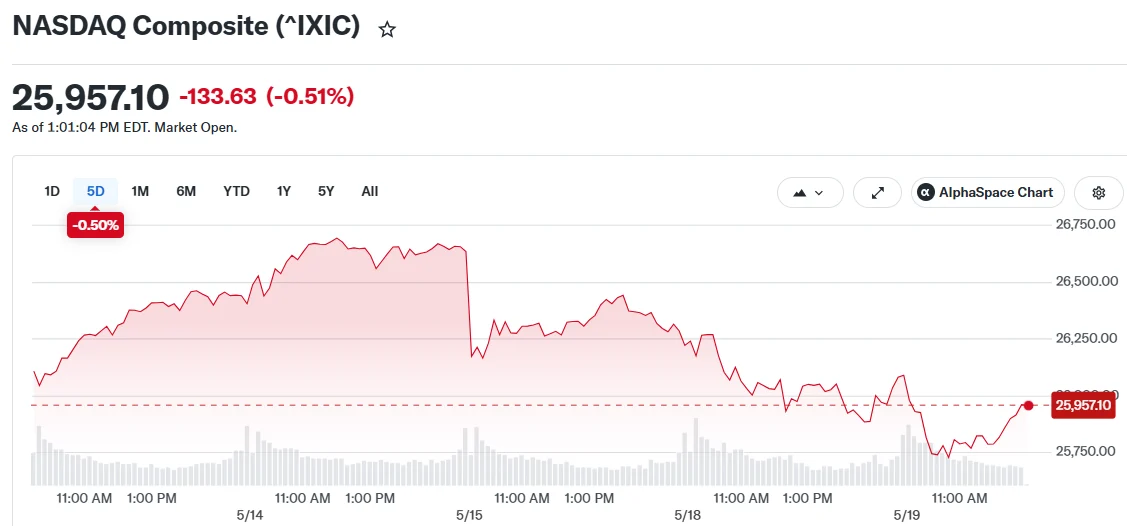
The Nasdaq Composite registered approximately a 1.2% decline, while the S&P 500 retreated 0.8%. The Dow Jones Industrial Average posted a more modest decrease of roughly 0.5%. These losses marked consecutive negative sessions across all major market benchmarks.
Early Tuesday trading witnessed the 10-year Treasury yield crossing the 4.6% threshold. Meanwhile, the 30-year yield temporarily touched 5.2%. Historically, ascending bond yields create headwinds for equity valuations, particularly affecting high-growth technology companies.
An unusual simultaneous decline in both stocks and bonds has unsettled market participants. Traditionally, bonds serve as a protective buffer when equities decline, but this inverse correlation has recently deteriorated.
Yield Increases and Inflation Concerns Fuel Market Retreat
Inflation anxieties remain central to current market turbulence. Supply disruptions in the Strait of Hormuz have elevated crude oil prices, sparking concerns about cascading inflationary pressures across the economy.

Market attention has intensified on the Federal Reserve’s next moves. A segment of the financial community anticipates potential interest rate increases should inflationary trends persist. Such policy tightening would particularly impact valuations for growth-focused and AI-related equities, which rely substantially on favorable borrowing conditions.
Treasury Secretary Scott Bessent contributed to market anxiety during Tuesday remarks in Paris. He urged international partners to implement financial penalties against Iran, specifically advocating for designating Iranian financial operators and closing Iranian banking operations. These comments preceded the market opening bell.
Major indices opened sharply lower, with both the Dow and S&P 500 falling 0.5%, while the Nasdaq dropped 0.6% in early minutes.
Despite prevailing market headwinds, Deutsche Bank strategists observed that worldwide economic indicators have “continued to surprise on the upside, particularly in the last couple of weeks.” This resilience has provided some support for risk assets.
Iranian Diplomatic Developments and Nvidia Results Take Center Stage
President Trump indicated Monday that “serious negotiations” regarding Iran’s nuclear capabilities are underway, suggesting a “very good chance” for diplomatic resolution. He confirmed postponing planned military strikes against Iran scheduled for Tuesday, responding to appeals from regional Gulf partners.
Markets demonstrated measured optimism following these announcements. However, yields maintained their upward trajectory, and technology shares continued declining.
Investors are also analyzing bond positioning data from Bank of America’s most recent fund manager survey. Results indicated investor bond allocations have reached a four-year nadir in May, with preference shifting toward commodities, utility stocks, and emerging market equities. Notably, fifty percent of surveyed fund managers still anticipate Federal Reserve rate reduction within the coming twelve months.
The trading week’s most closely watched event remains Nvidia’s Wednesday earnings announcement. The chip manufacturer is considered a key bellwether for artificial intelligence sector health. Expectations are elevated, and results could significantly influence technology stock momentum throughout the remainder of the week.
Latest market readings showed the Dow trading near 49,562, the S&P 500 around 7,380, and the Nasdaq hovering near 25,960.
Get 3 Free Stock Ebooks
Discover top-performing stocks in AI, Crypto, and Technology with expert analysis.
- Top 10 AI Stocks - Leading AI companies
- Top 10 Crypto Stocks - Blockchain leaders
- Top 10 Tech Stocks - Tech giants


