


Key Takeaways
- Combat lessons from Ukraine demonstrate that unmanned aerial systems can effectively perform traditional military functions including reconnaissance and direct action
- AeroVironment delivered fiscal 2025 revenues of $820.6 million, representing 14.45% growth year-over-year, fueled by Department of Defense procurement
- Palantir achieved Q1 2026 revenues of $1.63 billion, with its artificial intelligence infrastructure becoming essential for managing autonomous drone networks
- Kratos Defense achieved 2025 revenues of $1.347 billion and projects 2026 revenues could reach $1.675 billion, driven by its XQ-58A Valkyrie production contract
- Western defense industries face critical supply chain exposure through dependence on Chinese-manufactured drone components, prompting new Pentagon procurement restrictions effective January 1, 2027
The military landscape is undergoing a fundamental transformation, with several American defense contractors positioned at the forefront of this evolution. Combat operations in Ukraine have validated that affordable unmanned systems can accomplish missions previously requiring highly trained personnel — a shift capturing significant investor interest.
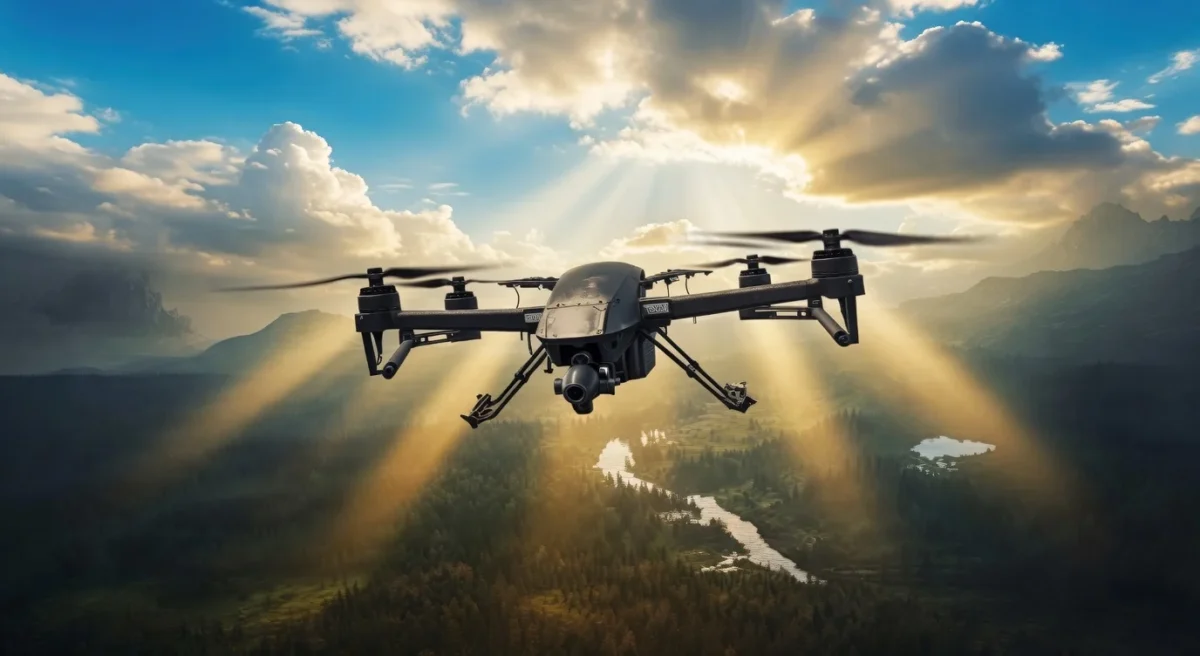
Unmanned aerial vehicles now execute intelligence gathering, precision targeting, and kinetic operations at costs dramatically below conventional approaches. These systems provide superior speed, extended operational range, and reduced personnel exposure. Throughout 2024, Ukraine manufactured approximately 1.2 million drones simply to maintain defensive positions against Russian forces.
This represents more than a passing military fad. Defense strategists worldwide are redesigning operational concepts around drone-centric tactics, and the corporations providing these capabilities are experiencing substantial revenue expansion.
AeroVironment stands as perhaps the most obvious winner. The corporation manufactures the Switchblade loitering munition system, which has seen extensive deployment in Ukrainian combat zones. Additionally, it produces the Puma and Raven platforms, utilized by American and partner militaries for tactical intelligence operations.

The corporation achieved record fiscal 2025 revenues of $820.6 million, marking a 14.45% increase from the previous period. The Department of Defense has awarded contracts worth hundreds of millions for Switchblade platforms, including a $64.6 million modification awarded in 2023. The Pentagon’s Replicator Initiative — targeting deployment of thousands of autonomous platforms — should generate additional demand.
Software Infrastructure: Palantir’s Strategic Position
Scaling drone operations involves more than just manufacturing hardware. It fundamentally requires solving complex data challenges. Palantir has emerged as a critical player in this domain.
Its Gotham software manages real-time intelligence fusion and targeting support for American and coalition military forces. The company’s artificial intelligence platform, AIP, now enables coordination of autonomous platforms, including swarm operations requiring minimal human oversight.
Palantir posted Q1 2026 revenues of $1.63 billion. Management noted that its domestic business segment more than doubled within a 12-month timeframe. Government contracts continue forming a substantial portion of its order backlog, demonstrating sustained demand from defense and intelligence agencies.
Kratos Defense has pursued a contrasting strategy. Instead of expensive platforms, it develops affordable systems engineered to be attritable. Its XQ-58A Valkyrie represents a jet-powered autonomous platform designed to accompany manned aircraft, accepting high-risk assignments at a small fraction of traditional fighter costs.
The United States Marine Corps designated the Valkyrie as a program of record — making it the first Collaborative Combat Aircraft entering Marine production. Airbus has established a partnership with Kratos for a European variant intended for the German Luftwaffe, with operational deployment anticipated by 2029.
Kratos posted full-year 2025 revenues of $1.347 billion, representing approximately 17% organic expansion. The company projects 2026 revenues between $1.595 and $1.675 billion, while CEO Eric DeMarco has articulated a strategic revenue objective of $2.5 to $3 billion by 2028.
The Critical Supply Chain Vulnerability
Despite accelerating production capabilities, a fundamental structural challenge underlies the entire industry. The overwhelming majority of drone propulsion motors, electronic speed controllers, and critical components used in both military and civilian unmanned systems originate from Chinese manufacturers.
This includes platforms assembled domestically within the United States. The motors powering these systems frequently come from Chinese sources.
Unusual Machines is working to address this vulnerability. The corporation provides NDAA-compliant drone components manufactured domestically, containing no Chinese-origin materials. It secured a $12.8 million Pentagon contract in October 2025 to deliver approximately 160,000 drone components for Army use. In March 2026, the company completed a $150 million public offering to expand production capacity.
Full-year 2025 revenues reached $11.2 million — modest but double the previous year. Management is targeting a $30 million annualized revenue run rate by year-end 2026.
REalloys is specifically addressing rare earth supply chain risks. The corporation is establishing a completely integrated rare earth processing and magnet manufacturing capability independent of China, with facilities in Saskatchewan and a metallization plant in Euclid, Ohio. By early 2027, it projects production of approximately 525 tonnes annually of NdPr metal, a critical material for high-performance magnets used in drone propulsion systems.
New Pentagon procurement regulations becoming effective January 1, 2027 will prohibit Chinese-origin rare earth materials in critical defense applications, establishing a firm compliance deadline for defense contractors to secure alternative suppliers.
Get 3 Free Stock Ebooks
Discover top-performing stocks in AI, Crypto, and Technology with expert analysis.
- Top 10 AI Stocks - Leading AI companies
- Top 10 Crypto Stocks - Blockchain leaders
- Top 10 Tech Stocks - Tech giants


