



TLDR
- The 10-year Treasury yield surged to 4.687%, marking a 16-month peak, while the 30-year yield climbed to 5.198%, its highest point since 2007.
- Geopolitical tensions in the Middle East, persistent inflation pressures, and expanding federal debt are fueling the yield surge.
- Elevated yields create headwinds for equity markets, increase consumer borrowing expenses, and push mortgage rates upward.
- International bond markets mirror U.S. trends, with Germany’s 10-year yield hitting a 15-year peak.
- Equity markets took a breather Wednesday, with futures indicating slight gains ahead of Nvidia’s highly anticipated earnings release.
U.S. Treasury rates experienced a dramatic overnight surge Tuesday, with the 10-year note climbing to 4.687%—its steepest level in sixteen months. Meanwhile, the 30-year bond touched 5.198%, marking its highest point since the financial crisis era of 2007.
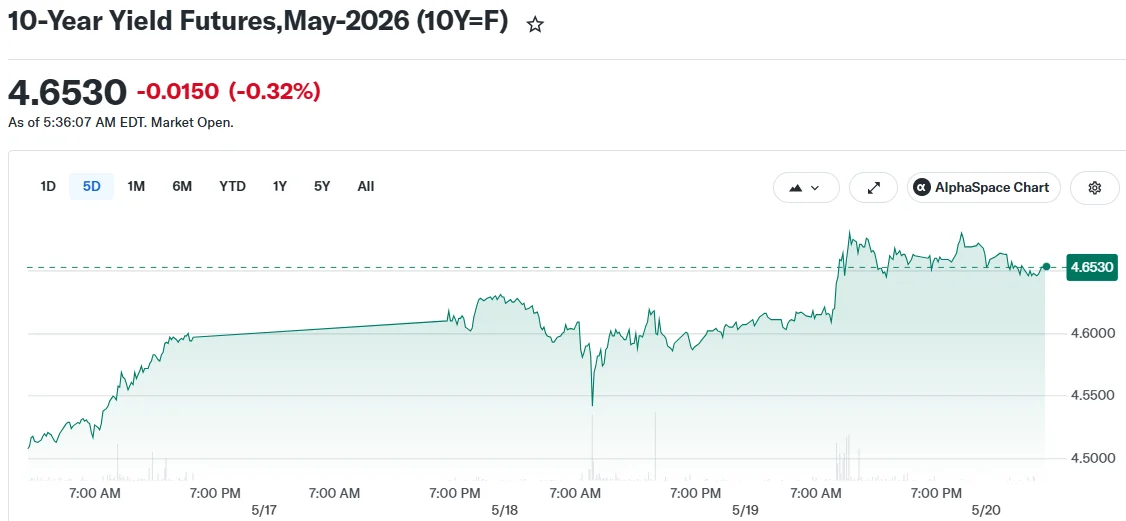
Though yields have moderated slightly to 4.65% and 5.17% respectively, they remain at concerning elevations. Two-year Treasury notes are also trading at their highest levels since February 2025.
Fixed-income markets are responding to a convergence of mounting economic pressures. The escalating Middle East crisis has effectively shuttered the Strait of Hormuz, driving energy costs upward and sustaining inflation anxieties.
April’s Consumer Price Index registered a 3.8% increase—the most substantial annual gain witnessed in three years. Gasoline prices skyrocketed by more than 28% during the identical timeframe.
The expanding federal deficit compounds these challenges. With America’s national debt reaching $38.5 trillion, each percentage point increase in interest rates translates to an additional $3.2 trillion in debt servicing costs over ten years.

Last Friday’s economic forecast from the Federal Reserve Bank of Philadelphia projected subdued economic expansion, moderate employment growth, and persistent inflationary pressure. Derivatives markets are now incorporating the likelihood that the Federal Reserve’s next policy adjustment might be a rate increase rather than the previously anticipated reduction.
What Rising Yields Mean for Investors and Borrowers
Escalating Treasury yields immediately diminish the market valuation of outstanding bonds. Fixed-income investors maintaining long-duration positions face capital depreciation if liquidating holdings prior to maturity.
Equity market participants are experiencing similar pressures. When government securities deliver risk-free returns exceeding 5%, stocks become comparatively less appealing. Tech stocks commanding elevated valuations face particular vulnerability to this dynamic shift.
Corporate borrowing costs escalate alongside rising yields, potentially constraining profitability. Mohit Kumar, Jefferies’ chief European economist, revealed his firm recommended clients steer clear of long-duration bonds given the current energy price disruption.
Home loan rates, which track the 10-year Treasury benchmark, are positioned to climb correspondingly. Floating-rate obligations including credit card balances and home equity credit lines will likely become costlier.
Savers discover a silver lining as elevated yields enhance returns on certificates of deposit and extended-term savings instruments. Newly issued bonds also deliver superior interest payments compared to securities originated during lower-rate environments.
Global Markets React
Bond market turbulence extends beyond American borders. European and Japanese long-term government securities have similarly declined in value, propelling yields toward multi-year summits.
Germany’s 10-year bund, serving as the eurozone’s reference rate, reached a 15-year zenith Tuesday before retreating 2 basis points to 3.17% Wednesday.
Asian equity indices declined for a fourth consecutive trading session, with the MSCI Asia-Pacific benchmark excluding Japan dropping 0.5%. European shares advanced 0.2% as German yields experienced modest pullback.
Wednesday brought tentative positive developments as two Chinese petroleum tankers successfully navigated through the Strait of Hormuz, providing brief optimism for oil markets. Brent crude futures retreated 2%. Nevertheless, market observers cautioned that previous expectations regarding the waterway’s reopening have previously proven premature.
U.S. equity futures suggested moderate appreciation Wednesday. Market participants maintained keen attention on Nvidia’s quarterly financial results scheduled for later that day, while the broader investment landscape remained overshadowed by sustained elevated yields.
In diplomatic developments from Beijing, Chinese President Xi Jinping conducted discussions with Russian President Vladimir Putin, emphasizing the urgency of resolving the Middle East confrontation—a progression financial markets continue monitoring closely.
Get 3 Free Stock Ebooks
Discover top-performing stocks in AI, Crypto, and Technology with expert analysis.
- Top 10 AI Stocks - Leading AI companies
- Top 10 Crypto Stocks - Blockchain leaders
- Top 10 Tech Stocks - Tech giants


