


Key Highlights
- Uniswap community voting window opens July 19 through July 26 for two critical governance decisions
- First measure introduces v4 protocol fee activation spanning seven blockchain networks
- Second measure expands v2 and v3 fee collection to Robinhood Chain
- Revenue from both initiatives will support the current UNI token burn protocol
- Robinhood Chain generated over $6 billion in Uniswap trading volume during its first ten days
The Uniswap decentralized exchange community prepares to decide on two critical governance measures that may significantly increase the quantity of UNI tokens removed from total supply. The voting period begins on July 19 and concludes on July 26.
The initial governance measure seeks approval to implement protocol fees across designated Uniswap v4 liquidity pools. The implementation would encompass Ethereum, Arbitrum, Base, BNB Chain, Polygon, Optimism, and Robinhood Chain. This marks the inaugural governance decision regarding v4 fee structures.
The companion proposal, introduced by Uniswap creator Hayden Adams, aims to enable fee collection for v2 and v3 deployments on Robinhood Chain. All three protocol iterations were deployed to the network during its July 1 launch.
Robinhood Chain operates as an Ethereum Layer 2 scaling solution utilizing Arbitrum’s underlying technology. The network’s Uniswap deployments surpassed $6 billion in total trading volume by July 10, achieving this milestone within ten days of going live.
Cryptocurrency analyst BATMAN, recognized on X as @CryptosBatman, drew attention to UNI’s price movement on July 13. He emphasized that UNI serves as the dominant automated market maker on Robinhood Chain, generating additional protocol revenue. His technical analysis indicated a chart breakout pattern, suggesting a retest would offer an attractive entry opportunity.

Both governance measures channel collected protocol fees through Uniswap’s TokenJar infrastructure. Specialized searchers claim these accumulated fee assets by depositing equivalent-value UNI tokens. The deposited UNI is subsequently transferred to a permanent burn address. Fees generated on alternative blockchain networks are bridged to Ethereum before final destruction.
Adams commented on X: “Based on current volumes, especially Robinhood, we expect the impact on UNI burn to be substantial.”
Distinct v4 Fee Architecture
Implementing fees on v4 necessitated novel technical infrastructure. In contrast to v2 and v3 deployments that employ predetermined fee structures, v4 pools support customizable hooks and adaptive fees that adjust per block.
The governance measure introduces a V4FeePolicy smart contract for fee computation alongside a V4FeeAdapter for implementing governance parameters. Liquidity pools are categorized into “families” with fees determined through rule-based calculations rather than individual pool configuration.
An additional v4 governance vote addressing five supplementary chains — Celo, Soneium, Worldchain, X Layer, and Zora — is scheduled as a separate measure. Uniswap’s GovernorBravo smart contract restricts individual proposals to ten onchain operations.
Historical UNI Burn Performance
The UNI token burn system was established through the “UNIfication” governance overhaul approved in December 2025 with overwhelming 99.9% community support. That historic vote enabled fee collection across v2 and v3 Ethereum mainnet pools while permanently destroying 100 million UNI from the treasury reserves.
The fee collection program has subsequently extended to 11 distinct blockchain networks. The protocol achieved a single-day record by burning 186,000 UNI tokens during the previous month.
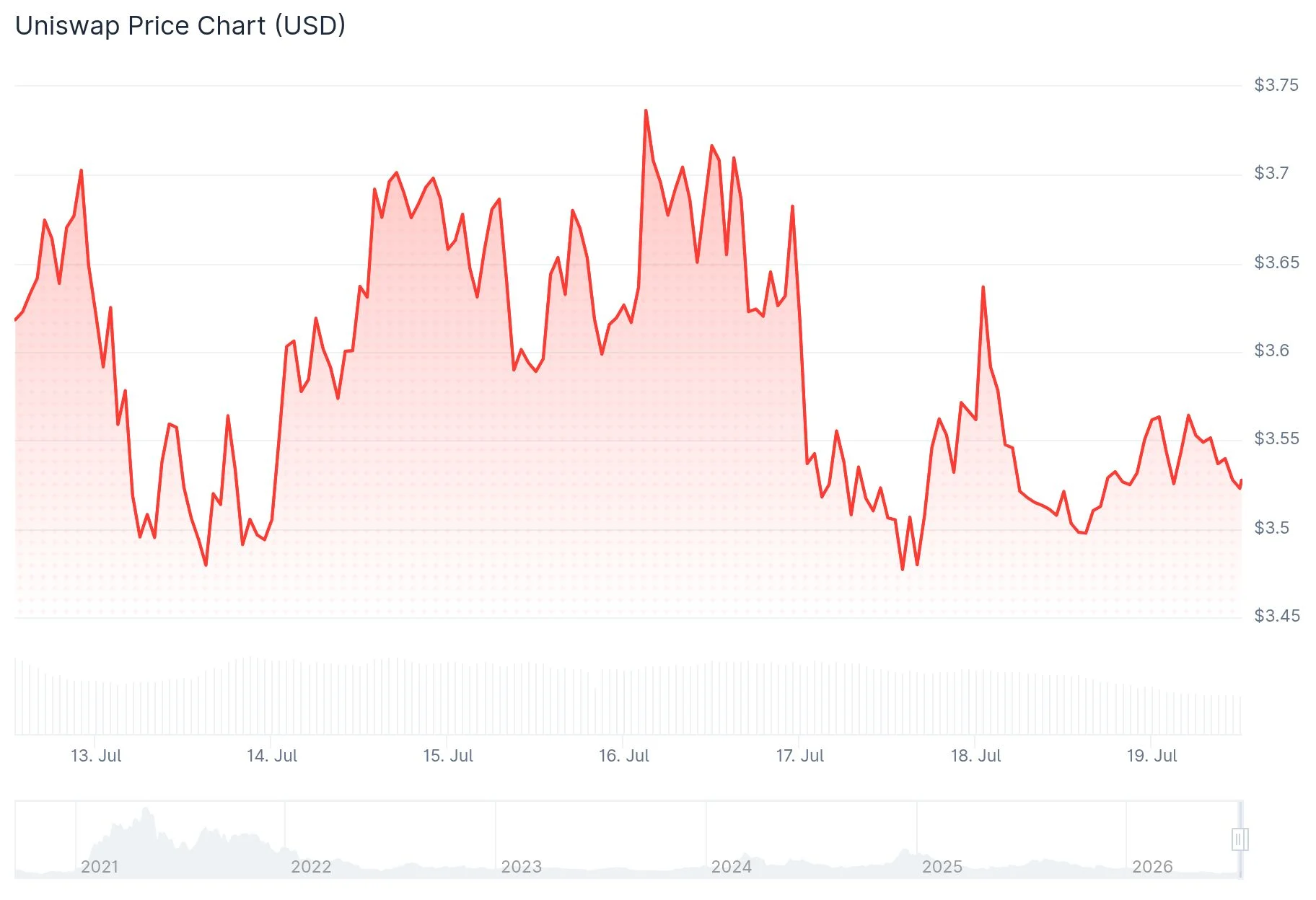
UNI is presently valued at approximately $3.50.
Get 3 Free Stock Ebooks
Discover top-performing stocks in AI, Crypto, and Technology with expert analysis.
- Top 10 AI Stocks - Leading AI companies
- Top 10 Crypto Stocks - Blockchain leaders
- Top 10 Tech Stocks - Tech giants


