


TLDR
- Following a spectacular 460% first-day gain, Unitree stock plummeted 45% from its peak
- Market capitalization briefly touched $66 billion before shedding more than 200 billion yuan within days
- Q1 adjusted earnings collapsed 53% amid rising expenses and sparse commercial demand
- The volatile debut has intensified criticism of China’s regulated IPO pricing mechanisms
- Market observers point to a widening disconnect between robotics enthusiasm and practical applications
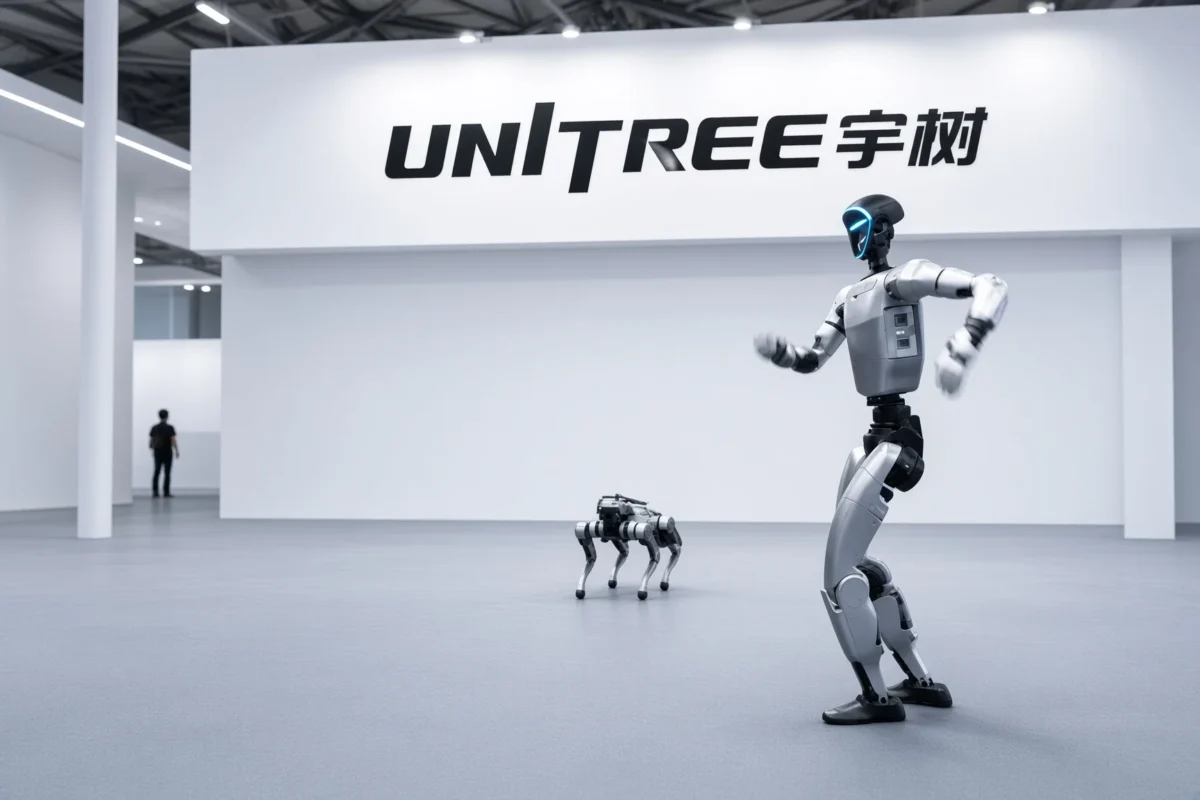
The dramatic rise and fall of Unitree has emerged as a stark warning for China’s technology investors. The humanoid robotics specialist based in Hangzhou has seen its shares tumble approximately 45% from an intraday high of 1,100 yuan, achieved mere days following its August 19 listing on the Shanghai exchange.
Monday’s closing price stood at 603.08 yuan, a significant retreat from the 845 yuan recorded at the end of the inaugural trading session. Despite this correction, the stock continues to command roughly four times its initial offering price of 150.80 yuan.
The listing day proved remarkable by any measure. Close to 9.8 million individual investor accounts vied for approximately 9.7 million shares made available to the public. Trading commenced 629% above the issue price and concluded the first day with a 460% gain, momentarily establishing a company valuation near 445 billion yuan, equivalent to approximately $66 billion.
Come Monday’s session end, that valuation had contracted to roughly 244 billion yuan, erasing upwards of 200 billion yuan in market capitalization within seven days.
Financial Reality Emerges
The sharp reversal followed closer examination of Unitree’s underlying business fundamentals. While revenues expanded more than four times to reach 1.7 billion yuan in 2025, with the company posting profits at the time of going public, recent performance tells a different story.
Latest quarterly figures paint a less optimistic picture. The first quarter of 2026 saw adjusted net income decline 53% to roughly 40 million yuan, pressured by escalating operational costs.

Company founder Wang Xingxing conceded during the World Robot Conference that humanoid robots have yet to achieve readiness for widespread industrial adoption. His remarks highlighted their current inability to match human efficiency in basic operations and their limited versatility across varied work environments.
Prior to the public offering, HSBC analysts had cautioned that the recent uptick in humanoid robot deliveries might prove difficult to maintain absent substantial advances in artificial intelligence capabilities.
Regulatory Framework Questioned
The extreme volatility has reignited debate surrounding China’s approach to initial public offerings. Government regulators maintain significant influence over approval processes and pricing determinations, while the STAR Market’s constrained initial share availability can generate acute supply shortages when investor appetite runs high.
Limited short-selling mechanisms leave doubtful investors with minimal options to challenge overvalued market debuts.
Venture capital investor Abraham Zhang characterized the system as one enabling major stakeholders to exit at excessive valuations while individual investors bear the subsequent losses. “Those fortunate enough to secure IPO allocations departed satisfied,” he observed.
A retail participant who suffered losses expressed frustration online, arguing that advancing Chinese technological innovation “must not be financed through retail investor suffering.”
Unitree’s experience is not isolated. CXMT, a manufacturer of DRAM memory chips, experienced a 466% surge during its Shanghai debut the previous month before encountering comparable downward pressure.
Notwithstanding the selloff, Unitree delivered over 5,500 humanoid robots throughout 2025, positioning it among the globe’s leading suppliers. Nomura analysts suggest its accelerated product innovation cycle provides a competitive edge in this emerging industry.
Get 3 Free Stock Ebooks
Discover top-performing stocks in AI, Crypto, and Technology with expert analysis.
- Top 10 AI Stocks - Leading AI companies
- Top 10 Crypto Stocks - Blockchain leaders
- Top 10 Tech Stocks - Tech giants


