



Key Takeaways
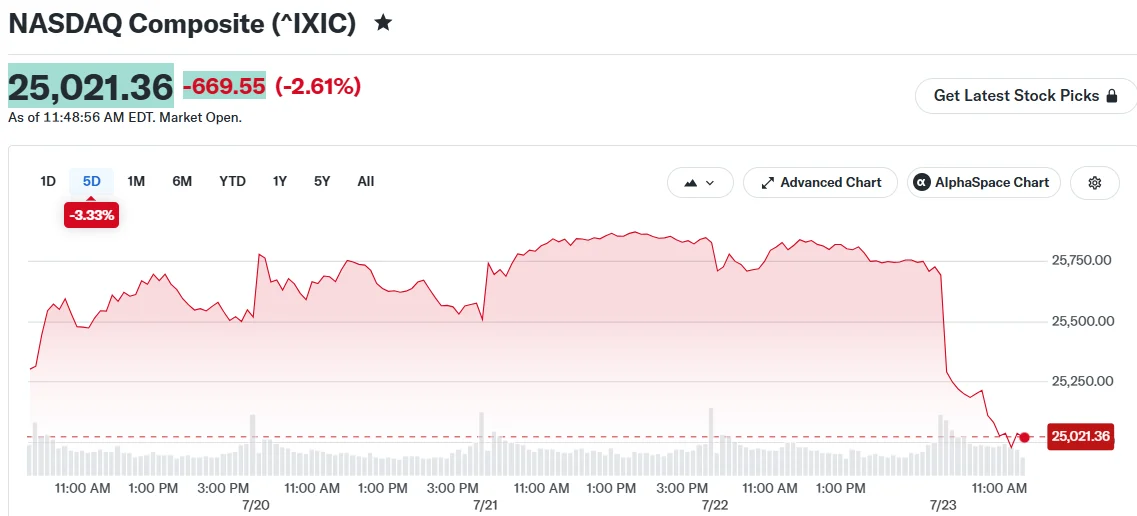
- Thursday saw the Nasdaq plunge over 2.5%, with Alphabet and Tesla leading the decline
- For the first time ever, Alphabet reported negative quarterly free cash flow, with Q2 capex hitting $44.9 billion
- Tesla stock plummeted 13.5% following disappointing margins and $5.8 billion in quarterly capital spending
- Major technology companies like Amazon, Meta, and Microsoft experienced significant declines
- Industry experts caution that combined capex from five leading tech giants may exceed free cash flow generation by 2027
Thursday’s quarterly earnings from Alphabet and Tesla sent shockwaves through financial markets, as both technology behemoths revealed capital expenditure levels that completely eclipsed their free cash flow generation. The reports have intensified scrutiny over whether artificial intelligence infrastructure investments can deliver returns quickly enough to justify current valuations.
The technology-heavy Nasdaq Composite tumbled 2.8% to settle around 24,975. Meanwhile, the S&P 500 declined 1.5% and the Dow Jones Industrial Average retreated 1.2%.
Financial Results Trigger Market Reaction
Alphabet’s second-quarter revenue reached $119.8 billion, surpassing analyst expectations of $116.9 billion. The Google Cloud division showed particularly strong performance, generating $24.8 billion—an impressive 82% increase compared to the previous year.
However, it was the capital expenditure figure that sent alarm bells ringing among investors: $44.9 billion spent in just three months, representing a doubling from the same period last year. This expenditure completely consumed the company’s $39.1 billion in operating cash flow, resulting in the company’s first-ever quarterly negative free cash flow.
The company increased its annual capex forecast to $195–205 billion from the previous $180–190 billion range, while indicating that spending would continue climbing through 2027.

CEO Sundar Pichai defended the expenditures, stating that artificial intelligence investments are “redefining what’s possible across every part of our business.” Investors weren’t convinced. Alphabet shares tumbled more than 7% during Thursday’s session.
Tesla’s results followed a comparable pattern. The electric vehicle manufacturer delivered 480,126 vehicles, exceeding projections, yet automotive gross margin registered at 16.3%—notably below the 18.04% analyst consensus.
Capital expenditures skyrocketed 142% to reach $5.8 billion as Tesla pushes forward with its robotaxi initiatives and AI development programs. CEO Elon Musk reassured analysts that the company remains optimistic about investment returns. The stock dropped 13.5%.
Broader Technology Sector Concerns
The market downturn extended throughout the technology sector. Amazon shares declined nearly 5%, Meta experienced a close to 4% drop, and Microsoft slipped more than 2%. The Philadelphia Semiconductor Index had already retreated more than 20% from its late-June high before these quarterly reports emerged.
According to a Reuters examination, Microsoft, Alphabet, Amazon, Meta, and Oracle are collectively projected to spend more on capital expenditures than they produce in free cash flow by 2027. The analysis reveals that for each dollar of incremental operating cash flow these firms anticipate generating between 2025 and 2027, they’re planning $1.57 in capital spending.
This financial equation was sustainable when these corporations operated primarily on high-margin software business models requiring minimal physical infrastructure. Artificial intelligence is fundamentally altering that dynamic.
Keith Lerner, chief investment officer at Truist, characterized the market movement as more of a sector rotation rather than a wholesale market exodus, noting relative strength in Industrials, Energy, and Healthcare sectors.
“The bull market still deserves the benefit of the doubt, but this reinforces our view from the past month that markets were entering a bumpier period,” Lerner said.
Market participants are now closely monitoring upcoming earnings from Meta and Microsoft on July 29, followed by Amazon on July 31. These releases will help determine whether this week’s declines represent an isolated response or signal the beginning of a more comprehensive revaluation of AI-focused company valuations.
Get 3 Free Stock Ebooks
Discover top-performing stocks in AI, Crypto, and Technology with expert analysis.
- Top 10 AI Stocks - Leading AI companies
- Top 10 Crypto Stocks - Blockchain leaders
- Top 10 Tech Stocks - Tech giants


