



A comprehensive new study examining artificial intelligence’s impact on the workforce has identified customer service representatives, data entry specialists, and telemarketing professionals as the roles facing the most significant threat from AI-powered automation.
The AgentLocker AI Jobs Automation Index evaluated 3,611 distinct AI applications, cross-referencing their capabilities against employment statistics, compensation data, and career projections from US labor markets.
This groundbreaking analysis reveals that existing AI solutions are currently designed to handle workplace responsibilities accounting for roughly $3 trillion in yearly US worker compensation, demonstrating the enormous economic footprint of AI-enabled automation.
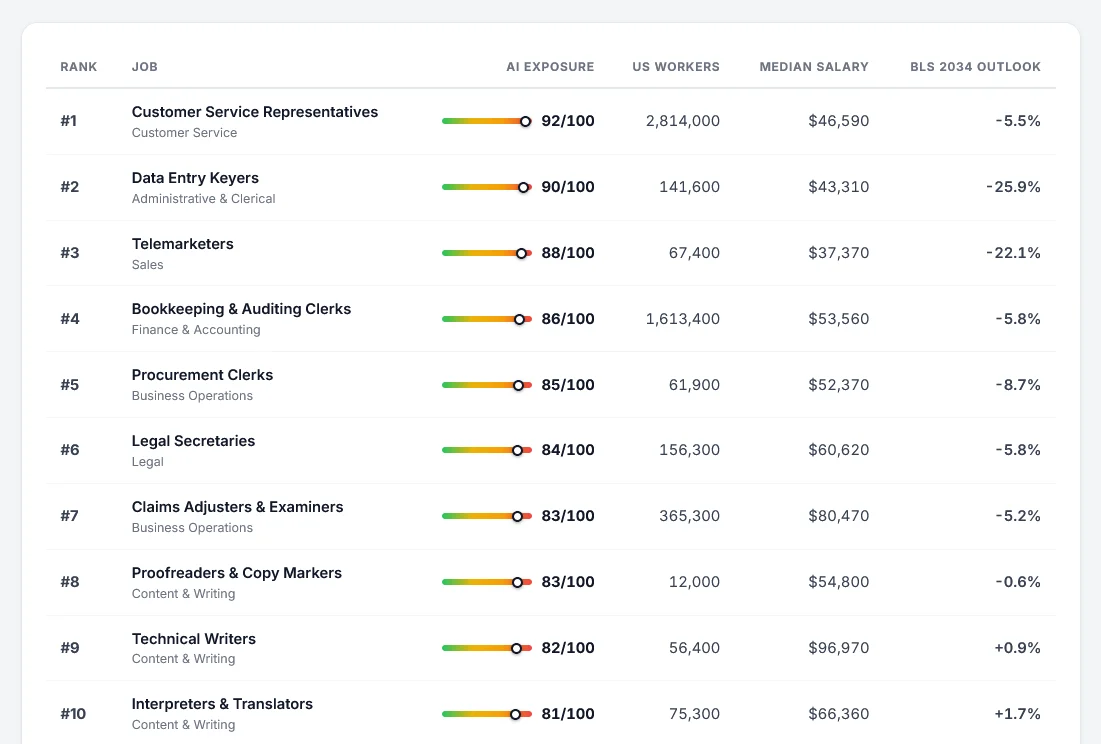
Customer service roles show maximum vulnerability to AI replacement
Among the 25 professions examined, customer service representatives emerged as the most vulnerable occupation, achieving an AI exposure rating of 92 out of 100.
The United States currently employs approximately 2.8 million people in customer service positions, with workforce projections indicating a 5.5% contraction in this sector between 2024 and 2034.

Data entry keyers secured the second position with an exposure rating of 90, while telemarketers followed closely at 88.
The complete list of the ten most AI-exposed professions includes:
- Customer Service Representatives — 92/100
- Data Entry Keyers — 90/100
- Telemarketers — 88/100
- Bookkeeping & Auditing Clerks — 86/100
- Procurement Clerks — 85/100
- Legal Secretaries — 84/100
- Claims Adjusters & Examiners — 83/100
- Proofreaders & Copy Markers — 83/100
- Technical Writers — 82/100
- Interpreters & Translators — 81/100
Many occupations ranking high on this assessment are simultaneously experiencing anticipated workforce reductions.
The Bureau of Labor Statistics forecasts that data entry positions will contract by 25.9% through 2034, while telemarketing roles face a projected decline of 22.1%.
Business operations emerges as primary target for AI development
When examining broader occupational categories, AgentLocker’s research identified Business Operations as receiving the most concentrated AI development attention.
An impressive 1,202 AI applications—representing 33.3% of all examined products—demonstrated capabilities aligned with business operations functions.
Marketing secured second place with 930 dedicated tools, while Content & Writing attracted 828 solutions.
Additional job categories receiving substantial AI investment included productivity optimization and office management, research and analytical functions, customer support services, administrative operations, and software engineering.
These findings illuminate where AI developers currently identify the most lucrative market opportunities.
Repetitive digital tasks encompassing research activities, content creation, communication workflows, administrative duties, and data processing are receiving substantially more AI innovation compared to industries where physical labor predominates.
- Healthcare, by comparison, showed only 1.3 AI tools per 100,000 American workers within the AgentLocker analysis.
- Research & Data Analysis had significantly higher concentrations.
Elevated AI exposure doesn’t guarantee job elimination
Among the study’s most compelling discoveries is evidence that certain professions facing substantial AI exposure are nevertheless projected to expand.
Software developers registered an AI exposure rating of 68/100, yet this occupation anticipates employment growth of 15.8% from 2024 through 2034.
Data scientists show an exposure measurement of 66 while simultaneously expecting workforce expansion of 33.6%.
Market research analysts demonstrate similarly elevated exposure with a score of 79, but still project employment gains of 6.7%.
These patterns indicate AI may fundamentally reshape numerous careers rather than completely replacing them.
Professionals may increasingly leverage AI for executing specific tasks while maintaining responsibility for strategic judgment, quality control, specialized expertise, and other functions that remain challenging to automate.
Conversely, occupations where elevated AI exposure aligns with existing workforce contraction may experience more severe disruption.
Customer service, data entry, telemarketing, bookkeeping, procurement, legal secretarial positions, and computer programming all demonstrate this concerning pattern within the index.
AI developers pursuing massive salary pool
AgentLocker calculates that American job functions currently addressed by existing AI technologies represent approximately $3 trillion in yearly worker compensation.
This substantial figure doesn’t forecast actual wage losses attributable to AI displacement.
Rather, it quantifies the scale of economic opportunity that software enterprises are pursuing through developing tools capable of executing tasks historically performed exclusively by human workers.
Even capturing a modest fraction of work conducted across domains including business operations, marketing, software development, customer support, and financial services could constitute an extraordinary marketplace for AI companies.
Measuring actual AI development rather than theoretical potential
Most discussions surrounding AI’s employment impact concentrate on speculative forecasts about artificial intelligence’s future capabilities.
The AgentLocker index adopts an alternative methodology by examining AI products currently available in the marketplace.
Each of the 3,611 tools within the AgentLocker database was categorized according to their functional capabilities and aligned with 16 comprehensive job function categories. Individual professions were subsequently evaluated based on how extensively their primary responsibilities could be performed by currently available AI solutions.
Employment statistics, compensation information, and growth projections were validated against official US Bureau of Labor Statistics records.
AgentLocker indicates the index will receive regular updates as additional AI products launch in the market.
Get 3 Free Stock Ebooks
Discover top-performing stocks in AI, Crypto, and Technology with expert analysis.
- Top 10 AI Stocks - Leading AI companies
- Top 10 Crypto Stocks - Blockchain leaders
- Top 10 Tech Stocks - Tech giants


