


Key Takeaways
- AlzeCure Pharma shares skyrocketed more than 301% following revelation of a licensing partnership with Eli Lilly covering Alzheimer’s therapy candidate Alzstatin ACD680
- The partnership carries potential aggregate value surpassing $1 billion, royalties not included
- AlzeCure secures $10 million in immediate upfront compensation alongside prospective development and sales-based milestone payments
- Eli Lilly acquires worldwide commercialization rights to ACD680, a gamma-secretase modulator designed to address toxic amyloid-beta accumulation
- The agreement awaits clearance from Swedish regulatory bodies under foreign direct investment protocols
Shares of AlzeCure Pharma rocketed more than 301% higher Tuesday following the Swedish biotechnology firm’s announcement of a significant licensing partnership with Eli Lilly concerning its Alzheimer’s disease candidate, Alzstatin ACD680.
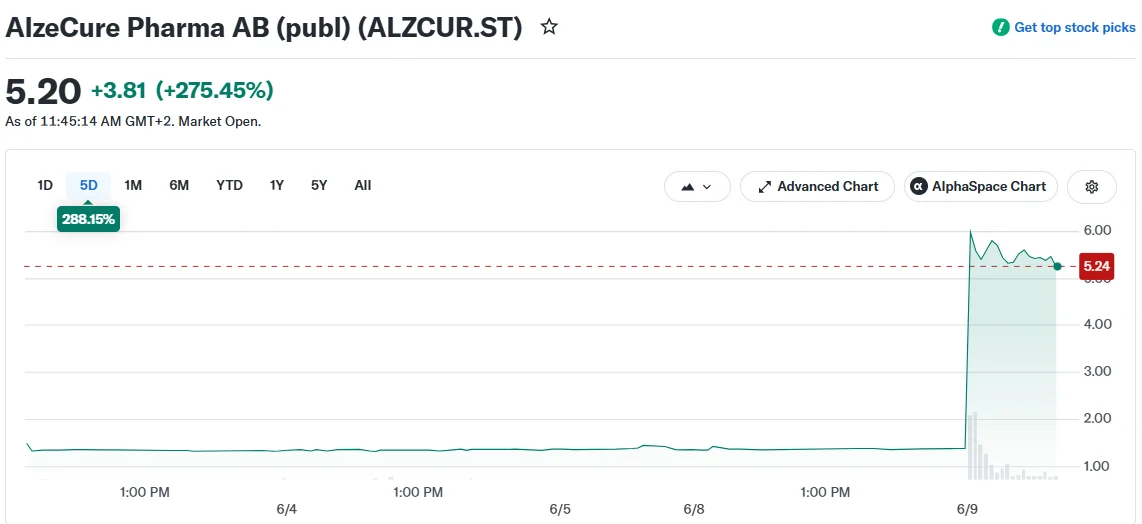
The agreement transfers worldwide commercialization rights for ACD680 to Eli Lilly, with the preclinical-stage compound at the center of a deal potentially worth more than $1 billion excluding royalty arrangements.
AlzeCure stands to collect $10 million immediately upon closing. Beyond the upfront sum, the Swedish company will be eligible for both development-stage and commercial milestone payments, supplemented by tiered mid-single digit percentage royalties on eventual product sales.
Alzstatin ACD680 functions as a gamma-secretase modulator. Essentially, the compound aims to decrease generation of amyloid-beta 42, a toxic protein variant that accumulates as brain plaques characteristic of Alzheimer’s disease.
Simultaneously, the drug candidate is engineered to increase production of shorter, benign amyloid protein forms — Aβ37 and Aβ38 — which may counteract accumulation of the pathological variant.

Chief Executive Martin Jönsson characterized the partnership as “an important milestone for AlzeCure and Alzstatin.” He suggested the compounds might eventually enable prevention of Alzheimer’s disease entirely.
Distinguishing Features of ACD680
Chief Scientific Officer Johan Sandin emphasized that the Alzstatin platform generates small-molecule therapeutics. This distinction carries significance because small molecules generally prove more straightforward to produce and deliver compared to larger biological therapies.
Sandin additionally highlighted the mechanism’s robust genetic connection to Alzheimer’s pathology, providing the scientific approach with solid theoretical underpinnings.
While the gamma-secretase modulator strategy has faced challenges historically in pharmaceutical development, the genetic evidence supporting Alzstatin’s design philosophy distinguishes it from previous unsuccessful efforts.
The Lilly Partnership
Eli Lilly ranks among the most engaged pharmaceutical companies in Alzheimer’s research. The corporation’s currently marketed treatment Kisunla addresses amyloid plaque pathology, making incorporation of a preclinical small-molecule asset consistent with its comprehensive pipeline approach.
For AlzeCure, this partnership represents endorsement of extensive research on a technology platform that has maintained relatively low visibility beyond Swedish borders.
The transaction requires regulatory clearance before finalization. Swedish government authorities must grant approval under foreign direct investment oversight before the deal can officially close.
AlzeCure maintains its listing on Nasdaq First North Premier Growth Market. Eli Lilly shares advanced approximately 1.57% following the announcement.
The $10 million upfront compensation provides AlzeCure with instant financial resources. Milestone-based payments connected to development achievements and commercial success could substantially increase total compensation if ACD680 progresses successfully through clinical testing phases.
Get 3 Free Stock Ebooks
Discover top-performing stocks in AI, Crypto, and Technology with expert analysis.
- Top 10 AI Stocks - Leading AI companies
- Top 10 Crypto Stocks - Blockchain leaders
- Top 10 Tech Stocks - Tech giants


