



Key Takeaways
- US stock futures showed modest gains Friday morning following Thursday’s brutal tech selloff
- Mega-cap tech stocks collectively shed approximately $800 billion in market capitalization
- Weak earnings results from Alphabet and Tesla sparked the technology sector downturn
- President Trump’s Section 301 tariffs ranging from 10% to 12.5% became active overnight
- Bitcoin retreated 0.4% to trade at $65,360 amid declining risk appetite
Wall Street futures posted tentative gains early Friday as market participants attempted to stabilize following one of 2024’s most severe trading sessions for technology equities.
Futures tied to the Dow Jones Industrial Average climbed approximately 0.5%. Contracts linked to the S&P 500 advanced 0.2%. Nasdaq futures showed minimal movement, gaining just 0.1%.
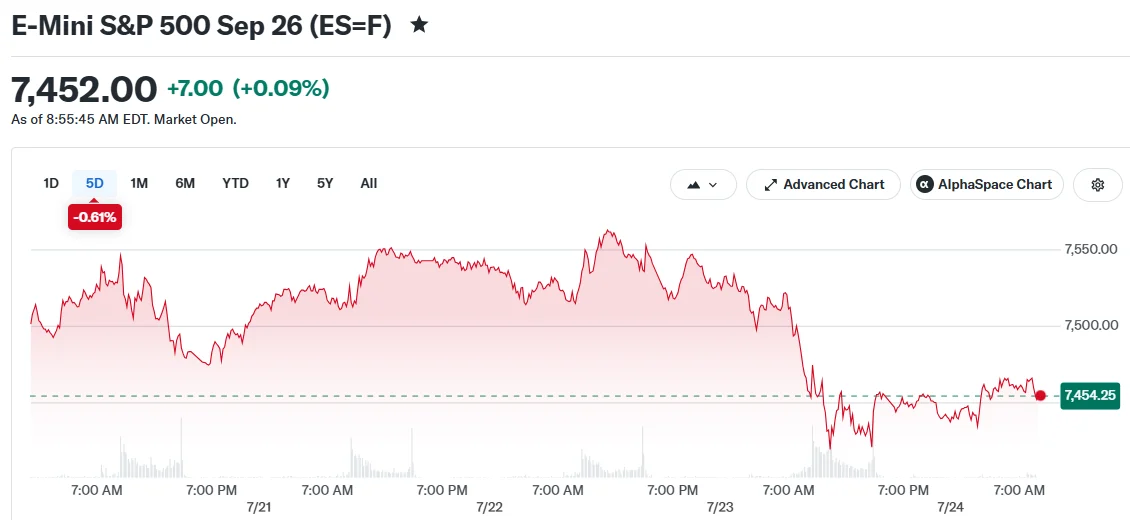
This tepid bounce follows Thursday’s devastating session, during which the “Magnificent Seven” technology behemoths collectively erased close to $800 billion in market capitalization within just one trading day.
The dramatic downturn was fueled by quarterly results from Alphabet and Tesla, where both companies revealed escalating artificial intelligence expenditures that rattled investor confidence. Asian markets mirrored Wall Street’s weakness, with significant declines recorded across Japan’s Nikkei and South Korea’s KOSPI indices.
New Tariff Regime Compounds Market Anxiety
As markets opened Friday, a fresh wave of American import duties came into force. The administration’s Section 301 tariff framework now encompasses virtually all incoming US goods, imposing levies of 10% to 12.5% on shipments from America’s largest trade partners.

Certain energy commodities received exemptions from the new tariff structure. Administration officials indicated the revised framework was engineered to withstand potential legal scrutiny more effectively than previous iterations.
Oil prices retreated Friday morning, with Brent crude declining roughly 2% to settle just beneath the $99 per barrel threshold. This pullback provided modest relief on inflation concerns. Nevertheless, Brent remains positioned for weekly gains after momentarily breaching the $100 mark on Thursday.
Artificial Intelligence Investment Concerns Drag Tech Lower
The technology-heavy Nasdaq continues to underperform relative to the Dow and S&P 500 in pre-market activity, signaling persistent investor nervousness surrounding artificial intelligence capital expenditures.
Semiconductor manufacturers Micron and Sandisk both traded lower before the opening bell. Deutsche Bank’s chief strategist Jim Reid characterized the situation as “a challenging 24 hours for markets,” citing the volatile combination of surging oil prices and AI investment uncertainty.
The benchmark 10-year Treasury yield stabilized around 4.70% on Friday, following Thursday’s climb to an 18-month peak. Elevated bond yields typically weigh on growth-oriented equities by diminishing the present value of anticipated future profits.
The US dollar index remained unchanged. Bitcoin declined 0.4% during the past 24 hours to $65,360, mirroring the broader caution surrounding risk-sensitive assets.
Corporate earnings scheduled for Friday release include reports from American Express, NextEra Energy, and Verizon. Key economic releases comprise S&P Global’s preliminary purchasing managers index for July alongside fresh new home sales data.
Despite Friday’s pre-market stabilization, all three primary US equity benchmarks are trending toward weekly declines.
Get 3 Free Stock Ebooks
Discover top-performing stocks in AI, Crypto, and Technology with expert analysis.
- Top 10 AI Stocks - Leading AI companies
- Top 10 Crypto Stocks - Blockchain leaders
- Top 10 Tech Stocks - Tech giants


