


Key Highlights
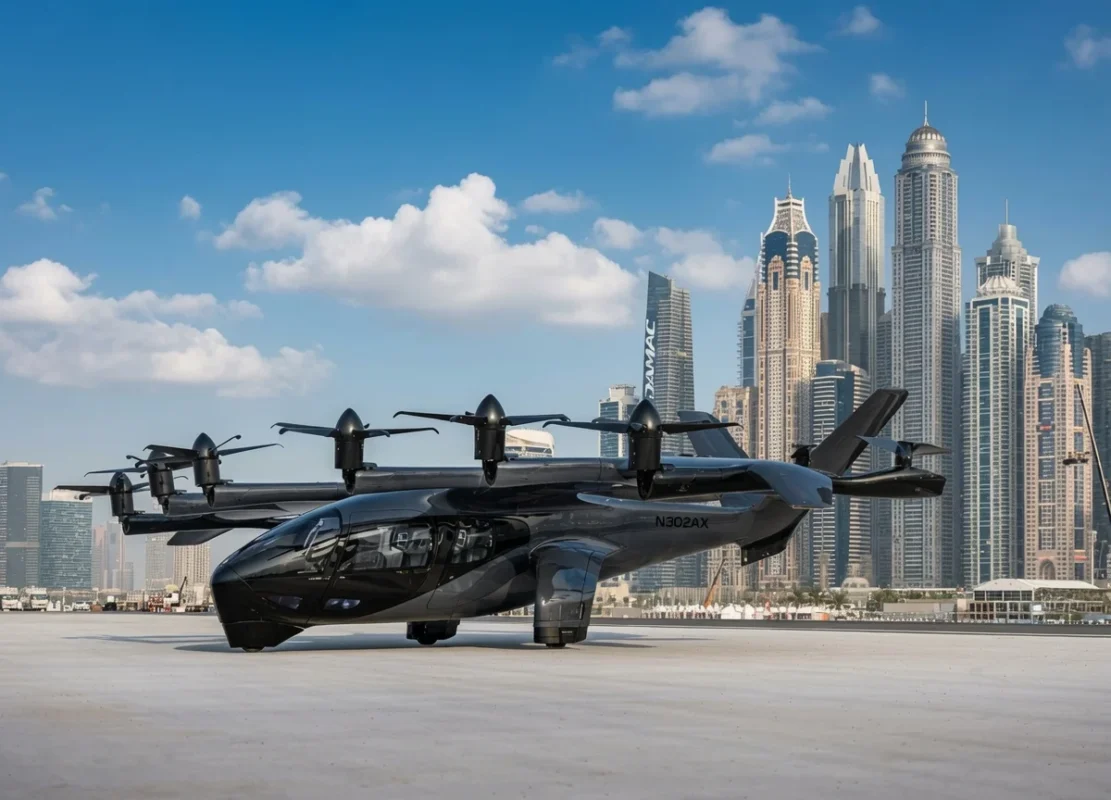
- Archer Aviation introduced Halo, an autonomous commercial vertical takeoff and landing aircraft, during Wednesday’s Farnborough International Airshow.
- The aircraft was co-developed with Anduril Industries, a defense technology firm, and shares its airframe with Anduril’s military version, Thunder.
- Featuring a series hybrid-electric propulsion system and dual tiltrotor configuration, Halo is compact enough to fit in a standard shipping container.
- Marubeni Aerospace Corporation has been announced as Halo’s inaugural strategic launch partner.
- Intended applications include offshore energy logistics, cargo transport, humanitarian relief missions, and maritime support operations.
At Wednesday’s Farnborough presentation, Archer Aviation (ACHR) introduced Halo, an autonomous commercial aircraft developed in partnership with defense technology innovator Anduril Industries. At announcement time, ACHR stock traded down 1.61%.
Serving as the commercial equivalent to Anduril’s Thunder military aircraft—which debuted days earlier at the same airshow—Halo utilizes an identical airframe, hybrid-electric propulsion architecture, and foundational technology suite.
The design represents a ground-up development effort, constructed entirely from scratch rather than modifying existing aircraft designs. According to Archer CEO Adam Goldstein, the platform leverages eight years of accumulated electric aviation expertise.
“Our collaboration with Anduril enabled us to channel all that accumulated expertise into something unprecedented: a completely new aircraft representing an entirely different category of range, velocity, and cargo capacity,” Goldstein explained.
Halo incorporates a series hybrid-electric propulsion architecture combined with dual tiltrotors. This tiltrotor configuration optimizes performance throughout various flight stages while maintaining minimal acoustic signatures during vertical operations.

Operating without any human pilot aboard, the aircraft functions entirely autonomously—a critical capability for the commercial cargo operations Archer envisions.
Additionally, the aircraft’s dimensions allow it to be transported within standard shipping containers, enabling deployment via air freight, ground transport, rail networks, or maritime shipping. The company emphasized that the platform leverages commercial supply chains for scalable high-volume manufacturing.
Commercial Applications
Halo addresses operational gaps where traditional aircraft prove inadequate—specifically, extended-range cargo delivery to remote sites lacking runway infrastructure.
Primary use cases encompass offshore energy platform resupply, freight logistics, humanitarian assistance deliveries, medical cargo transport, and maritime support missions. These sectors prioritize payload volume, operational range, and autonomous functionality over passenger amenities.
Marubeni Aerospace Partnership Announcement
Archer designated Marubeni Aerospace Corporation as Halo’s strategic inaugural partner. Marubeni Aerospace, operating as a division of Japan’s Marubeni Corporation, serves as representative for multiple international aircraft and rotorcraft manufacturers.
The partnership will focus on collaborative market analysis, commercial application identification, and strategic deployment planning for the aircraft platform.
Marubeni Aerospace President and CEO Satoru Nakagawa characterized Halo’s autonomous operation combined with its range capabilities, payload capacity, and vertical takeoff functionality as “a highly suitable solution” for its intended market segments.
Archer indicated that further launch partner announcements are anticipated prior to the conclusion of 2026.
The Farnborough International Airshow represents a premier global forum for commercial aviation announcements and strategic partnerships, increasingly spotlighting emerging aviation technologies such as electric propulsion and autonomous flight systems.
Get 3 Free Stock Ebooks
Discover top-performing stocks in AI, Crypto, and Technology with expert analysis.
- Top 10 AI Stocks - Leading AI companies
- Top 10 Crypto Stocks - Blockchain leaders
- Top 10 Tech Stocks - Tech giants


