



Key Takeaways
- Spot Bitcoin ETFs in the United States experienced net withdrawals of $462.7M during the previous week, breaking a three-week positive streak
- Ethereum ETFs attracted $196.9M in net capital during the identical timeframe, highlighted by BlackRock’s impressive $148.8M influx on Friday
- The ETH/BTC trading pair has climbed more than 25% throughout Q3, marking its strongest quarterly performance since the third quarter of 2025
- Ethereum’s third-quarter return on investment is nearing 60%, approaching its historical Q3 peak of over 66%
- Both cryptocurrencies exhibit unclear directional momentum, with critical moving averages serving as technical barriers
Last week witnessed American spot Bitcoin exchange-traded funds register net capital outflows totaling $462.7 million, bringing an end to three consecutive weeks of positive accumulation. Simultaneously, Ether-based ETFs secured $196.9 million in fresh capital, prompting speculation regarding institutional allocation strategies.
The exodus from Bitcoin investment vehicles persisted throughout four consecutive market days, spanning Tuesday through the end of the trading week. The most significant hemorrhaging occurred on Thursday, when Bitcoin-focused funds witnessed $282.7 million in redemptions during a single trading session—the largest daily withdrawal figure observed since July.
The ARK 21Shares Bitcoin ETF experienced the heaviest redemptions, totaling $234.2 million in capital exits. Grayscale’s Bitcoin Trust ETF recorded $129.1 million in outflows. BlackRock’s iShares Bitcoin Trust ETF saw $52.5 million depart, while Fidelity’s Wise Origin Bitcoin Fund registered $50.7 million in withdrawals.
However, when examining the broader monthly picture, Bitcoin ETFs maintain a positive trajectory for September, accumulating approximately $307.3 million in net inflows on a month-to-date basis.
Ether Investment Products Attract Continuous Capital
Regarding Ethereum-focused products, capital movements displayed volatility during the initial trading days before experiencing substantial positive momentum heading into Friday. BlackRock’s iShares Ethereum Trust ETF dominated that session with $148.8 million in incoming capital, with the 21Shares Core Ethereum ETF following at $29.1 million.

These Ethereum ETF figures align with an overarching quarterly pattern. The ETH/BTC ratio has appreciated over 25% during this quarter, representing its most substantial quarterly advancement since the third quarter of 2025. Ethereum’s return on investment for Q3 is closing in on 60%, marginally below its record-setting Q3 performance exceeding 66% established the previous year.
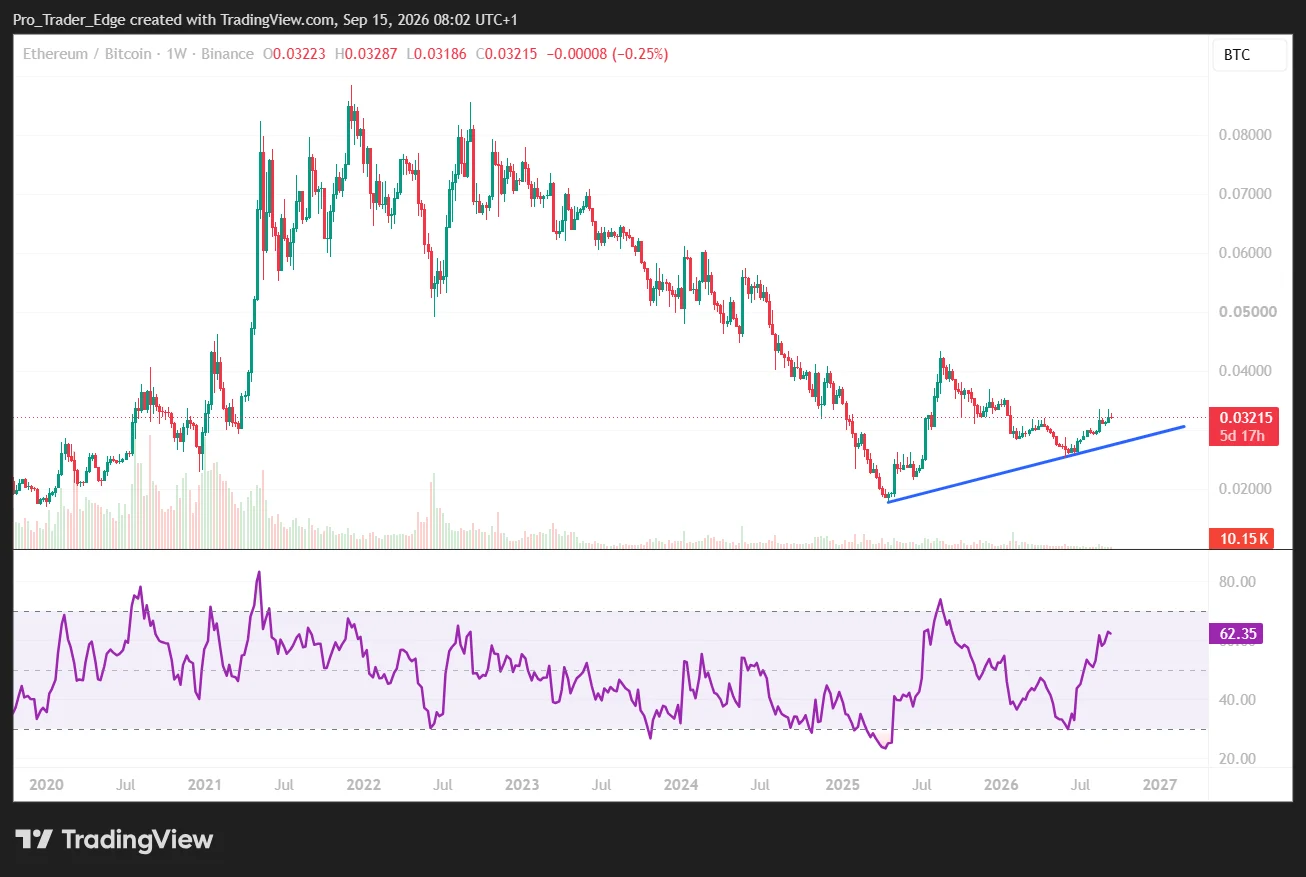
Ethereum’s share of total cryptocurrency market capitalization has likewise expanded by over 25% on a quarter-over-quarter comparison, whereas Bitcoin’s dominance increased by a modest 1.5% during the corresponding timeframe.
Technical Picture Remains Ambiguous
Notwithstanding the flow statistics, neither cryptocurrency’s price movement has definitively validated a sustained capital rotation.
Bitcoin declined to $76,370 during the week but discovered buying interest above its 100-hour exponential moving average positioned at $77,290. Subsequently, it has advanced toward its 200-hour moving average located around $78,151, with current pricing hovering near $78,200 as of Monday’s trading open.
Ethereum experienced a downturn to $2,402 before executing a dramatic reversal to $2,666, representing approximately 7.75% appreciation within several hours. Nevertheless, this upward thrust has been almost completely negated, with pricing returning to approximately $2,510, marginally above its merged 100- and 200-hour moving averages at $2,494 and $2,497 respectively.
According to market analysts, Ethereum must decisively penetrate and maintain levels above the $2,531 to $2,567 resistance band to demonstrate genuine bullish conviction.
Technical strategists emphasize that a single week of contrasting ETF performance could simply indicate portfolio rebalancing activities or strategic profit realization rather than a fundamental directional shift. Multiple successive trading sessions featuring Ethereum accumulation concurrent with Bitcoin withdrawals would be required to validate an authentic institutional rotation.
Both digital assets are endeavoring to establish stable footing, yet neither has convincingly breached critical resistance thresholds.
Get 3 Free Stock Ebooks
Discover top-performing stocks in AI, Crypto, and Technology with expert analysis.
- Top 10 AI Stocks - Leading AI companies
- Top 10 Crypto Stocks - Blockchain leaders
- Top 10 Tech Stocks - Tech giants


