



Key Takeaways
- Friday witnessed the Nasdaq-100’s steepest volatility-adjusted decline in seven months, plummeting 4.8%
- BofA analysts caution that an additional 2% pullback could unleash systematic fund liquidations across the market
- Record-breaking Nasdaq exposure of over $12 billion was dumped by leveraged and inverse ETFs during Friday’s session
- Monday brought relief as semiconductor stocks including Nvidia and Micron spearheaded a market recovery
- Middle East escalations between Iran and Israel sent crude oil surging nearly 4%, complicating the market outlook
The dramatic Nasdaq plunge witnessed on Friday has sent shockwaves through financial markets, prompting investors to question whether the worst is behind them or still to come. Here’s a comprehensive breakdown of the situation.
The Catalyst Behind Friday’s Market Turmoil
The Nasdaq-100 experienced a severe 4.8% decline on Friday, marking its most significant volatility-adjusted loss since October 2025 and ranking as the 13th most severe such decline dating back to 1985. The selloff was ignited by May’s unexpectedly robust employment data, which significantly increased market expectations for potential Federal Reserve rate hikes in the coming months.
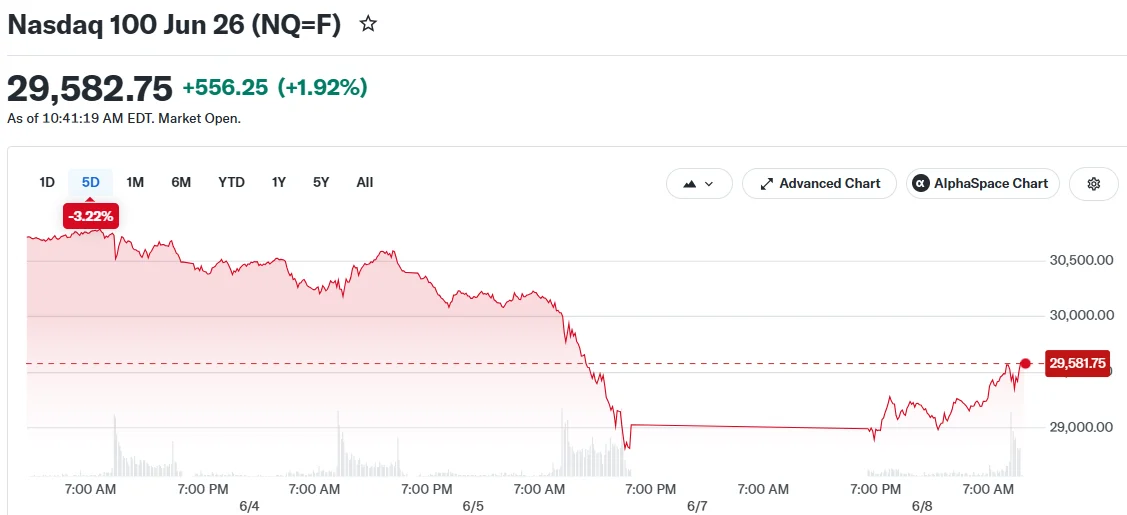
The surprisingly strong employment figures forced market participants to recalibrate their interest rate forecasts. Elevated borrowing costs typically pressure technology and growth-oriented equities, which had enjoyed an extended rally prior to Friday’s downturn.
Bank of America strategist Chintan Kotecha indicated that the selloff has likely initiated an unwinding process among commodity trading advisor (CTA) funds and other systematic trading strategies. These algorithmic-based investment vehicles execute predetermined selling programs when market prices breach specific technical thresholds.
According to BofA’s analysis, stop-loss triggers for Nasdaq-100 positions were positioned approximately 4.3% to 6.8% beneath pre-Friday price levels. This positioning suggests that the most conservative algorithmic models have already begun their liquidation processes.

The financial institution emphasized that the unwinding sequence may remain incomplete. An additional decline ranging from 90 basis points to 2% could activate more extensive selling among a broader group of systematic funds. For the S&P 500, stop-loss thresholds are situated roughly 40 basis points to 2.6% lower, while Russell 2000 triggers rest approximately 2% to 5% below current levels.
Friday’s session alone witnessed leveraged and inverse exchange-traded funds liquidating more than $12 billion worth of Nasdaq exposure—an unprecedented amount based on BofA’s historical records.
Monday’s Market Recovery and What Comes Next
Equity markets staged a comeback during Monday’s trading session. The Dow Jones Industrial Average advanced approximately 0.3%, while the S&P 500 posted gains of around 0.6%, and the Nasdaq Composite rallied 0.9%.
Semiconductor stocks powered the rebound. Micron shares surged 9%, while Nvidia climbed 2% following comments from CEO Jensen Huang characterizing Friday’s selloff as a potential entry point for artificial intelligence investments.
Friday’s decline had terminated a nine-week winning streak for the S&P 500. While Monday’s upward movement failed to completely erase those losses, the session demonstrated renewed interest from buyers targeting oversold technology positions.
Market participants are now focused on Wednesday’s upcoming Consumer Price Index release, which will provide crucial insight into whether elevated oil prices are translating into broader inflationary pressures. Federal Reserve policy decisions throughout the remainder of the year may depend heavily on these inflation metrics.
Oracle’s quarterly earnings report is scheduled for Wednesday as well. Additionally, SpaceX‘s highly anticipated initial public offering, projected to become the largest public market debut in history, is slated for Friday.
On the geopolitical front, Iran launched missile strikes targeting Israel for the first time since April, prompting retaliatory action from Israel. Brent crude oil prices spiked nearly 4% to approach $98 per barrel before moderating slightly.
This heightened geopolitical instability introduces additional complexity as market participants attempt to evaluate the inflation trajectory and interest rate path through the remainder of June.
Get 3 Free Stock Ebooks
Discover top-performing stocks in AI, Crypto, and Technology with expert analysis.
- Top 10 AI Stocks - Leading AI companies
- Top 10 Crypto Stocks - Blockchain leaders
- Top 10 Tech Stocks - Tech giants


